Students identify heavily eroded gravestone

 University of Leicester
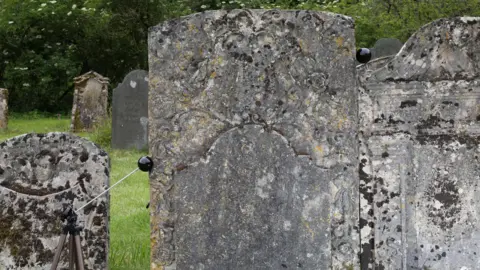
University of Leicester students have uncovered and restored the inscription on an 18th Century tombstone in Leicestershire.
The university said the group, who took part in the archaeological field school in Loddington, used digital imaging technology to identify the wording on the heavily eroded gravestone.
It said the team revealed the gravestone belonged to Henry Reeve, a 22-year-old man, who died in 1772.
Dr Jane Masséglia, associate professor of ancient history at the University of Leicester, said the Reeves were a "well-known local family" who were living in the village from at least the early 1600s.
The university said students applied reflectance transformation imaging to study the heavily worn gravestone in the churchyard.
The imaging technique captured detailed surface information through multiple light sources.
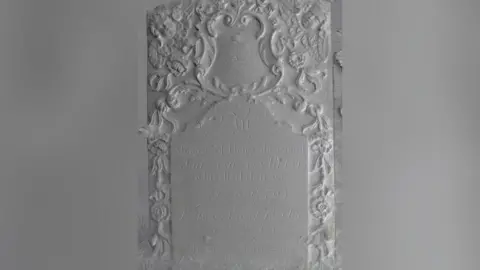
The team said by using this technique they were able to process the images and enhance the legibility of the stone, which read: "In Memory of Henry, the Son of John and Ann Reeve, Who died Jan 23, ANNO 1772, In the 22 year of his age".
 University of Leicester
The imaging also showed two faint lines of text at the base of the stone, which read "Affliction sore with patience bore, Physicians w{h}ere in vain."
The university said this was a variant of a popular 18th Century verse often found on the tombstones of those who had died after long illness.
It added that the inscription appeared to omit a "he" in the first line and included a stray "h" in "were," which it said reflected challenges faced by craftsmen before modern text-editing tools.
The team, the university said, also identified a third, partially visible inscription on a shield above the main text, which is currently under further analysis.
Masséglia said: "Spending your day in a graveyard might sound a bit morbid, but really it's about putting the people back into the landscape that we're excavating.
"The Reeves were a well-known local family who, we can see from the parish records, were living in Loddington from at least the early 1600s.
"Last year, we deciphered the neighbouring stone to Henry's, and now we realise that it was his mother's.
"She died 20 years after her son and was buried right next to him, their headstones so close that they are touching.
"We wouldn't have understood what we were looking at without RTI. We're combining traditional fieldwork with digital techniques so we can recover voices that would otherwise remain lost."
Listen to BBC Radio Leicester on Sounds and follow BBC Leicester on Facebook, on X, or on Instagram. Send your story ideas to eastmidsnews@bbc.co.uk or via WhatsApp on 0808 100 2210.
