Residents 'anxious' after Drumcree parade ruling - O'Neill

 BBC
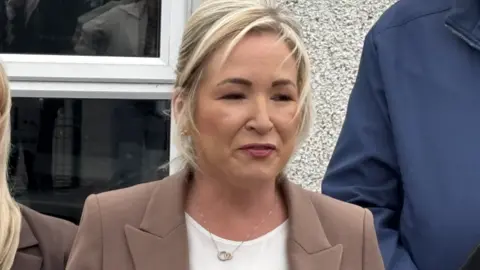
BBCFirst Minister Michelle O'Neill has said residents from the mainly-nationalist Garvaghy Road in Portadown are "anxious" at what she called "triumphalism" by unionist leaders following a court ruling over one of Northern Ireland's most contentious parades.
The High Court quashed a decision to impose restrictions on the annual parade at Drumcree outside Portadown on Tuesday.
The Parades Commission had banned this year's paradefrom the Garvaghy Road - a move which reflected every decision it has made since 1998.
The Orange Order has since confirmed it intends applying for another Drumcree parade in the coming days.
Nigel Dawson, Portadown District Master, said a "significant date" in the calendar may be chosen for the parade.
Asked if this could be 28 September, known as Ulster Day by unionists, he said no final decision had been taken.

Dawson said the order would be consulting with its legal team before submitting an application to the Parades Commission.
He said the Orange Order was agreeable to mediation with Garvaghy Road residents but questioned whether they wanted to engage in discussions.
Earlier a representative of a residents' group said there would be no point in discussions if the Orange Order had a "pre-determined outcome".

Earlier, Democratic Unionist Party (DUP) MP Carla Lockhart said she was "dumbfounded" that commission members had not "already voluntarily resigned" following the court ruling.
Lockhart said there would be a fresh application to parade.
O'Neill attended the Drumcree Community Centre on Wednesday and met residents who, she said, had shared their experience of the "darkest days that this community have witnessed over the last 30 years".
O'Neill said it was a "confident community, a community that is very much looking forward towards the future and do not want the days of the past visited upon them once again".
"This is a community that is also anxious by what they saw yesterday, a triumphalism that was expressed by the leaders of unionism standing shoulder to shoulder claiming a victory over this community," she said.
"Does anybody really want to see those days? This community doesn't, I certainly do not want to see those days visited upon us."
O'Neill said the "days of pushing any parades or any sort of negative experience again on any community here will not be acceptable or tolerated by anybody".
Lockhart, the Upper Bann MP, earlier told BBC Radio Ulster's Good Morning Ulster: "The current commissioners must go and for me that is the starting point."
She added: "I am actually dumbfounded that they haven't already voluntarily resigned, but we are now calling on the secretary of state to exercise his rights to ensure that they are removed."
Lockhart said that collectively with fellow unionists "we have asked for the immediate removal of the commissioners, given all that has gone before, all that has been revealed in this ruling, we have asked for an independent review into the very structures, the governance, the accountability of the Parades Commission."
The legal challenge was brought by a member of the Orange Order.
The Parades Commission has said the High Court's decision "does not affect any future considerations and decisions by the commission of future parades or protests".
The Northern Ireland Secretary of State met the Parades Commission chair on Wednesday.
A Northern Ireland Office (NIO) spokesperson said Sir Chris Bryant expressed "serious concern over the issues highlighted" in the judgement during the meeting.
The NIO added that Sir Chris told the chair that "public confidence in the Commission has been damaged and needs to be restored".
He's asked for written assurances that the commission's decision-making processes are "fair and robust", that they act "independently and impartially" and that they have a plan to "enhance public confidence".
He has asked for a response "by close of play on Friday".
 Pacemaker
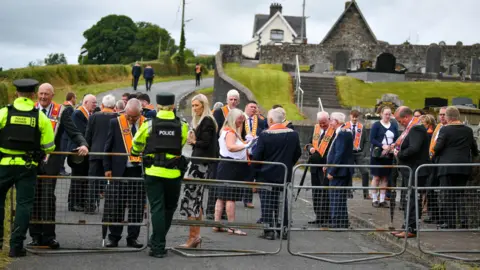
John O'Dowd, a Sinn Féin assembly member for Upper Bann, said on Wednesday that any resignations by Parades Commission members were a matter for the commissioners and for the secretary of state.
He said it was "completely beyond me" as to why the DUP and Orange Order and others were "refighting this battle".
 Pacemaker
When did the Drumcree dispute begin?
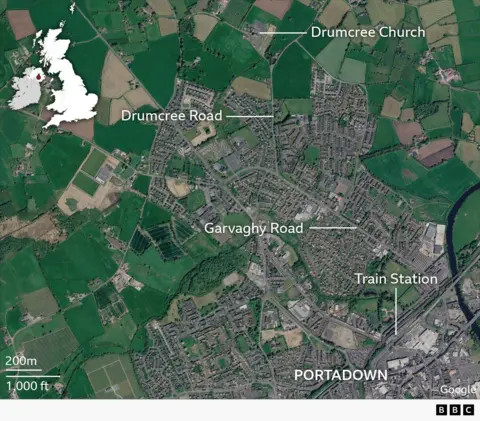
In 1998, the Parades Commission ruled that the Orange Order should not march down Portadown's Garvaghy Road on the end leg of its annual march from Drumcree Church.
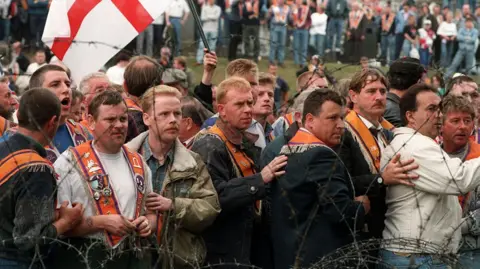
It was a move that ultimately led to a decades-long parading dispute, sparking some of the most serious public disorder in Northern Ireland's history.
Stand-offs continued in subsequent years as members of the Order walked to police barricades in protest at the restrictions. Protests were also held by residents living along the Garvaghy Road.
 Pacemaker
The High Court was told on Tuesday that the commission conceded the case last week and requested the court quash its determination before a full hearing.
The commission conceded a procedural error in how it dealt with the annual application for permission to walk along the Garvaghy Road.
Not all six members of the public authority had signed off on the final determination before it was issued last month.
Lawyers representing the local Orangeman claimed the commission's latest decision unlawfully breached his rights to freedom of belief, expression and peaceful assembly under the European Convention on Human Rights.
Lawyers for the applicant also argued that Garvaghy Road residents had refused talks with the Orange Order and the commission breached legislation by making it "a pre-requisite to a parade".
The Parades Commission said it "welcomes scrutiny and accountability".
What has been the reaction?
The Northern Ireland secretary said on Tuesday that it was "really important that the Parade's Commission carries the respect of all communities in Northern Ireland, otherwise it simply can't function".
Sir Chris said he had not read the "precise terms" of what has been said, but added that he was "concerned that it looks as if the Parades Commission have not got things right here".
The Grand Orange Lodge of Ireland said the ruling made "the position of the current commissioners untenable".
Breandan Mac Cionnaith of the Garvaghy Road Residents' Coalition said people "had pointed out their concerns, their worries" at the meeting with O'Neill on Wednesday.
"I think people also have to be realistic, it is 28 years since the last Orange march ever came down Garvaghy Road and it has already been said who wants to open that can of worms again?"
He said the Orange Order parade "finished" in 1998 and it "will not be repeated".
"No more marches," he added.
Loyalist activist Jamie Bryson, who was involved in bringing the case, said on Wednesday that the parade in Portadown was "always unfinished business for the loyal orders, it was always an injustice".
"Before we even get to a new application, certainly a number of these commissioner positions are unsustainable," he said.
Bryson said it was a "very important parade", but that no-one is "asking for a parade which resembles 1995, 1996, 1997, they simply want to complete their traditional parade to get their bannerette home".
Former SDLP assembly member for Upper Bann, Dolores Kelly, said she believed "the commission on this case has dropped the ball".
However, she said the Parades Commission "decision over the last number of years has been the right decision".
"But let's not overplay the outcome, the outcome is simply that the commission was found to not have followed procedure guidelines.
"It's nothing new for unionism to call for the parades commission to resign."
