Trackers locate 'island's first' Asian hornet nest

 Isle of Wight Asian Hornet Team
Specialist electronic tracking equipment has helped locate what is believed to be the first yellow-legged Asian hornet nest found on the Isle of Wight.
The nest was located by the National Bee Unit (NBU) last week after an initial picture of a hornet was submitted on the Asian Hornet Watch app by a member of the public.
Asian hornets feed on insects and are a threat to native bees, because they like to feed bee grubs and dismembered adult bee thoraxes to their young, beekeepers say.
Miniature trackers were fitted to hornets in an attempt to trace their nest. The Isle of Wight Asian Hornet Team, which assisted the tracking operation, said islanders should "remain vigilant" for signs of the insects and their nests.
 PA Media
The group said the photograph taken in Cowes at the end of August had provided "vital evidence" that had allowed the nest site to be investigated.
Bait stations were set up to attract foraging hornets.
Once regular activity had been confirmed, radio trackers were attached to individual hornets, allowing their movements to be followed as they returned to their nest.
It was eventually located high in an oak tree on 7 September.
The nest is being studied to find out the extent of the colony's development, before being destroyed.
 Isle of Wight Asian Hornet Team
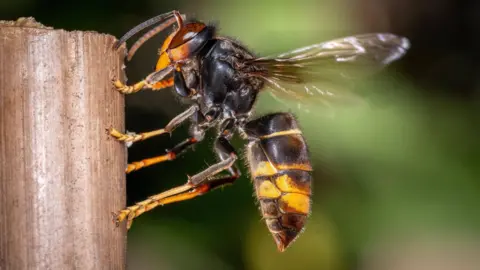
Asian hornets, which are smaller than native species to the UK, have yellow legs and an orange face, and prey on insects including honey bees.
The Isle of Wight Asian Hornet Team is a charity set up by island beekeepers to help combat the threat of Asian hornets and the risk they pose to honey bees and pollinating insects.
It said early detection of nests was "crucial" and urged people to download the Asian Hornet Watch app to report sightings.
"The nest had gone unnoticed for much of the summer, demonstrating how easily a yellow-legged Asian hornet colony can develop without being detected," it said.
"If a nest reaches the reproductive stage, it can produce numerous new queens. Those that successfully mate and survive hibernation have the potential to establish new nests the following spring."
Earlier this month, the NBU reported there have been 53 Asian hornet nests found and 167 sightings in the country this year, compared to 93 and 389 respectively last year.
