'People are still surprised that women can lift men'

 James McConnell/BBC
It's a hot day and the circus tent is packed.
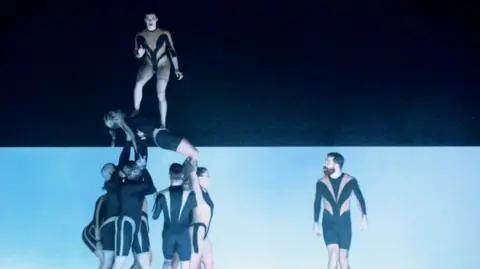
On a circular stage, through a haze of smoke and spotlights, a tower of 10 acrobats grows towards the canvas roof.
As they clamber over one another to the summit of their human pyramid, the audience applauds and then gasps as the acrobats drop backwards without looking into the waiting arms of their colleagues.
This performance of Wolf by Circa, a touring circus company from Brisbane, Queensland, is a meticulously choreographed display of trust and rigorous training, with athletes of any gender lifting and throwing other cast members.
The company has just spent two weeks performing at the Norfolk and Norwich Festival.
But its female acrobats say that everywhere they go, audiences are still surprised that they are able to lift the men.
"People come up to us and think the show's amazing and say, 'And even the women are strong,' which is so shocking," says Chelsea Hall, 25, from Australia.
 Circa tour video
"It's meant as a compliment, but it's really shocking. Most women, with the training and skill sets that we have... it's quite normal for us."
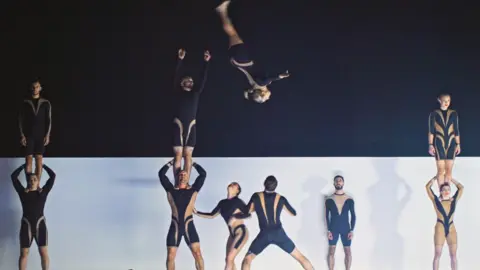
In Wolf, cast members of all genders lift and are lifted, and move between acrobatic roles as bases, aerialists and flyers.
But they say audiences still expect men to provide the bases with the women "flying".
"There is an established precedent as to what people have seen growing up, and it has to slowly shift over time," says Hall, who uses she/they pronouns.
"It's really, really nice to be part of the shifting culture."
One stunt in the show sees Chelsea in a "bridge" – bent over backwards with both hands and feet on the floor, while male colleague and acrobat Sam Letch stands on them.
"It's not something I personally particularly worry about," says Letch, 29.
Sam is 6ft 1in (1.85m) tall and weighs 14st 2lb (90kg). His usual role is as a base, but Wolf sees him up in the air several times.
 Circa tour video
On this reversal of expected roles, he says: "I think the only difference is that there's a lot more care involved and it's a lot more precise.
"When we're in the room and creating, there's never usually a conversation about, 'Oh, maybe we should get one of these guys to do it.' It's just, there's no reason why not."
Circa has been performing since 2004 to audiences in more than 45 countries.
Asked about the approach to gender in training and choreography, artistic director Yaron Lifschitz says: "I am interested in what people are capable of, rather than what they are told they can do, where they come from, what kind of things they want to do.
"It is both gratifying and confounding when this is what people take away. I'm glad they celebrate the possible but don't see that as the focus or point."
 James McConnell/BBC
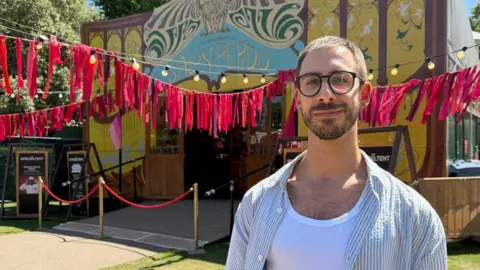
Jon Bonaventura, 32, from Australia, is an acrobat and aerialist. He says that while he has always specialised in aerial ropes, he understands it's not what audiences always expect to see.
"In very traditional circus, you would often see the very feminine, very beautiful diva in the air," he says.
"But in more contemporary aerial, that's not always the case. There's a lot of really amazing male aerialists, especially in the UK."
 James McConnell/BBC
 James McConnell/BBC
Bonaventura performs one of two aerial solos in the show. The other aerialist, and associate artistic director, is Christina Zauner, 31, from Austria.
She says prior to joining Circa, she was craving a feeling of "what it means to be strong", having started out in ballet, which has clearly defined gender roles.
"When children are there, and you can see them watch you, I think this is what makes this job incredibly special: to show such a young human, this is possible – you can do this too," she says.
"And I think it really can change what their perspective is, of what is possible for them."
Do you have a story suggestion? Contact us below.
Follow Norfolk news on BBC Sounds, Facebook, Instagram and X.
