Digital ID plan to be scrapped in Burnham's first major policy pledge

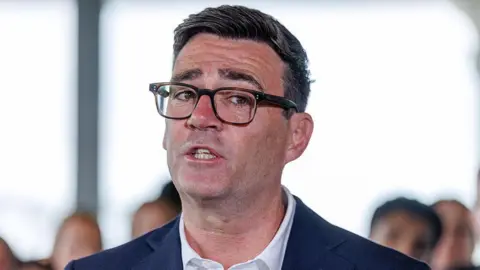 Getty Images
Andy Burnham will scrap plans for a government-issued digital ID for all British adults when he becomes prime minister on Monday.
The move, which follows plans for new oil and gas drilling in the North Sea, will shift focus to "the daily priorities facing people across the country", Burnham's office said.
Under Sir Keir Starmer, the government had already watered down proposals to introduce a mandatory digital ID for workers in the UK.
Now, by dropping the plans entirely, Burnham's spokesperson said the "time and resource that was going to be spent on a national ID scheme will go instead to where it's most needed, such as helping with the cost of living".
"This reprioritisation of public resource shows a change in direction towards improving everyday life and strengthening local economies over expensive national government schemes."
Plans for a digital ID scheme had initially been introduced by Sir Keir ahead of Labour's conference last year.
At the time, he argued that mandatory digital ID for workers would make it easier to clamp down on immigrants working illegally and modernise the state.
As well as tackling illegal immigration, Sir Keir said a digital ID system would enable citizens to prove identity to access key services quickly instead of having to hunt for utility bills.
The Office for Budget Responsibility estimated last November that the programme would cost £1.8bn over three years, but Downing Street rejected this figure.
In January, after nearly three million people signed a parliamentary petition opposing the introduction of digital IDs, the government changed its approach.
Instead, ministers ditched the compulsory part of the scheme and relaunched it as voluntary, saying digital IDs could eventually allow people to do everything from managing their childcare to filling in tax returns on a "one stop" app.
Soon after, Home Affairs Committee Chair Dame Karen Bradley said the government was right to introduce digital ID but had botched the launch.
In a report setting out the committee's investigation into the launch and subsequent changes to the policy, Dame Karen called attempts to set out the plans "nothing short of a fiasco" which "raised fears of government over-reach into people's lives".
Burnham will become prime minister after meeting with King Charles III on Monday, and his office said "one of the first things this government will do is put its focus where people need it right now".
Scrapping digital ID, the spokesperson said, will mean "redirecting the resources earmarked for the scheme towards people's everyday priorities".
Speaking to Sunday with Laura Kuenssberg, deputy Labour leader and Burnham ally Lucy Powell said the money saved by scrapping the scheme was "not an insignificant amount" and would be "reprioritised and redistributed in different ways".
"But it's not just about the money - it's actually about the attention and the focus, so that the whole of government machinery can work in service of the agenda and the vision that the Labour government is setting out under Andy Burnham," she said.
Reacting for the Conservatives, shadow technology secretary Julia Lopez accused Burnham of "trying to pretend he's riding to the rescue" after Labour "wasted millions of pounds on this project".
"After pressure from the Conservatives, mandatory ID was already apparently off the table. Andy Burnham now needs to explain whether that was untrue, or whether he is simply claiming credit for a decision that had already been taken", she said.
Liberal Democrat MP Lisa Smart said people would be "hugely relieved to know they are no longer set to be forced to hand over their data just to go about their daily lives".
"We have long said the obscene sums earmarked for digital ID would be a huge waste of taxpayers' money, and it's a relief that Burnham has woken up to that" she said in a statement.
The update on digital IDs follows news that Burnham will announce plans for new oil and gas drilling in the North Sea after he becomes prime minister.
The Labour Party's 2024 manifesto - which the new leader said he would follow - had pledged not to issue new licences but to honour existing ones.
While details of the oil and gas plans are not clear, the incoming prime minister is expected to uphold the manifesto commitment.
This means the Labour leader could pledge to speed up existing plans to drill more in the North Sea, where many oil and gas licences already approved in recent years remain largely undeveloped due to a variety of reasons.
Powell said she expected Burnham to take a "pragmatic approach" on oil and gas drilling adding: "I don't think it's a change of policy, it's more of a change of emphasis."
As Burnham prepares to take office on Monday, Conservative leader Kemi Badenoch warned his plans for government are "airy fairy" in an interview for Sunday with Laura Kuenssberg.
She accused Burnham of not being aware of "what the country's priorities are" and stressed the country needs a leader ready to "take tough decisions".

