'We make tuning forks for musicians, sound therapists and doctors'

 BBC / Jack Hadaway-Weller
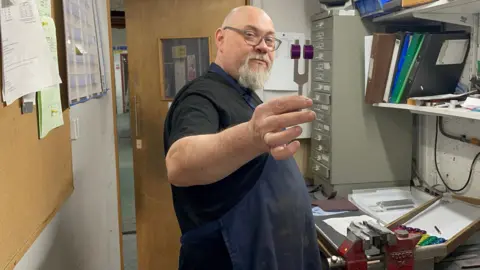
At a small factory in Sheffield city centre, hundreds of small metal tuning forks are made every day before being shipped around the world.
Their most common use is to tune musical instruments, but they are also sent to doctors, sound therapists and scientists.
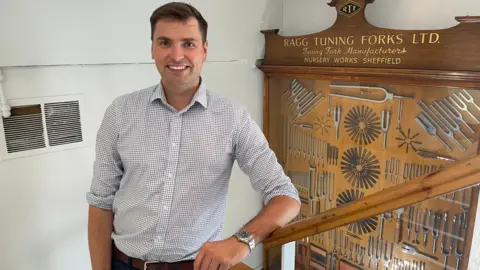
Ragg Tuning Forks is the UK's oldest manufacturer of the device, tracing its business back to 1833.
Brothers John and William Ragg originally produced razors, scissors and knives but in 1841 they started making tuning forks specifically for musicians.
"The first tuning fork was made by a man called John Shore in the 1700s, so when Ragg started making theirs it would've been for a musical application," says Daniel Garrett from the company.
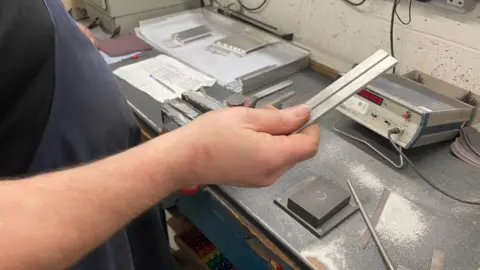
A tuning fork is a small metal device, often made from steel or aluminium, which has been shaped to create a sound at a specific pitch.
By striking the fork, the sound rings out until it stops vibrating, meaning that anyone tuning a musical instrument can match the sound of the fork with the note being played.
"Most people will know a tuning fork for musical purposes, so for instance, tuning a violin or tuning a piano," says Garrett.
Ragg continues to supply the music industry, as well as serving emerging markets.
"Now we manufacture a range of tuning forks here; musical, medical, sound therapy and also scientific tuning forks," explains Garrett.
 BBC / Jack Hadaway-Weller
Medical tuning forks can be used to conduct a number of different kinds of hearing tests including the Rinnie test or Weber test.
Commonly in a Weber test, a 512 Hz fork is struck and placed in the centre of the forehead to determine if hearing loss is worse in one ear than the other.
A lower frequency fork which vibrates less, such as a 128 Hz, can also be used by doctors as a quick sensory test to check for nerve damage or bone fractures before further examination.
 BBC / Jack Hadaway-Weller
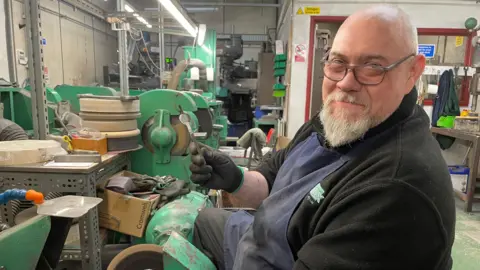
The forks are machined and filed down by hand from a single piece of metal and are then left to cool before their frequencies are checked manually.
"When it gets hot, the frequencies drop down so you've got to wait for it to cool down for the frequency to come back up," says Chris Helliwell, one of the machinists.
The frequency of the fork can either by altered by further filing or the addition of weights.
"You go closer to the end of the leg to make the frequency lower and if you want higher you go the other way," adds Helliwell.
"The only thing the weights do is slow your vibrations down, it makes it so you don't have to have a fork which is twice as long."
Some tuning forks can also be used to help calibrate machinery and equipment such as radar guns, used by police forces to calculate speed.
 BBC / Jack Hadaway-Weller
For Ragg, their fastest growing market is in sound therapy, where some users listen to a fork's long ringing sound to calm them.
"Ultimately the benefits are relaxation," says Christian Jensen, a sound therapy practitioner in Harrogate who regularly uses tuning forks.
"I have lots of different kinds of instruments including tuning forks, gongs, hand pans, native flutes, didgeridoos.
"The forks are popular in one-to-one sessions," he adds.
Garrett says despite fewer people using tuning forks in the traditional way, Ragg are finding new ways to sell the product which they have been making for 185 years in what is now the UK's oldest factory for the specialism.
"The market's actually growing for tuning forks, more and more people are using them for different applications and we're sending them all over the world."
Listen to highlights from South Yorkshire on BBC Sounds, catch up with the latest episode of Look North
