US Supreme Court has dealt heavy defeats to Trump, while expanding his power
By President Donald Trump's standards, his response to the Supreme Court ruling against him on birthright citizenship was rather tepid.
He said Tuesday's decision was "too bad for our country", before going on to endorse legislation that would reinstate his proposed limits on the longstanding legal principle that anyone born in the country is a US citizen.
The chances that Congress will act on that are slim, however. Democrats would almost certainly block any effort in the US Senate, and even if such a law were enacted it is unclear how it would pass constitutional muster.
And while this decision was a blow to Trump, it brings to an end a Supreme Court term that has mostly continued a trend of recent years.
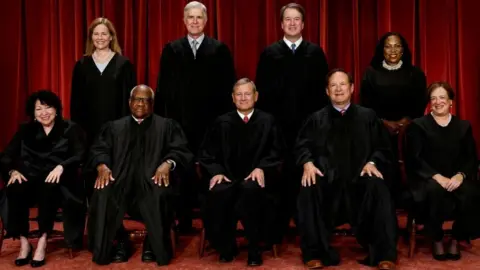
Its conservative majority, cemented during his first term, has delivered a series of major victories for the president. It has methodically expanded executive power and shielded Trump, and all future presidents, from prosecution for official actions.
A handful of conservatives, however, joined ranks with the court's three liberal justices to place clear limits on some of Trump's most ambitious immigration, trade and law enforcement polices - issues that have been central to his political identity for more than a decade.
On Tuesday, the court rejected the president's attempt to end birthright citizenship for the children of temporary visitors and undocumented migrants. It was closely decided, however, with only five of the court's nine justices finding a constitutional guarantee for such a right.
Back in February, by a slightly more solid six-to-three margin – including Trump appointees Amy Coney Barrett and Neil Gorsuch - the court also struck down the president's attempts to use existing federal law to enact sweeping new tariffs on America's trading partners.
Trump responded to that decision with far more anger than he did on Tuesday, holding a hastily arranged press conference to state that he was "absolutely ashamed" of three "lapdog" conservative justices who joined the court's liberals.
In December, a different grouping of conservatives – Chief Justice John Roberts, Brett Kavanaugh (another Trump appointee) and Barrett – again sided with the liberals to block the president from deploying National Guard soldiers to Chicago to enforce immigration law and control crime.
In each of these cases, Trump and his team had pushed the boundaries of presidential authority, often incorporating novel or seldom-used legal theories to back up their actions.
Trump's birthright citizenship revocation cut against more than 125 years of Supreme Court precedent interpreting what most legal scholars thought was clear language in the US constitution.
His tariffs, which were imposed and retracted by presidential decree, collided with recent Supreme Court rulings that major new policies had to be explicitly approved by Congress.
Trump's attempts to deploy the National Guard were a rare instance of a president trying to do so over the objections of local and state officials. It was nipped in the bud by the court, which weighed in to uphold a lower court's ruling.
Beneath these landmark cases, however, were a long list of decisions that provided Trump with more incremental – but substantive – expansion of his power and advantaged his fellow conservatives.
"There will be occasional deviations, but I think this is a very strong, very conservative court with the broadest conception of presidential power that we have ever seen," said Kate Shaw, a professor of law at the University of Pennsylvania.
On Monday, the court's six conservatives ruled that Trump could dismiss members of regulatory federal agencies Congress had established to be "independent", based only on policy disagreements.
Although in a separate opinion, the court carved out an exception for members of the powerful Federal Reserve, which sets US monetary policy, the decision will give Trump – and future presidents – increased sway over vast swathes of the federal bureaucracy. They will be able to handpick those who determine labour, election, communications, environmental and financial regulations.

 Reuters
Although Trump didn't win his big-ticket birthright case, the court's conservative majority has repeatedly handed the president more power over immigration enforcement.
Last week, it upheld the his revocation of temporary protected status for Haitian and Syrian immigrants – many of whom have been in the US for more than a decade. The court also made it more difficult for refugees to claim political asylum, requiring that they be physically present on US soil to do so.
The court also gave Trump groundbreaking victories when it came to federal elections.
Although the court on Monday declined to block the counting of mail-in ballots postmarked by election day but received later – a ruling Trump condemned - it issued other decisions that will greatly advantage his fellow Republicans.
In a ruling that was overshadowed by birthright citizenship on Tuesday, the court loosened campaign finance restrictions and limits on how much political parties can spend on candidates.
Given that the national Republican Party currently has more than $125m in its coffers, while its Democratic counterpart is in debt, the decision will give Trump's side a decided advantage in this year's midterm congressional elections.
In April, the court's six conservative justices ruled that congressional districts drawn to give racial minorities more voting power were inherently unconstitutional, striking down a key provision of the 1965 Voting Rights Act. That decision has allowed Republican-controlled southern states to redraw multiple House of Representatives districts to favour their party's candidates.
Trump may, at times, have been frustrated by this Supreme Court – and by the three jurists he named to their lifetime seats during his first term.
But the court has given him authority that none before him in the White House have been able to wield.
With rumours swirling about the possibility that one of the court's senior conservative justices may soon retire, Trump may not yet be done leaving his mark on America's judiciary.
