Roman coins among finds along East West Rail route

 East West Rail
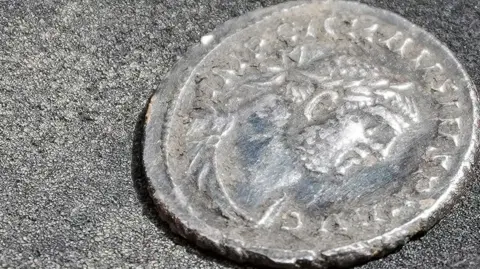
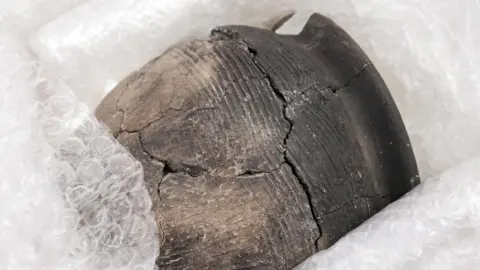
Roman coins, a Late Iron Age vase and pottery are among the finds uncovered along the proposed route of East West Rail (EWR).
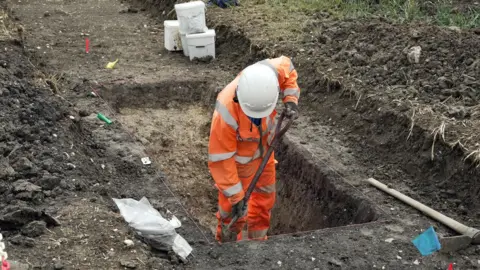
Work on 1,000 archaeological trial trenches has now been completed in Bedfordshire and Cambridgeshire - which sit along the route planned to connect Cambridge and Oxford.
One of the Roman coins discovered bears the name of the Roman Emperor Carausius (c. AD 250-293), who commanded a Roman fleet based in the English Channel.
Mike Court, historic environment lead at EWR Co, said the work was "essential to helping us design and deliver the railway in a way that respects the environment and our shared heritage".
 East West Rail
The trenches form an essential part of the environmental assessment work required to inform the Development Consent Order (DCO) process.
EWR Co says it plans to submit its DCO application in 2027 to secure permission for the railway.
The company will complete approximately 6,000 archaeological trial trenches over a period of around two years along the entire route.
Each trench is typically around 50m (164 ft) long, two metres (6.5 ft) wide and excavated to a depth of approximately half a metre (1.6 ft).
Before excavation begins, geophysical surveys are undertaken to identify areas of interest.
Archaeologists then excavate targeted sample sections, known as slots within the trenches, to better understand their age, condition and significance.
Jorn Pace, programme manager at EWR Co, said they "were working closely with landowners and local communities throughout the process to minimise disruption".
 East West Rail
Joss Piper-Jarrett, archaeology survey Manager at EWR Co, said: "Every discovery helps build a richer picture of the people who once lived here.
"When you're excavating these features, you're often the first person to see them in 2,000 years, sometimes even longer, which is a really special feeling - it's pretty amazing."
Once the finds are excavated they are carefully cleaned, analysed, recorded and added to the archaeological archive, he adds.
Do you have a story suggestion for Beds, Herts or Bucks? Contact us below.
Follow Beds, Herts and Bucks news on BBC Sounds, Facebook, Instagram and X.
