The strange history behind Scotland's 'Odyssey forest'

 Universal
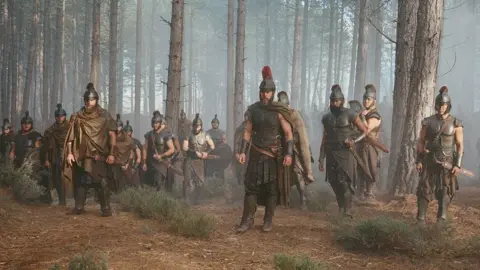
One of Scotland's most unusual forests is set to appear on cinema screens later this month as a location in The Odyssey.
Starring Matt Damon, Anne Hathaway, Tom Holland and Zendaya, the film is based on a poem written almost 3,000 years ago about Greek hero Odysseus and his journey home after years away at war.
Culbin Forest on the Moray Firth coast was among Scottish sites where filming of a battle between warriors and giants took place last year.
The forest's long history includes tales of a witch and a violent sand storm, a "great fire" - and being shelled by the Royal Navy.
"Culbin is a unique place," said Ruaridh Maxwell, environment forester at Forestry and Land Scotland (FLS), which manages the forest.
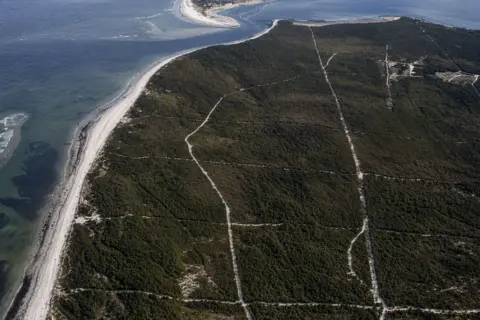
It is a place popular with hundreds of walkers and cyclists who are drawn to the long tracks that criss-cross its landscape.
Culbin also has protected status due to its habitats that support birds, dragonflies and more than 500 species of flowering plants, including rare single-flowered wintergreen.
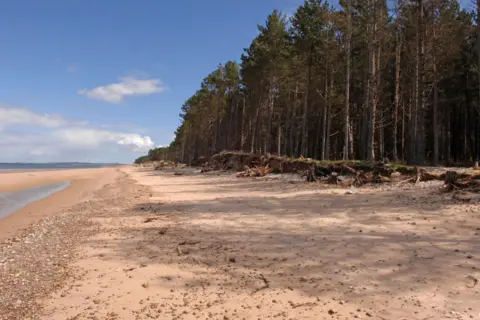
But more than 300 years ago, Culbin was a "virtual desert".
 FLS
FLSUntil the late 1690s, Culbin was a thriving agricultural community.
But over hundreds of years sand had been blowing in from an extensive area of dunes along the nearby coast, slowly encroaching on flat, fertile fields.
In 1694, the Great Sand Drift is said to have engulfed 16 farms and the local laird's home in wind-blown sand in a single night.
Superstitious residents who had fled the storm believed the land had been cursed by a witch.
Thirty-two years earlier, Isobel Gowdie, a woman living in nearby Auldearn, had been suspected of witchcraft.
During her trial she foretold that a farm at Culbin would be smothered by sand.
 FLS
FLS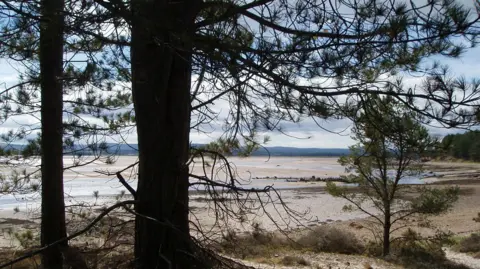 FLS
FLSThe Forestry Commission, now known as FLS in Scotland, bought Culbin in the 1920s in part to stabilise the sand-dune system.
A History of Culbin Forest 1921-1951, which is held in FLS's archives, tells of marram grass and Corsican pines being planted to keep sand in place.
In June 1939, a wildfire swept through the area and damaged 382 acres.
The history book describes a rare "crown fire" breaking out 60ft (18m) up in the tops of trees.
During World War Two, Culbin Forest came under fire again.
The forest and part of the surrounding area were used as a mock battleground, with some of the training there used in preparations for 1944's D-Day Landings.
Royal Navy ships shelled Culbin from the Moray Firth, leaving scars that were visible for years. Tank crews also trained with live rounds.
 Universal
Today, the forest is largely managed under what is called a continuous cover system.
"This involves selectively felling trees and retaining a cover of mature trees," Ruaridh said.
"This method has benefits for biodiversity whilst producing quality timber."
He added: "Much of the restocking is done through natural regeneration of trees.
"This produces trees which are ideally suited to the conditions at Culbin."
The quiet of the forest is now only broken by the sound of visitors, the occasional forestry operation - and battling Greek heroes.
