The questions Andy Burnham answered in Yorkshire

 PA Media
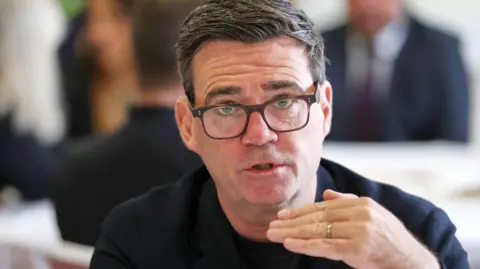
Prime Minister Andy Burnham has set out a number of priorities during his visit to West Yorkshire on Thursday.
Speaking at a waste dump in Bradford, he said he would crack down on fly-tipping and look into equipping fire and rescue services with more resources to tackle wildfires and flooding.
He also spoke about plans to boost infrastructure and support British farming.
Below are the four questions he answered from BBC Yorkshire.
How will you tackle fly-tipping?
During his visit to Bradford, he said West Yorkshire and Greater Manchester would be the first areas with new region-led approaches to waste crime.
This would include giving mayors and council leaders the lead in co-ordinating councils, police, regulators, and other enforcement agencies.
"It's a new approach, it's needed because this issue has grown and grown but we're confident now that we've got the right resources in place," he said.
"If you look at the clean-up costs of the huge (illegal) sites, well, they are double-figure millions and you can't leave a situation growing and then the costs over there are huge when actually you should be spending the money upfront, and that's the change that we're making."
He said fines for fly-tipping would increase from £300 to £5,000 and offenders could be given up to nine points on their driving licence.
"What we're doing here is making sure that those who do this, and blight communities, all of a sudden will be in a position where it's no longer easy to do," he said.
Do you support West Yorkshire's tram plans?
"I supported her [Tracy Brabin] in my former role, I won't be changing my tune now," he said.
"West Yorkshire needs a mass transit system like Greater Manchester, like the West Midlands and and that is what it will get."
He said the proposed scheme would involve extending the tram south of Leeds, connecting areas where a lot of new housing is planned, particularly around South Bank, and potentially continuing towards a redeveloped Elland Road.
"When you've got those big regeneration schemes around the infrastructure you can capture some of the value that is created to pay for the infrastructure in the first place, so we'll look at all of that to make this stack up," he said.
Is there a north-south divide in how wildfires are treated?
Burnham was asked the question following an article about Alison Hume, the MP for Scarborough and Whitby, who claimed a devastating wildfire in the North York Moors last year was "overlooked" by the government and national media because it was in the north of England.
Burnham said he understood her point but said from his own experience wildfires always received a national response.
He accepted wildfires were a growing problem and pledged to look into the resources available to fire and rescue services in autumn, which he believes are currently insufficient.
"We don't have that aerial support that other countries have that can make dealing with those fires much quicker.
"We're looking towards the end of the year now and yes a bit of rain and we think there may be a wetter end of year coming and that's when the fire service has to turn to flooding.
"Flooding still isn't a statutory responsibility of the fire and rescue service, so I'm going to hold a summit to say it's a changing world out there, our fire and rescue services are on the front line of that changing world, sometimes I think they feel they're out there without the resources but I'm going to make sure that we change that and adequately equip them to face all of this."
Will wildfires and hot summer impact cost of food?
Burnham did not directly answer the question but acknowledged farmers have had a difficult summer.
He said during a visit to a farm in Cornwall last week, he was shown potatoes much smaller than usual, with some not good enough to sell.
"It's been a really, really tough time. I'm here today in Bradford with the Environment Secretary Angela Eagle and I was very pleased that Defra moved quickly to provide extra flexibility to farmers in this difficult time so more ability to graze cattle in areas that have been set aside for environmental improvement, more funding to build reservoirs on the farm so in years to come we can manage these issues better.
"No one's going to say that this is a whole solution but at least I can say in my first month and a difficult summer I have had it brought over to me the challenges that British farming is facing."
He hopes in the futures changes can also be brought to government food procurement policies when it comes to food in schools, hospitals and prisons.
He said: "I think British farming should work with the government to make sure we change procurement to secure British farming through that going forward."
Listen to highlights from West Yorkshire on BBC Sounds, catch up with the latest episode of Look North.
