Prisoner guilty of planning Talbot Green murder from his cell

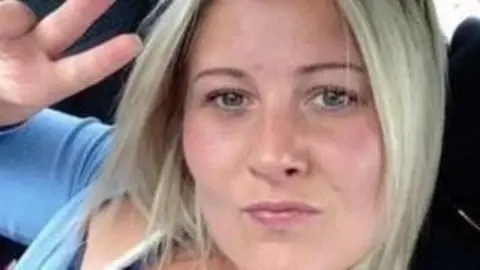 Family photo
A convicted murderer has been found guilty of orchestrating the shooting of a woman in south Wales from his prison cell.
Renaldo Baptiste used a hidden "prison phone" to supply the gun that killed Joanne Penney in Talbot Green in March 2025.
Baptiste is one of four more people convicted for their part in the murder of Joanne Penney, who was caught up in a turf war between two drug gangs operating in south Wales.
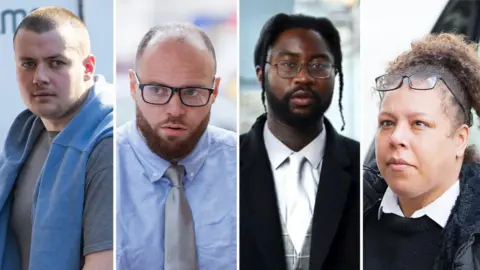
At the end of a second trial following the shooting in Talbot Green, Rhondda Cynon Taf, in March 2025, a jury also found Cardiff women Donna James and Laura John guilty of assisting an offender.
Molly Cooper, from Leicester, was convicted of acquiring ammunition for a firearm.
Five others were convicted of Penney's murder as part of a drugs turf war, at a previous trial earlier this year.
A total of 11 members of the organised crime gang, who have been convicted during the two trials, in connection with Penney's murder will be sentenced at a later date.
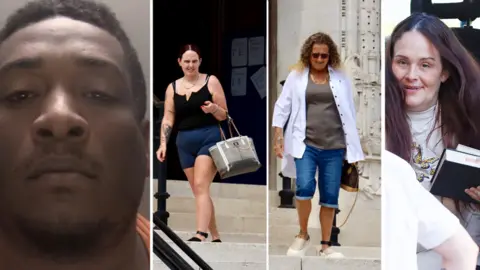 Leicestershire Police/BBC/Athena Picture Agency
Penney died after being shot through her heart by Cardiff drug dealer Marcus Huntley, who had travelled to Talbot Green with his friend Jordan Mills-Smith, along with Melissa Quailey-Dashper, to carry out a revenge attack.
Quailey-Dashper, from Leicester, was paid in crack cocaine to knock on the door, which was opened by Penney.
Joshua Gordon, a Leicester drug dealer, was in a nearby car. Huntley admitted his guilt; Mills-Smith, Quailey-Dashper and Gordon were found guilty by the first trial's jury.
Baptiste was jailed in 2022 for a minimum of 25 years for murdering a man who used to work for his drugs supply business.
He told the second Talbot Green trial that he became involved with Gordon to make money by acting as "a middleman [by] stockbroking" for him if Gordon ran out of drugs.
He told jurors that he sourced drugs from prison using his "prison phone".
He admitted being part of an Organised Crime Gang (OCG) known as Rico, and sourcing drugs for Huntley and Mills-Smith, who sold crack and cocaine in south Wales.
The pair branched out and targeted Talbot Green, but another OCG was already selling drugs in the area. When the Cardiff pair placed a dealer at 10 Llys Illtyd in Talbot Green to sell drugs, the rival dealers took offence.
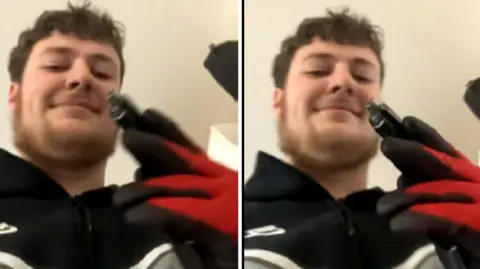 South Wales Police/CPS
They "confronted and humiliated" members of the Cardiff gang, prompting Huntley's group to discuss obtaining a gun and ammunition to "send a message".
Huntley contacted Baptiste to discuss the sale of a .38 Smith & Wesson pistol and "10 sweets", slang for bullets.
In other messages between them, Huntley told Baptiste: "Leg shots only."
Baptiste replied with a laughing emoji.
Baptiste claimed that "leg shot" meant a half-gram quantity of cocaine and had nothing to do with guns.
He denied knowing that Huntley had obtained a handgun, a converted starter pistol and said he had nothing to do with arranging it.
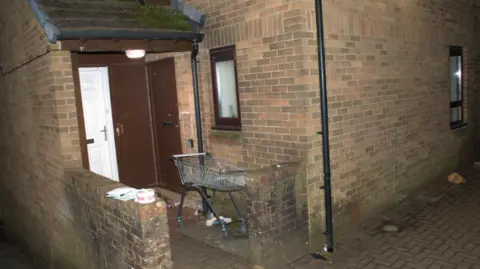 South Wales Police / CPS
The trial heard that, after the shooting, two cars drove back to Leicester, and panic set in with a series of frantic WhatsApp group calls on the evening of 9 March 2025.
In his evidence, Baptiste told the court that Mills-Smith had phoned him.
"He didn't say who had done the shooting or who had been shot," he said.
"I didn't know someone had died until I read it online."
The jury heard that the first group call began at 22:05, with the last of five calls ending at 02:54 the following morning.
In that period, the group spent a total of four hours and four minutes on group calls.
The next day, Huntley tried to cover his tracks, burying the starter pistol and ammunition in a park near his home in Cardiff, and travelled to Leicester.
He was arrested on a National Express coach a few days later by armed police.
Mills-Smith fled Wales to his father's home in Suffolk, but he needed the help of his mother and girlfriend to pay for a coach ticket to London.
When arrested, his mother, Donna James, who denied assisting an offender, told the police that she "found out afterwards" and that she had "nothing to do with this".
James, who played for Arsenal Women until the age of 17, said she did not have a good relationship with her son, who was raised by her mother.
She admitted becoming addicted to crack cocaine and having a number of health conditions, including fibromyalgia and Ménière's disease.
When asked why Mills-Smith wanted his grandmother's bank card, she said he wanted to visit his father, who was unwell.
The court was shown telephone banking and email records confirming the purchase of a coach ticket from Cardiff's Sophia Gardens to London Victoria.
Records also showed a train ticket was bought from London Liverpool Street to Stowmarket, in Suffolk, where Mills-Smith was arrested.
Phone data showed conversations between James and John discussing the tickets, including screenshots and confirmation emails.
Records also showed a taxi was booked to take Mills-Smith from John's house to the coach stop.
James sent a message saying: "Taxi is outside."
John replied: "He in it."
Later that evening, James received a message from Orville Taylor, Mills-Smith's father, saying: "Our son is one hour away. I'm going to meet him."
Jonathan Rees KC, prosecuting, said "high levels of DNA" matching Cooper, 33, were recovered from the ammunition used in the shooting, and were found in the parcel buried by Huntley.
He said it suggested she had "handled the ammunition at some point".
She admitted being part of the Rico OCG but denied possessing, purchasing or acquiring ammunition without a firearm certificate.
Police found 16 live 8mm blank cartridges that had been modified into improvised projectiles, wrapped in a latex glove, buried in Heritage Park in St Mellons.
They matched the pistol and the cartridge that killed Penney, which was found under a shopping trolley outside 10 Llys Illtyd in Talbot Green.
They also matched two spent cartridges found in another latex glove at Bryn Celyn, Pentwyn, the home of Mills-Smith's grandmother and the location where the revenge attack was planned.
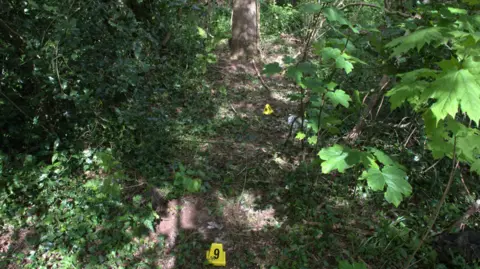 South Wales Police/ CPS
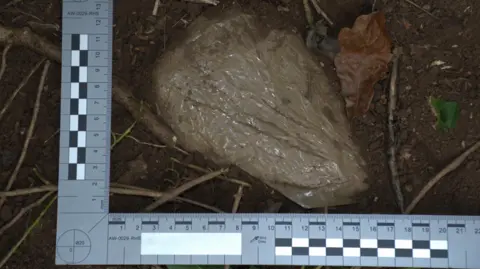 South Wales Police/ CPS
Cooper said she did not know how her DNA came to be on the cartridges.
"I've never seen or touched those bullets before and that's the truth," she said.
A forensic expert told the court that DNA analysis confirmed a match to Cooper.
No DNA from any other individual was found.
The court heard it was at least a billion times more likely than not to be Cooper's DNA.
Three other people - Tony Porter, Callum Kelleher and Sai Manne - had already pleaded guilty to participating in the activities of an organised crime group.
Porter, found not guilty of murder at the end of the first trial, has already been sentenced for his membership of an OCG.
A total of 11 people, Kelleher and Manne - along with Huntley, 21, Mills-Smith, 33, Quailey-Dashper, 40, Ginova, 23 and 27-year-old Gordon, and the four convicted at the second trial at Cardiff Crown Court, are due to be sentenced next month.
Additional reporting by Stephen Fairclough
