How do you tell your children you have cancer?

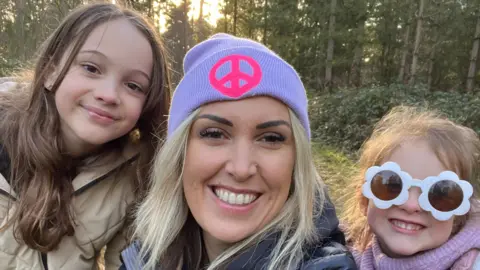 Keri Bird
When Keri Bird was diagnosed with breast cancer, her first thought was, 'How do I tell my children?'. The mum-of-two immediately sought support, but found there were limited resources to help parents or young people. So how do families navigate a cancer diagnosis? And what is the effect on children?
Keri was 37 when she found out she had the disease, in February 2025.
She says: "My first thought as a mum was, 'How am I going to tell two small children that mummy's got cancer?'.
"What are they going to think? Are they going to be scared? What sort of language do I use? Do I be honest?"
She says the diagnosis was a lot to process, but her priority was her daughters and she feared they could be traumatised by the experience.
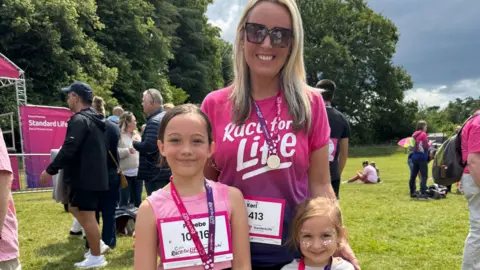 Keri Bird
Keri, who lives in Bury St Edmunds in Suffolk, searched for advice at a local hospital but was shocked by how little she could access.
"I was terrified of getting it wrong, but also couldn't bear the thought of carrying this in secret from them," she says.
"I knew that how I handled that conversation could shape how they experienced everything that followed.
"I was very surprised that actually there is very little structured support for children and young people who are navigating a cancer diagnosis [of a loved one].
"The effect of that ripples through the family and the close community.
"We are left to kind of navigate that ourselves and look for the support."
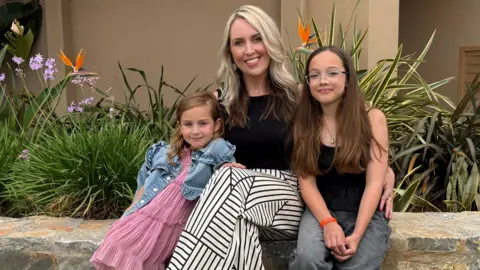 Keri Bird
Going forward, Keri says she wants to see the effect on children considered within the NHS cancer pathway and signposted guidance, including more online resources that are easy to access.
She says her eldest daughter struggled to use the word 'cancer', asking her teacher instead if she "knew about Mummy's thing".
"I reassured her, and it was really important that it wasn't a taboo word in our house or at school."
If you, or someone you know, has been affected by cancer, the organisations listed at BBC Action Line may be able to help.
Keri, who is now receiving hormone therapy, says the effects go on beyond the initial diagnosis.
"It affects daily life in ways people don't always see which is mainly fatigue, joint and muscle pain, which means I can't always be as active with my children as I'd like. We're finding our new normal, and that's still ongoing.
"That's the reality for a lot of families."
Earlier this year, researchers discovered cancers in young people were rising.
A fact Keri says will mean more young families and their children needing help and support.
Following her diagnosis and treatment, Keri is in the process of launching her own charity, Little Ripples.
She hopes it will offer immediate help through digital resources to parents and children in an age-appropriate way.
The NHS has been contacted for comment.
'My child was scared to go to school'
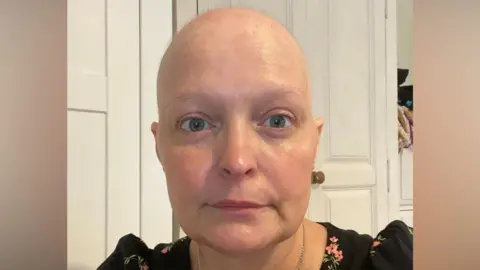 Louise Palmer
Louise Palmer, 52, was diagnosed with stage three triple negative breast cancer three years ago.
Upon hearing the words 'you have cancer', she immediately thought of her five kids, then aged 11 through to 26, wondering: "How the hell am I going to tell my children?"
Even after years of treatments, she says the hardest part of her cancer journey was giving them the news.
"It sticks with me to this day. This was one thing I couldn't protect them from," she says.
Louise, from Rougham in Suffolk, says it was "nearly impossible" to find resources or advice on how to tell or support her children, finding that most were focused on grief.
Instead, she attempted to remove fear from the equation wherever possible and give her children some control.
Her son Sam, then 11, helped to shave her head.
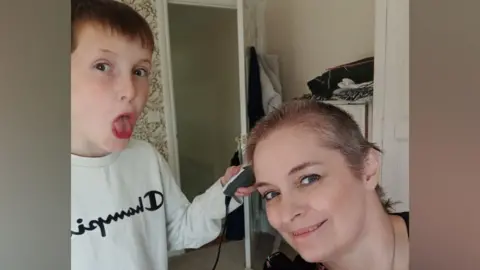 Louise Palmer
However, Louise says all of her children have had long-lasting effects from watching her go through treatment.
She says her eldest daughter, Katie, has increased health anxiety. One of her sons has struggled with his mental health, and her youngest feared going to school in case Louise died.
"That was like a sword in my heart. Not leaving was his attempt at control," she says.
"The biggest feeling was guilt. That I'd affected all their lives and I couldn't do anything about it."
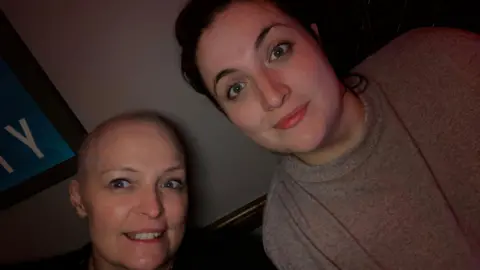 Louise Palmer
Katie admits she "shattered" when her mum told her the news, and doesn't know if she will "ever be fully fixed".
"The trauma and pain from seeing your mother go from a strong lady to someone who was broken by something out of their control is the hardest thing I've ever witnessed," she says.
Louise, who has to have yearly mammograms for the next three years, says she feels her family were "left in limbo" through a lack of support, and she often wondered, "How do I get them through this?".
'I got health anxiety from my own mum's treatments'
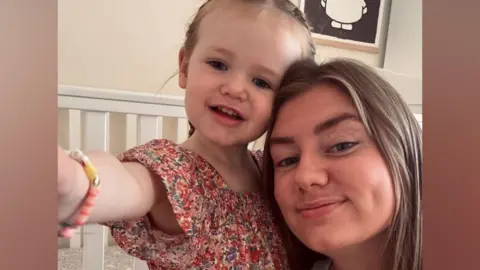 Hefina Everard
Twenty years ago, when Hefina Everard was aged just eight, her mum Helen was diagnosed with breast cancer.
She says it's something that has had a huge impact throughout her life.
Recently, the disease has returned, and she is now navigating how to explain it all to her own three-year-old daughter, Margot.
She says the years of treatment and operations her mum endured left her terrified of hospitals and doctors.
"I remember going to school and crying - scared mum wouldn't be there when I got home," she says.
"It's left me with a lot of health anxiety."
Living with a poorly parent also left her "with a lot of anger", and she has only just started to understand the pressures her mum must have felt now she is a mother herself.
"I look back and think, 'How on earth did she have two young kids? How did you manage?'.
"She blames herself and she has a lot of guilt about it, because I have heard her say she's worried she ruined our childhoods."
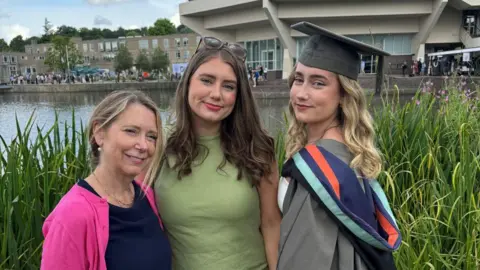 Hefina Everard
Hefina's mum Helen says her own mother died of cancer when she was 10 years old and was convinced she would die when she got her diagnosis, aged 40.
"I felt very guilty for inflicting pain and worry for all those around me. I almost withdrew a bit from the children, in my head thinking it would be less harmful for them when 'the time came'," she says.
"I knew the pain of losing a parent from my own experience and it's something you carry with you all through life."
The family are now struggling to find age-appropriate material to help explain the situation to Margot, who has started noticing some changes.
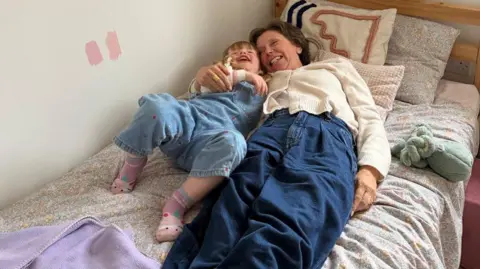 Hefina Everard
Helen says: "I would say the only thing she has commented on is why does Gangu [her version of Mamgu - Welsh for grandmother] take so many tablets, which I tell her is to keep me well.
"She also found my wig hilarious, as I would slip it off in front of her, so suddenly I would be Gangu without hair!"
Hefina says she has been surprised to find out that many people are still not asked by clinicians if they have any children in their life, or offered advice on telling them at the point of diagnosis.
She would like to see more resources available for families in a similar position.
'Important to talk'
Claire Taylor, chief nursing officer at Macmillan Cancer Support, says it is important parents know there is no right or wrong way to start the conversation.
"After receiving a cancer diagnosis, parents' first thoughts are often to worry about how they are going to tell their children and the impact it will have on them," she says.
"People often feel that talking to children will make them worry, but it is important to give them the chance to talk openly about their fears and worries."
She suggests using simple language and giving them the option to ask questions and talk about how they feel.
Taylor urged parents to reassure children they can ask more questions later and reach out to their schools, where appropriate.
Do you have a story suggestion for Suffolk? Contact us below.
Follow Suffolk news on BBC Sounds, Facebook, Instagram and X.
