'Dad had a gun under his pillow': The story of how the largest collection of medieval coins was found

 British Museum
It was the stuff of movie fantasy - a digger gouging earth on a building site suddenly revealing a cascade of gold.
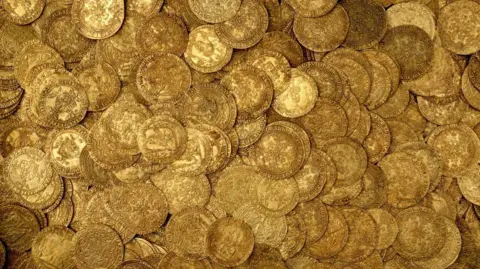
The Fishpool Hoard was discovered in what is now Ravenshead, Nottinghamshire, 60 years ago by workers on a new housing estate.
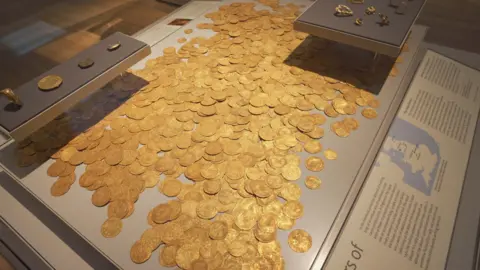
Consisting of more than 1,200 coins and nine pieces of jewellery, it proved to be the largest collection of medieval gold coins ever found in the UK.
Ahead of a plaque being installed near the site, the BBC revisits a story which also involved light-fingered locals, allegations of corrupt police and a mystery man moving through the world of London coin dealers.

It had been a routine day doing ground work for a cul-de-sac in a quiet part of central Nottinghamshire in March 1966, with builders and machine operators looking forward to going home.
A five-year-old boy David Welham - who lived nearby and enjoyed watching the machines - was preparing to say goodbye for the day.
But with a final heave of the digger bucket, a shower of gold was released from the soil.
Instead of a foundation trench, the machine had opened up not only a scramble for stolen treasure, but a legal minefield and forgotten moment of desperate rebellion from England's history.
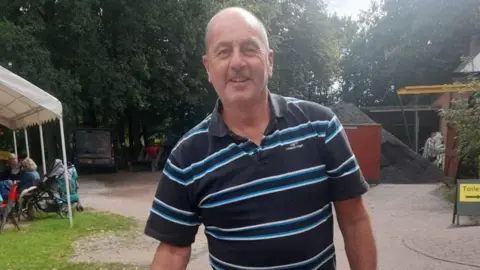
Pete Hawkins, aged 17 at the time, was working nearby with the son of foreman Jim Flint.
Hawkins said: "Someone came running down and said to him 'come on, we've found something, you've got to help us out!'
"I stayed working and soon packed up my tools and went to go home but the man who gave me a lift had gone without me - it turned out he had put some of the gold in his car and gone.
"But the next day all hell was let loose on the site - all the papers were there, the police and some big boys from London.
"We didn't know what was happening until lunch when the foreman handed some of the gold around - there was a chain and rings and a coin so heavy it weighed my hand down."
Flint was quoted in The Times newspaper as saying: "In our excitement we grabbed up handfuls of the coins and stuffed them into our pockets.
"As it was time to knock off work, we took the stuff home with us. My share was so heavy I could hardly walk."
 Pete Hawkins
After washing them in the sink, the sheer enormity of what they had - along with mounting interest from the authorities - prompted Flint and his colleagues Alfred Martin and Michael Blythe, along with digger driver John Craughwell, to go to the police.
But this tangled tale of lost medieval gold had only just begun.
Accusations soon emerged that not all of the coins had been handed in, and more, that there was a discrepancy between the numbers handed over to the local policeman and the number noted on the official record.
Local bobby PC Howard Taylor was suspended pending an investigation.
 British Museum
William Wilson, a local police detective, was appointed as coroner's officer to deal with the situation - and did so in a manner most unlike a traditional bobby.
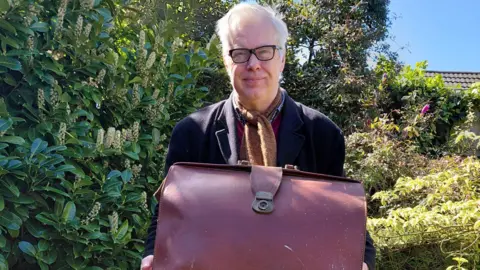
His son Mark Wilson said: "My father had taken a leather case up [to the find site] - I've still got it in the garage.
"He brought it home and it was full of gold coins and jewels.
"I was very young at the time and not knowing any better, thought these were things to play with, and he came home and was astounded to see me playing with the coins, he almost had a fit.
"While he was holding on to them, he slept with his old wartime service revolver under his pillow.
"He then took it, this case full of gold, to London to have them examined by experts."
 Mark Wilson
Wilson was whisked to the capital in an unmarked police car, which was "in wireless communication with headquarters", according to the Nottingham Post newspaper.
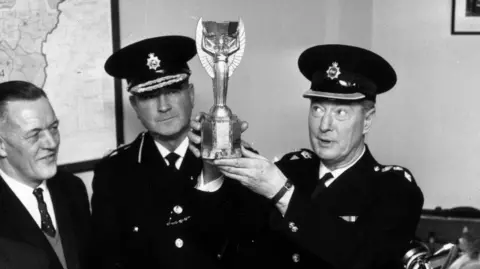
Such precautions may be explained by the fact that just two days before the hoard was found on 22 March, the Jules Rimet Trophy - the trophy awarded to the winners of the football World Cup - had been stolen in London.
The effect of this is reflected in a no-nonsense comment from a police spokesman to the Nottingham Post.
When asked about the transfer, he said: "We cannot disclose when or how because of the security risk.
"We don't want to give people ideas and bearing the mind the disappearance of the World Cup, we feel we cannot be too careful.
"The lowest estimate of its value is £30,000 and we shall be relieved to see the back of it."
Such fears appear to have been justified.
In the weeks that followed, a man calling himself Hewlitt Cosgrove Thompson paid three visits to a coin dealer in London, selling them about 50 medieval gold coins for more than £23,000.
Another dealer who bought some of these became suspicious and alerted the British Museum.
 Getty Images
Once in the hands of experts, the historical value of the hoard - as well as a possible explanation for its burial - began to emerge.
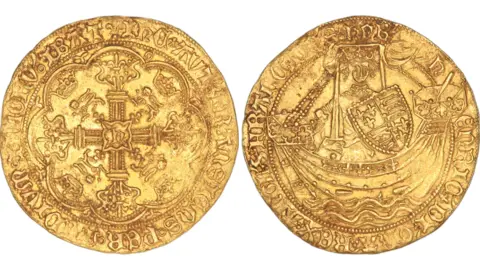
Elina Screen, a curator at the British Museum, said the coins were dated from the 1350s to 1464, and it was this latest date that was a major clue to their story.
"This was the period known as the Wars of the Roses and at this point, Yorkist King Edward IV was on the throne and his rival, Lancastrian King Henry VI, was trying to get it back," she said.
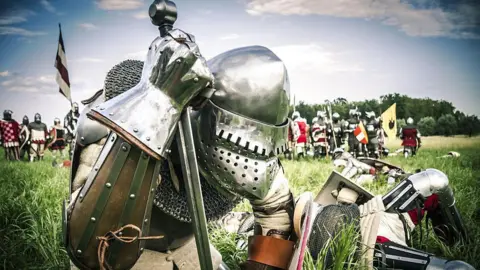
"Henry and his formidable Queen Margaret led a rebellion in the north of England, but their army was beaten at the Battle of Hexham.
"So it could be someone caught up in the Battle of Hexham - perhaps a Lancastrian fleeing or a Yorkist who had stolen it.
"Another clue is that a high proportion of the coins - 18% - aren't English, they come from France, Scotland and Burgundy - a key political player at the time."
 Getty Images
Records from the time show these were the areas where the Lancastrian court had travelled to raise money, making the hoard likely part of Henry's war chest.
But why was it hidden in Fishpool? And what was the area like at the time?
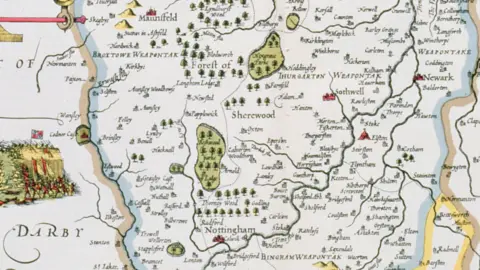
Andy Gaunt, director of community interest company Mercian Archaeology Services, explained Sherwood Forest was a royal hunting area made up of woodland and heath, with well-used routes and small settlements within it.
"The location [of the hoard] was a few miles south of Mansfield, a few miles west of Blidworth and the main road from Mansfield to Nottingham was about a mile away," he said.
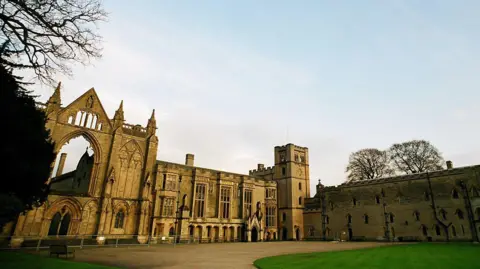
"This road went past Newstead Priory, which was the nearest habitation to where the coins were deposited.
"This would have provided a stopover for travellers and would have seen quite a bit of activity.
"So the site was a secluded location, possibly in woodland, away from a priory which might well be loyal to the opposition, and this person was presumably desperate.
"They were hoping for a time they could come back and claim the money, but that didn't work out for them."
So how much money are we talking?
Screen, from the British Museum, said the hoard was worth about £440 at the time.
"That doesn't sound that much to us, but in terms of its purchasing power, this is massive," she said.
"In terms of everyday life, this is 36 and a half years' wages for a skilled tradesman, who would earn about sixpence a day.
"You could buy a small to medium manor with it, you could equip several ships with it, it's a very big sum."
 Getty Images
Shortly after its discovery, estimates of its market worth reached £500,000 - but did any of the finders gain from their astonishing discovery?
At the inquest in December 1966 to decide on the treasure's fate, Nottinghamshire coroner Claude Mack did not spare the workmen who had filled their pockets.
According to coverage in The Times, he called Craughwell - who hid coins behind a skirting board at his house - a "self-confessed liar", and said Flint - who had buried 21 coins in his garden - had the chance to be honest but "did not take it".
He also suggested the pair, along with Blythe and Martin, had tried to frame the suspended PC Taylor, who was ultimately cleared of wrongdoing.
Mack forwarded the case to the director of public prosecutions, but the workmen faced no further action.
A jury decided only lorry driver Bernard Beeton and David Welham, then aged seven, who had handed in coins they found, should get to keep a share.
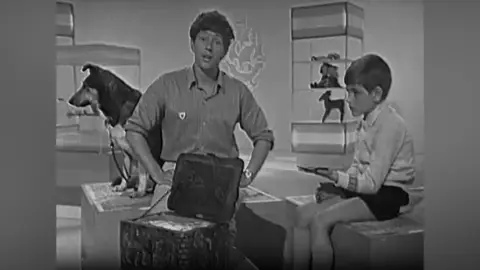
Beeton sold 85 coins for £85,000, while Welham's four not only raised £1,075 - but also secured him an appearance on children's show Blue Peter.
The Fishpool Hoard was honoured with its own cabinet in the British Museum, and in 2003 it was listed among its top 10 British treasures.
Apart from a small display in Ravenshead Library, residents of the village and Nottinghamshire as a whole would have little to tell of the extraordinary treasure found nearby.
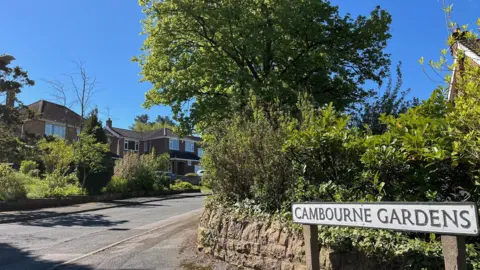
This is set to change, with Ravenshead Parish Council confirming it plans to install a plaque on a wall at the end of Cambourne Gardens.
But questions remain. To the enduring mystery of who buried the hoard can be added the true identity of Hewlitt Cosgrove Thompson, the man who sold more than 50 pieces of this unique find and vanished into history.
 Alamy
AlamyListen to BBC Radio Nottingham on Sounds and follow BBC Nottingham on Facebook, on X, or on Instagram. Send your story ideas to eastmidsnews@bbc.co.uk or via WhatsApp on 0808 100 2210.
