The WW2 child murder that devastated a family and a community

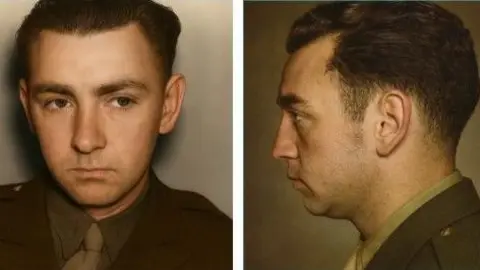 Military Archives
A woman whose aunt was murdered by an American soldier during World War Two has said the killer should never have been in the military.
Patricia 'Patsy' Wylie was just seven when she was murdered by William Harrison in September 1944.
Patricia's niece, Annie Kalotschke, says two psychiatrists who examined Harrison after the murder said he had "constitutional psychopathic personality disorder exacerbated by alcoholism".
"Basically that's the personality disorder that serial killers have," she said.
Kalotschke, who is a mental health counsellor, recently gave a lecture about her aunt's murder at the prison where Harrison was later executed.
She wants to highlight the need to be aware of the psychological make-up of those serving in uniform.
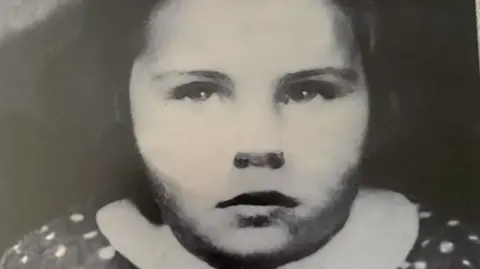 Family
Harrison, 22, was an alcoholic with a long record of disciplinary issues.
He was part of a combat crew stationed at Cluntoe Airfield in Ardboe, County Tyrone.
The Wylies lived in the nearby townland of Killycolpy.
Kalotschke said the first encounter the family had with him was in the summer of 1944, when Patricia's father Patrick was in a pub and among the American soldiers present was "this sad sack little guy at the end of the bar".
Patricia's father felt sorry for him and, on hearing Harrison felt homesick, invited him back to the family home.
"It was supposed to be just a cup of tea and he ended up staying for two days," Kalotschke said.
Harrison was court martialed for being absent without leave and sentenced to six months in the guard house.
He was released three months later and on 25 September, after drinking heavily, he returned to the Wylie home, ostensibly to return a money loan.
He persuaded Patricia's mother to let the child accompany him to the shop to buy treats for the family.
Instead, he took her to a nearby field, sexually assaulted her, then beat and strangled her.
Afterwards he returned to the pub to continue drinking.
 Annie Kalotschke
Leaving the family home with Patricia, Harrison encountered her nine-year-old sister Sadie, Kalotschke's mother.
He asked her to come with him instead, but she refused and Kalotschke believes this led to her mother's decision to later emigrate to New York as a teenager.
"I don't think my mother was ever as happy as she could have been, because this has always been holding over her head. There were behaviours I look at now and say 'this was survivor's guilt'.
"Over in the States there's no evidence of Patsy, you don't walk past the field every day."
 Dave Cable
Patricia's body was found by local people and Harrison was arrested, tried, convicted and sentenced to hang at Shepton Mallet prison in Somerset.
Kalotschke spoke to an American soldier who was present during Harrison's questioning as well as his defence attorney. Both said he showed no emotion and said he had killed the child "because she was going to tell".
Although his parents appealed to the White House for clemency, Harrison was hanged in April 1945.
 Annie Kalotschke
Despite this, Kalotschke said the family heard rumours Harrison had been seen boarding a ship in Belfast to return to America.
"I cannot imagine how you walk around thinking that might possibly be true and wondering if he's going to come back and finish the job with the rest of the family," she said.
Kalotschke said there were also those at the time who blamed Patricia's father for inviting Harrison into his home, accusing the family of being "Yankee lovers".
"That's hard for a family to live with.
"He overstayed his welcome because he was a sociopath.
"They (sociopaths) are really good at mimicking human behaviour - that's what he did."
Other locals took out their anger on American soldiers.
One told Kalotschke he used to go into the countryside to buy eggs, but after the murder people would "slam the door in their face" while on another occasion, a stone was thrown at his head.
He said he didn't blame them, because he was "a symbol of something absolutely horrible that happened to this community".
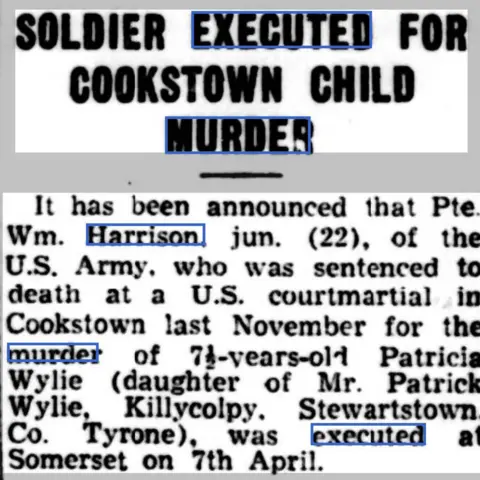 Annie Kalotschke
Harrison was hanged at Shepton Mallet by Thomas Pierrepoint, one of a famous family of executioners.
He took much longer to die than was usual, leading to speculation that Pierrepoint's deteriorating physical condition played a role.
However, Dave Cable, an historian of the prison, thinks another factor may have played a role.
"The murder of a child was, even by the grim standards of capital punishment, a uniquely shocking crime," he said.
"It is entirely plausible this weighed on Pierrepoint's mind and in my opinion, it is likely, in this instance, he cared less about efficiency and a little more about retribution."
 Dave Cable
Kalotschke says her aunt's tragic case highlights a need for discussion about military service for those living with certain psychological conditions.
She wants to deliver a lecture on the crime at US military training bases like Westpoint, The Citadel and Annapolis.
"They need to do tighter screenings and you need to know what happens when you put somebody in the army and they devastate an entire community."
