Perseid meteor shower reaches peak: When and where to catch a glimpse

 Getty Images
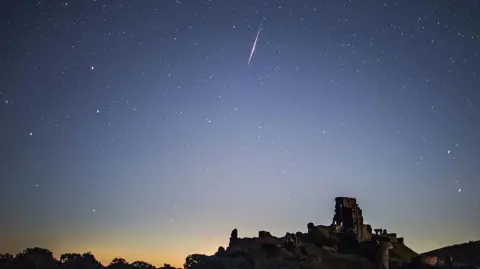
The best annual meteor shower has once again returned to our skies, and the Perseids dazzling display is set to peak on Wednesday night.
But skywatchers will be treated to not one, but two, impressive astronomical events within just a few hours of each other.
A deep partial solar eclipse will be also visible in the UK in the early evening before the Sun sets and the stars emerge. While the two events are unrelated, their timing makes for an exceptional night of stargazing.
Astronomer Dr Becky Smethurst said it was "the perfect cosmic coincidence of events".
Here is when to look up and where you will have the best views of the meteor shower.
What is the Perseid meteor shower?
Meteor showers happen when the Earth passes through trails of debris from asteroids or comets - a snowball of frozen rock and gas orbiting the Sun.
As that debris enters our planet's atmosphere, it burns up and creates spectacular streaks of light - meteors.
Royal Astronomical Society Research Fellow Dr Becky Smethurst described the Perseids as "one of the best nights for astronomy all year".
The Perseids, pronounced 'Per-see-ids', are caused by debris left behind specifically by the Swift-Tuttle comet.
This comet is considered large with its solid core measuring 16 miles (26km) across.
As it takes 133 years to complete a single orbit around the Sun - much longer than our own - some of the pieces of rock we see burning up could have been left behind more than a century ago.
"It's sort of like the Universe's own cosmic clock in a way," Smethurst said.
These meteors are visible all around the world and named because they appear to originate from the constellation Perseus.
When and where can I see it?
The Perseids is active from mid-July to 23 Aug this year, but on most nights the shower will only display a few meteors each hour.
But the best time to watch is on the peak nights, which this year is in the early morning hours between midnight and dawn on 12 and 13 August.
At this time there will be many, many more meteors. If you are really lucky, you could see more than 100 'shooting stars' per hour.
If possible, choose somewhere away from cities and artificial light. Light pollution will hide the fainter meteors, leaving only the brightest ones visible.
This year could offer especially good viewing conditions because there is a new moon, meaning there will be no bright moonlight.
Give your eyes around 20 to 30 minutes to adjust to the darkness and look towards the widest unobstructed area of sky possible.
What is the night-sky forecast for Wednesday?
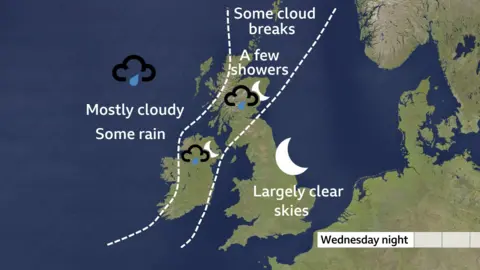
For most of England and Wales, stargazers will have largely clear skies throughout the night with just a small chance of one or two mist patches.
If you plan to stay up late in the very far north of England, Northern Ireland or much of Scotland you may need to employ a little more patience.
While some cloud breaks are expected, there will be large areas of cloud at times and even the risk of one or two showers.
For those in north-west Scotland, an early night might be a better option.
The forecast may yet change so keep checking with BBC Weather for the latest details.
Could I see a meteor during the eclipse?
During an eclipse, the sky darkens offering a short window to also see the Perseids at the same time.
But this will only be in the areas witnessing a total eclipse - like Spain - and not in the UK where only a partial eclipse will be witnessed.
But even there, the chances are extremely slim, "you would have to get very, very lucky to see a shooting star during the total eclipse," Dr Smethurst said.
Remember for a solar eclipse you must use certified solar glasses - looking directly at the sun without proper eye protection can cause permanent eye damage.


Get our flagship newsletter with all the headlines you need to start the day. Sign up here.
