'Every summer we admit hundreds of gulls for rehabilitation'

 BBC
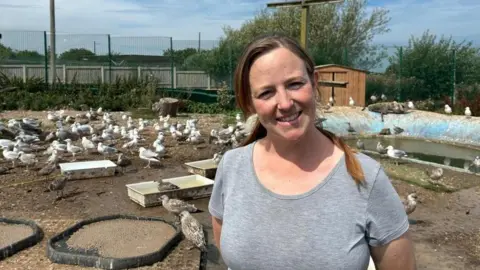
BBCAs synonymous with the seaside as battered fish, gulls are often characterised as chip-stealing scavengers, hovering by harbours for an opportunity to strike. But for one wildlife sanctuary in Whitby, the birds are poorly patients to be nursed back to health and released into the wild, like many other creatures in their care.
"Every summer between June and September, we admit hundreds of gull chicks for rehabilitation," says Alexandra Smith.
The Whitby Wildlife Sanctuary can care for up to 300 sick and injured gulls on site in the summer - resulting in quite the cacophony of noise, when they strike up a chorus.
Smith, the centre manager and founder, says this has been one of their busiest years to date.
"We've had to have several small temporary closures while we try to keep on top of the sheer volume of gulls that have needed help.
"Members of the public will call us whenever they come across a sick, injured or orphaned gull chick, which during summer season is [on] a daily basis."
Seaside residents and visitors might argue there's a gull round every corner, edging closer and eyeing up their ice cream - but some species' populations are struggling.
According to the RSPB, ten of the UK's breeding seabird species are now red listed, meaning they are classed as being of "greatest conservation concern".
Among that number is the common gull, the herring gull, kittiwakes and great black-backed gull, all of which can be spotted along Yorkshire's coastline.
One reason for this decline would be widespread avian influenza, which "badly affected" numbers in recent years, Smith says.
"This year, gulls do seem to have had a little bit of a comeback, which is great.
"We haven't come across any diseased cases which has been really hopeful for us."
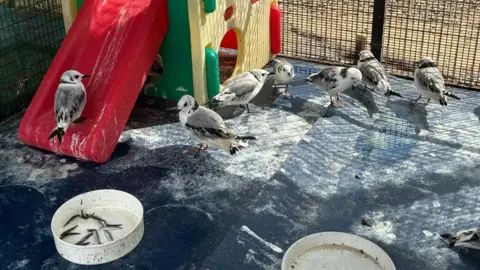
Many cases Smith and the charity's volunteers rescue are "really adorable little fluffy chicks" that tumble from the nest, often in residential areas.
They are then quarantined and hand-fed until they are older, and strong enough to join the adults in the main enclosure, waiting for their hospital stint to be over.
"Then if they're flying, they're eating independently, they want nothing to do with you. Our volunteers work very hard to gather them up again and release them," Smith says.
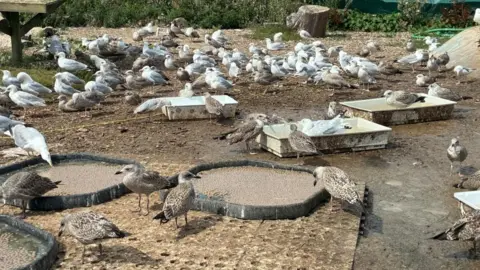
The gulls are freed between Redcar and Bridlington - after all, people might be less than thrilled if 300 gulls were let loose in the same spot, Smith notes with a smile.
This uneasy cohabitation between man and bird is well-trodden ground.
Over the years, North Yorkshire Council has introduced a variety of measures to manage gulls, which are protected under the Wildlife and Countryside Act of 1981.
In May, the authority proposed the use of "peck-proof bin bags", as part of a £119,500 "urban gull strategy" across Scarborough, Whitby and Filey.
Other tactics included educating businesses about waste control, and adding "proofing measures" on buildings where seagulls pose a public health risk.
But it's hardly surprising that the birds congregate in towns where free food and the possibility of "a pretty cosy life" is on offer, Smith points out.
"Generally, we as a species are quite wasteful. We've always got a lot of landfills, litter and waste food about and gulls know it.
"That's why they tend to choose to live side by side with us."
'Expect seagulls'
Rather than blaming the birds, adapting to peacefully co-exist will support species which have nationally been on the decline for the past three decades, she adds.
Across the region, there are schemes that support the conservation of endangered seabirds, in both natural and urban landscapes.
RSPB Bempton Cliffs in East Yorkshire is a well-known, protected habitat for large colonies of puffins, gannets, kittiwakes and guillemots.
Over in Scarborough, kittiwakes nesting in urban settings are part of a monitoring programme to safeguard the species, and help with future planning and construction in the area.
For Smith, and many others, gulls represent much more than the tourist-terrorising stereotype might suggest.
"I think actually the vast majority of people who live by the sea, who visit the sea, expect seagulls," Smith says.
"It wouldn't be the same going to a coastal town and not hearing the sound of a gull."
Listen to highlights from North Yorkshire on BBC Sounds, catch up with the latest episode of Look North.
