NHS long-term damage warning as hundreds of graduates still without jobs

 Mia Edgeworth
The NHS could face long-term damage if newly-qualified healthcare workers continue to struggle to find jobs after graduation, an expert has warned.
James Buchan, a specialist in health workforce policy, said there was a "reputational risk" to the NHS if prospective students no longer saw healthcare careers as a reliable route into employment.
One final year nursing student said the lack of jobs had made her question her decision to pursue her three-year degree while a paramedic graduate said she may move abroad.
The Welsh government said it was working with universities, health boards and graduates to get people into work.

The warning comes as hundreds of nursing, midwifery and paramedic students remain without NHS jobs in Wales.
Last month the NHS' workforce organisation, Health Education and Improvement Wales (HEIW), confirmed that almost 400 nursing and midwifery graduates remained without NHS positions after the first round of job matching concluded.
Buchan, a senior fellow at charity The Health Foundation, said new graduates expected to be able to move relatively smoothly into a career, and could potentially "begin to get discouraged" and consider alternatives.
"The NHS can only sustain service delivery through a good pipeline of newly trained health professionals coming into employment," he said.
"If that pipeline reduces or is partly blocked, that in turn creates service challenges."
He added policy had focused on dealing with the consequences after graduates struggled to find jobs, rather than addressing the causes sooner.
Mia Edgeworth, 21, is in her final year studying adult nursing at the University of South Wales in Cardiff and currently doesn't have a job lined up for when she finishes in August.
She is one of the 306 nurses who have not secured band five roles in June 2026.
"Before you even apply for nursing, when you attend the open days, they tell you that when you finish the course, you're guaranteed a job," she said.
"A few months prior to me finishing there was an email sent out saying there won't be enough jobs for everybody."
She said it was an "uncertain time" for her and she fears people will be reluctant to consider nursing as a career.
Edgeworth was the recipient of an NHS nursing bursary meaning her tuition fees were covered in exchange for a commitment to work for NHS Wales for two years post-graduation.
It is understood that those who have not been successful in finding a job during this initial process will be offered "flexibility" regarding the bursary's employment requirements.
A further allocation phase to match graduates to 131 remaining nursing roles will be completed by the end of July, which will reduce the total numbers without jobs.
 Mia Edgworth
About 70 final year paramedic students have been impacted by the recruitment freeze, including Lorna Edwards.
The 26-year-old said she was now considering leaving the UK in order to secure work.
"It wasn't my plan to move away from my family and friends, but ultimately there is no job in Wales," she said.
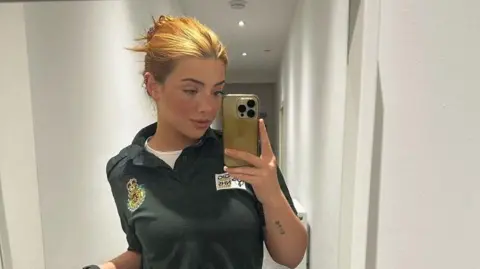 Lorna Edwards
Why are healthcare graduates struggling to find jobs?
In Wales, university places for healthcare-related courses are mapped out by HEIW, which uses data from health boards to predict the staff that the NHS will need in the future.
As it takes a number of years to train a healthcare worker, these forecasts are made several years in advance.
HEIW said forecasts underpinning the number of positions expected to be available this year were made during the Covid pandemic, where staff turnover was higher and the service was under exceptional pressure.
Since then, staff retention has improved, meaning fewer people have left the NHS and fewer vacancies have become available.
As a result, universities in Wales have paused certain courses for the 2026-2027 cohort.
Ryan Davies, 19, from Swansea, recently learned he would not be able to study a degree in paramedic science in his home city, despite having been initially offered a place after Swansea University withdrew offers for the 2026 cohort.
"It was really gutting," said Edwards, who currently works as a health care support worker.
He has since been offered a place on the adult nursing course at Swansea University and will start his degree in September.
"There's so much uncertainty - I try not to worry too much about it," he said.
 Ryan Davies
In September 2025, Audit Wales reported that NHS Wales had accumulated a three-year overspend of £481m.
Although health boards continue to report vacancies, many posts cannot currently be funded.
NHS workforce data recorded more than 5,600 full-time equivalent vacancies across Welsh health boards at the end of 2025.
How are NHS recruitment problems being addressed?
Earlier this month Wales's Health Minister Mabon ap Gwynfor held a summit with health bosses, universities and professional bodies.
A Welsh government spokesperson said it was "to find immediate solutions and prevent this from happening again and asked for actions from the summit to be rolled out nationally".
They said: "We know how disappointing it is for this year's nursing, midwifery and paramedics graduates who haven't secured the roles they worked so hard for.
"We have asked Health Education and Improvement Wales to coordinate a national support offer, including a single point of access to ensure graduates remain supported and connected to emerging employment opportunities."
The Royal College of Paramedics said it expected to see similar recruitment freezes across the UK later this year.
Earlier this year, the Royal College of Midwives said a survey of newly qualified midwives across all four nations found about a third had not secured a permanent role.
Buchan said although it was "not fair to call it a national problem at the moment", current workforce projections and data suggested it was likely to remain an issue requiring "policy responses across all four UK nations".
"Need is not being met, but the funding is not there to increase the workforce," he said.
The Department of Health and Social Care, has introduced a "Graduate Guarantee" for newly qualified nurses and midwives in England, after concerns there were 4,000 more nursing and midwifery graduates than vacancies.
The Scottish government said it was developing an NHS job guarantee to all medicine, dentistry, nursing and other NHS profession graduates in Scotland.
