Roman port dug up behind woman's home
The remains of what is believed to be a Roman port have been dug up on land behind a woman's home.
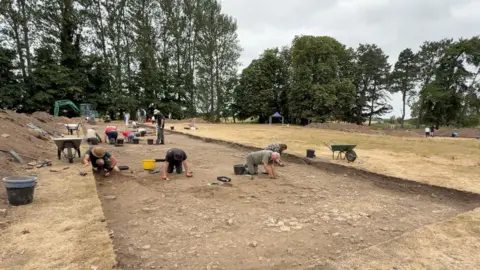
Archaeologists said they had found evidence of 12 buildings beneath a paddock close to the Humber estuary, in Brough, East Yorkshire.
Melanie Stanford, who owns the land, said it had come as a complete surprise to learn of the scale of the Roman settlement.
Dr Peter Halkon, site director, said the town was ideally located as a trading point, with access to York and the European continent.

 Josh Gorroño Chapman/BBC
Brough is thought to be on the site of Petuaria, the tribal capital of the Parisi, who lived in eastern Yorkshire during the Roman period.
Halkon, 70, is leading the community dig for the Petuaria ReVisited Project, which was set up in 2018 to shed more light on the town's Roman past.
He said the buildings would likely have been used to store goods taken off ships.
Other artefacts found there included pottery, animal bones and oyster shells.
"The Romans were incredibly fond of oysters," he said.
Roman walls in the area have been known about since the 1930s, but digs in recent years have led to new discoveries, including a Roman forum and a theatre.
 Josh Gorroño Chapman/BBC
Stanford said she was approached for permission to carry out a dig after ground-penetrating radar revealed the buildings.
"I said yes, let's see what's there.
"It's fascinating – I'm loving coming down here. I'm not doing the digging, I just enjoy watching.
"I'm learning more now and it's really exciting," she added. "With 12 buildings they might be coming back next year to do some more."
Volunteer James Newbound, who is studying archaeology at university, said the experience had been really enjoyable.
"Once you get the bug, you just have to keep going, because it's stuff that's never been seen since it was buried."
Listen to highlights fromHull and East Yorkshire on BBC Sounds, watch the latest episode of Look North.
Download the BBC News app from the App Storefor iPhone and iPad orGoogle Play for Android devices
