Indian police cracked down on 'cockroach' protesters. They went home and made memes about it

 Aleena Rehman/Manit/Vishakha
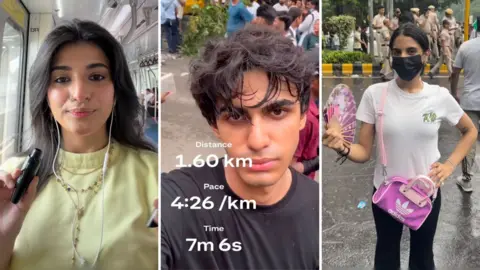
On Monday, 20-year-old Chhavi (name changed) paused outside a Delhi metro station on her way to what would become one of the largest demonstrations against Prime Minister Narendra Modi's government in the Indian capital in recent years.
She balanced her phone against a railing, stepped back and filmed a quick "fit check" - a video showing off her outfit before the protest.
"Going to get beaten by cops, guys," she smiled into the camera.
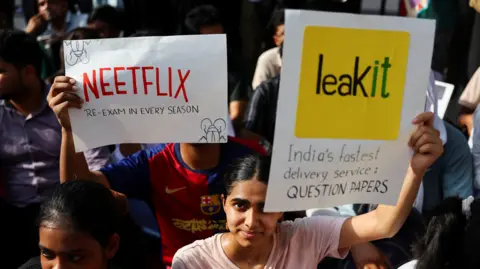
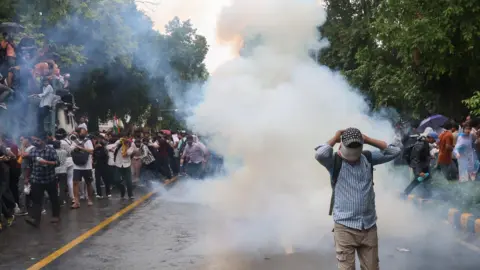
Hours later, police fired tear gas and charged demonstrators with batons as tens of thousands of supporters of the Cockroach Janta Party (CJP) – a youth-led movement that grew from protests over exam irregularities into a broader campaign for government accountability – marched towards parliament.
They demanded the resignation of Education Minister Dharmendra Pradhan over exam paper leaks and recruitment scandals. Pradhan has refused to resign, accusing the opposition of exploiting students for political gain.
Authorities suspended mobile internet around the protest site. By evening, protesters said scores had been beaten by police, while police said a number of officers had also been injured.
When Chhavi finally uploaded the videos that evening, one thing stood out. Before the march, she joked about being beaten by police. Hours later, she was still smiling - posing beside riot officers, flashing victory signs, filming through crowds and even interviewing an injured protester.
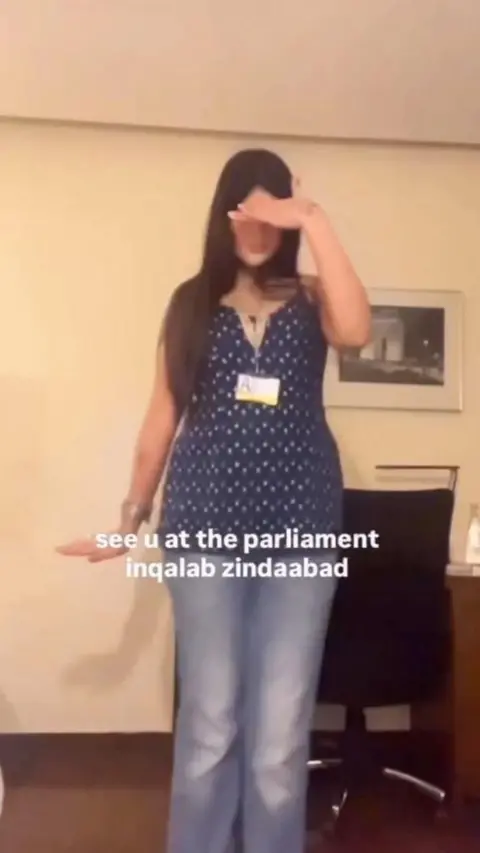
The clips were among thousands of reels, memes and first-person dispatches that flooded Instagram once protesters regained internet access. Some were raw with anger. Others were breathless, frightened or quietly defiant. Yet it was often the sardonic humour that drew the eye.
 Deeva Arora
One young woman calmly reapplied her lipstick in front of a line of riot police. Another joked she was "serving face at the protest because the government couldn't serve justice".
One reel began as a routine outfit reveal before abruptly cutting to protesters fleeing tear gas. Another gave a deadpan "review" of tear gas, rating its smell and sting like a new restaurant.
To many watching online, the humour seemed strangely at odds with the violence. For the young people making the videos, there was no contradiction.
None of the protesters interviewed for this story spoke about algorithms, engagement or going viral. They described filming as almost inseparable from protesting itself.
And when they turned to humour, it was almost always self-directed: joking about the kilometres logged fleeing baton charges or the absurdity of filming an outfit reveal moments before running into tear gas. The jokes did not erase the fear. They coexisted with it.
Experts say the trend hints at a broader shift in how a generation raised online experiences protest.
"Older generations separated political life from everyday life," said Joyojeet Pal, a professor at the University of Michigan who studies technology and society.
"Younger generations grow up with politics alongside their memes, their family pictures and their daily commutes." A protest, in other words, becomes just another moment to record.
Chhavi continued to film even after the crackdown began. Some commenters later accused her of treating the violence as content.
 Reuters
"But I was adrenaline-soaked, scared, petrified," she said. "It was either laugh in the face of fear or cry."
That instinct to keep filming, even as the situation turned violent, is one that Payal Arora, a digital anthropologist at Utrecht University, says has become increasingly common around the world. Smartphones have turned ordinary people into chroniclers of political upheaval, recording moments that might otherwise disappear.
"The act of capturing a protest is often an end in itself," she said. "Their message is more like: 'This happened. We were there. We will remember.'"
The humour, too, followed a pattern. No young protester described the day as funny. They spoke instead of tear gas, baton charges and the bewilderment of watching a peaceful march descend into chaos. The jokes came later, almost instinctively, as a way of carrying that experience.
People often mistake that humour for detachment, says Nishant Shah, director of Digital Narratives Center at School of Journalism & Communication at the Chinese University of Hong Kong. In reality, he argues, it serves almost the opposite purpose.
"Politics is everyday, emotional and experiential," he said.
Humour has long been part of protest movements. It can create solidarity, ease tension and help people endure moments of fear.
"Even when the cause is brutal and the fight fierce," Shah said, "there is joy, laughter, songs and hope. Without those things, protests don't sustain themselves."
Ishaan (name changed), 21, came to Delhi for his first protest. When tear gas shells landed nearby, he briefly considered leaving. Instead, he reached for his phone.
 EPA/Shutterstock
The reel he posted later showed white smoke drifting across the street beneath a simple caption: "Delhi Police doesn't realise I'm from Jamuna Paar."
For most Delhiites, the joke needed little explanation. Jamuna Paar - literally "across the Yamuna" - is shorthand for the city's eastern neighbourhoods and the subject of endless teasing over their neglected civic infrastructure.
"The smell there is worse than the tear gas," Ishan said, laughing.
He told the BBC the joke was never about pretending nothing had happened.
"It was about refusing to let fear dictate the memory of the day," he said.
Protests have always found ways to hold fear and hope in the same frame.
India's freedom movement had songs and speeches. Trade unions marched behind banners. Student movements embraced posters and street theatre. More recently, the anti-citizenship protests were marked by murals and public readings of the constitution, while the farmers' movement became synonymous with tractor rallies and livestreams from Delhi's borders.
Like many CJP protesters, Ishan spoke in the idiom of a generation raised online. To dismiss that language as frivolous, Shah argues, is to misunderstand what it is doing.
"We often make the mistake of trying to understand new technologies through older ways of thinking," Shah said.
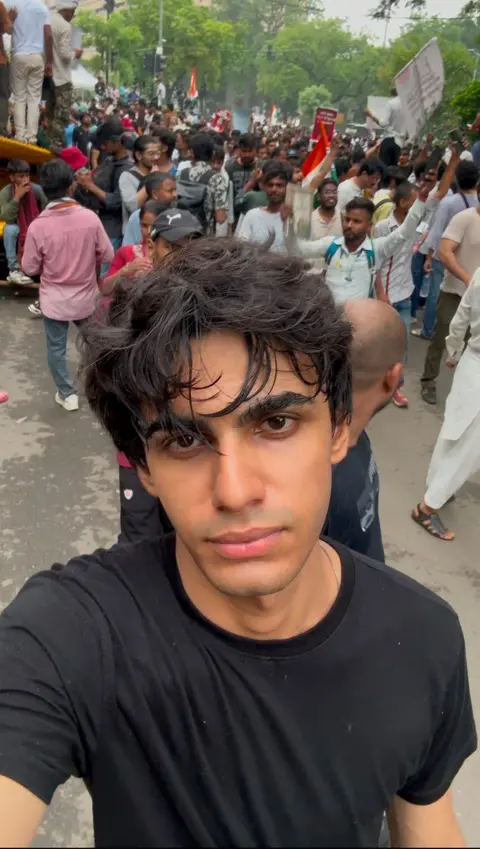 Manit
ManitBut a meme is not simply today's version of a political poster, he said. It gathers meaning as people remake it, parody it and pass it on. Sharing it becomes another way of participating in the protest.
That was true for Manit, an 18-year-old engineering student. It was his first protest, and he had almost decided not to film.
"I was scared," he said. Then he looked around. "Everyone was recording, talking to the camera, just being themselves. So I asked my friend to record me."
At first glance, the reel resembled the workout videos he usually posted. Only the final frame revealed the distance on his fitness app had been logged while fleeing police baton charges.
"I escaped the police," he laughed. "I ran and ran and ended up completing my workout too."
For Manit, that irony was precisely the point.
"Not all young people read the news," he said. "If humour can make important conversations accessible, why wouldn't we use it?"
*Some people's names have been changed to protect their identity
