'New law can help stop siblings being separated in care'

 BBC/Seb Cheer
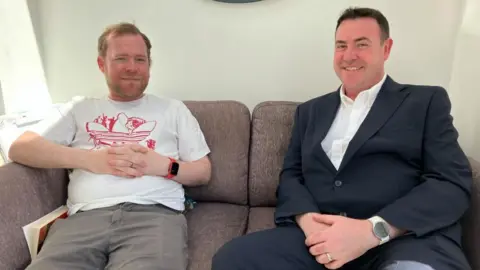
Chris Hoyle's brother Jonny is the only person who has been there for him his entire life.
But when they were taken into care as teenagers, they were separated from each other and had to fight to be reunited.
For decades, the brothers have campaigned for sibling relationships to be given a greater priority in the care system.
An amendment to the Children's Wellbeing and Schools Act, which became law on 29 April, gives sibling relationships equal priority to parental relationships for children in care.
"People take it as a given that most other brothers and sisters will grow up together," Jonny says.
"What this legislation does is puts that firmly in front of local authorities and says 'brothers and sisters are special and their relationships must be protected at all costs'."
Chris adds: "It's just nice to see good positive changes made to a system that desperately needs them."
The Hoyles' experience is not unique, according to the charity Become, which supports children in care and young care leavers.
It says 40% of children in care are separated from their siblings, rising to 80% for children in care homes.
More than a fifth of children in care live far from home, it adds, with some relocated hundreds of miles away.
 Supplied
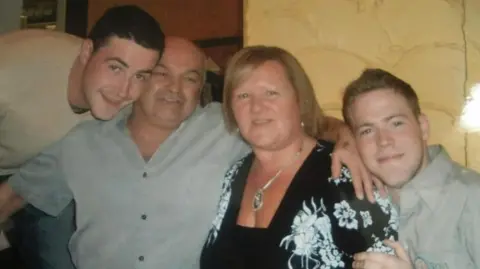
Jonny, now 41, went into care at the age of 13 and was placed with foster carers Trevor and Odette in Scarborough.
The following year, Chris, who is a year younger, also went into care.
However, a North Yorkshire County Council policy at the time meant teenagers were not allowed to share a bedroom, so Chris ended up living two miles away, with carers he says were "awful".
"Everyone [at Jonny's house] wanted me to go and live there but I couldn't because we couldn't share a bedroom, when we'd spent the majority of our lives sharing a bedroom," Chris explains.
"It just makes you angry."
Jonny spoke to a senior council officer and within days, Chris moved into his foster home.
Decades later, they are still thankful that they were reunited.
"In Chris, I have somebody that I share all of the things with," Jonny says.
"If something good happens in my life, Chris is the person I want to talk to and tell. If something difficult happens in my life, Chris is the person I have to share that with, problem-solve that with.
"Had we not been able to be together and live together, I wouldn't have that now. We have different lives, we live in two different parts of Yorkshire, but we share that connection."
 BBC/Seb Cheer
While some siblings, like Chris and Jonny, are separated after growing up together, others have little to no knowledge of their brothers or sisters.
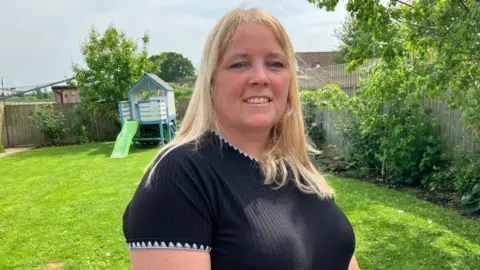
Kerry Parker was taken into care at four months old, and started living with a foster family in Wakefield who later adopted her at the age of five.
The 48-year-old, who now has three children and a grandson of her own, says her upbringing was "amazing", but she always knew she had biological siblings, and wanted to trace them.
"I wanted to know if somebody was like me, somebody looked like me, anybody had illnesses I'd had, if they were choosing the same options at school even," she says.
"I am very different to my adopted siblings."
Her family moved to North Yorkshire, where she still lives in a village near Ripon.
Aged 12 and with support from her adoptive parents, Kerry wrote a letter to social services.
Because her siblings had done the same, it was possible for addresses to be exchanged.
The first biological sibling Kerry met, aged 13, was her 16-year-old sister Dawn at Ripon bus station.
"It was just like we'd always known each other," she says.
They got lunch, drinks and "just talked".
"It was lovely, and because Dawn could get the bus and my dad could drive me to Ripon, it was easy to keep in touch then."
 Supplied
Kerry discovered similarities with all of her biological siblings, two sisters and two brothers, who all lived close to her.
"I look a lot like my biological sisters, we all absolutely love children," she says.
However, as adults with their own families and moving to different areas of the country, they have grown further apart.
"If we'd always been in touch, we'd always known each other, you've got a much more stable connection and you're much more likely to make the effort to keep in touch," she adds.
"It's an amazing thing to know where you've come from - whether it was a bad situation or not."
As adults, Chris and Jonny have both worked to support care leavers through campaigning and charity work.
Chris has supported care-experienced students through his work in higher education, and contributed to the 2022 independent review of children's social care, led by now-children's minister Josh MacAlister.
Jonny worked as a family support worker, social worker and manager at North Yorkshire Council.
 BBC/Al Candelin
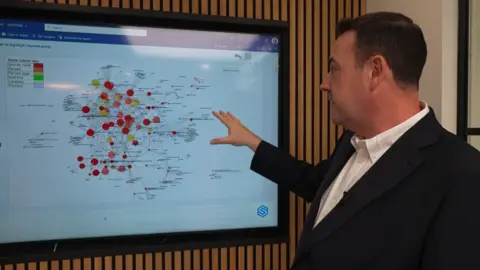
Jonny now works for a data consultancy in York, Simpson Associates, which uses artificial intelligence to create visual maps to illustrate a child's network.
"Traditionally, all of these people would be hidden," he explains.
"They'd be in a child's record somewhere but there's so much information that it would be almost impossible to identify all of these people and to recognise it."
The dots on the visual map represent people like football coaches, dance teachers, neighbours and friends, who may help to support a child who goes into care.
"At one point I was one of those dots and one of my most important lines was severed."
'More work to do'
Matt Blow, policy and public affairs manager at the charity Become, says being separated from siblings causes "huge instability" for children and negatively impacts their futures.
"Siblings may be the only person that's had the same experiences as them - growing up in the same environment - and can be a real source of love and stability and a lifelong relationship into adulthood," he says.
The change in law, he adds, will make a "real difference to young people's well-being, to their mental health, to their sense of identity and belonging, but most importantly to those lifelong relationships that are vital to help them thrive."
But despite being "delighted" at the years of campaigning paying off, Matt says there is more work to do.
"We need to ensure that children are not moved far away from the people and places that matter to them unless it's in their best interests."
Become is calling for greater investment and a national plan to assess what support is needed in different places.
Children's minister Josh MacAlister says brothers and sisters are "some of the the most important relationships that young people have and we know that care often breaks rather than builds relationships".
He says it has been "brilliant" that conversations with people who have experienced care - while writing the 2022 review and after becoming an MP and government minister - had been "translated into actual law".
"I don't want to give the impression that this is going to be a change in practitioner outlook, because I think lots of social workers are thinking about these things in the right way.
"What it does is give much greater weight to social workers and services to really think much more deeply about the importance of those relationships and it gives legal force to them."
MacAlister says the distance many children travel is a "feature of a care system that isn't sufficiently resourced to have the number of foster homes that are needed close to where children are already growing up".
The government is planning to create 10,000 extra places in foster care by the end of this parliament, alongside £2.4bn over the next three years in intensive support for families, he adds.
"I'm confident that we've got the comprehensive plan and set of measures that we need to bring this change in the law to life so that as soon as possible, if a young person enters care, they are able to stay connected with all the people in their life who love them, including their brothers and sisters."
Listen to highlights from North Yorkshire on BBC Sounds, catch up with the latest episode of Look North.
