Water company faces questions over effluent pipe

 Northumbrian Water
A water company's plan to build a partially underground pipe carrying sewage-treated water out to sea has sparked concern among councillors.
Up to £245m could be spent on the construction of Northumbrian Water's long sea outfall which would transport cleaned waste water from the Bran Sands Treatment Works in Middlesbrough and deposit it about 4.5km (2.7 miles) off the coast at Coatham, Redcar.
But Labour councillor Carl Quartermain has written to the water company to seek clarification on environmental assessments and the impact on bathing water.
Northumbrian Water said a number of environmental surveys were under way and it said it would continue to liaise with the community.
'Strict standards'
The project is still in the early preparation stages and a community drop-in event was held last month in Coatham.
The planned route of the pipeline would see the majority of it running through existing industrial land but it would also require tunnelling under South Gare Road and beneath sand dunes.
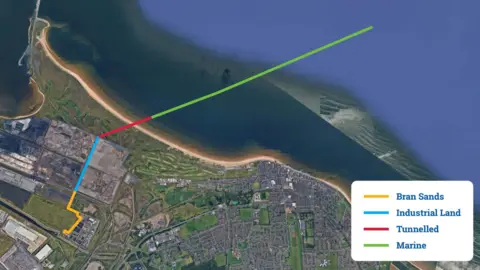 Northumbrian Water
Quartermain sought further details on projected future discharge volumes and any safeguards and monitoring from the water company.
He also said there was a concern about the extent to which residents were aware of the scheme and he feared potentially "limited" opportunities to engage and provide feedback.
Northumbrian Water said the waste was cleaned to "strict standards" allowing it to be safely returned into the environment through an existing outfall at Dabholm Gut, part of the Tees Estuary.
However, according to the Local Democracy Reporting Service, it still contains nutrients in the form of nitrogen and phosphorus which can contribute to excess algal growth on mudflats supporting a number of wildlife species.
The water company said it was following a directive from water industry regulators.
A spokesman for Northumbrian Water said the long sea outfall was the preferred option of Defra following "assessment of a range of potential solutions to support long-term environmental improvement objectives".
It would also enable water released from Bran Sands to be more widely diluted and dispersed within the open sea, protecting the estuary and its wildlife, it said.
The company said the tunnelling methods used would not have a negative impact on sensitive sand dunes.
