I wore bright colours in a sea of navy and black - Founder on 20 years of Belfast Mela

 ArtsEkta
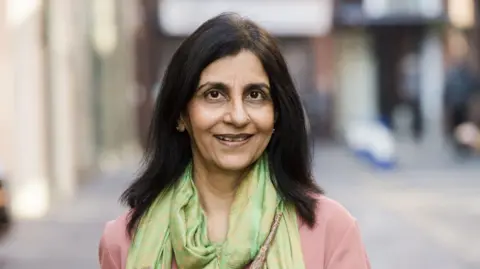
Nisha Tandon arrived in Northern Ireland nearly 50 years ago with little more than a suitcase and a college diploma in drama.
One of her earliest memories was the stark contrast in clothing between her old and new homes.
"My suitcase was like all bright colours... bright yellows and bright pinks. And here everybody was in browns and navy and black and I thought: 'oh my word'," she recalls.
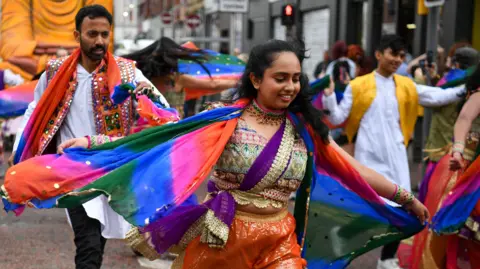
Decades later, vibrant colours remain prominent in her life as the founder of Belfast Mela - one of Northern Ireland's biggest annual celebrations of cultural diversity.
 Pacemaker
A highlight in Belfast's cultural calendar, it has become a space where diversity is proudly visible.
But Tandon's early years after her move from India were more uncertain, she told BBC Radio Ulster's Talkback programme.
She arrived, aged 20, in a "wet and horrible" place at the height of the Troubles in 1977 following an arranged marriage.
Her ambitions for life as a young woman altered dramatically.
"They were very, very instantly changed. I had to, had no other choice," she said.
"In those days, girls didn't have many choices. Yes, you were given that freedom to do your degrees and do your courses, whatever you wanted to do. But if parents say you have to get married, you have to do it and that's it.
"My ambition was always to be a theatre star. I wanted to do theatre, I wanted to travel.
"I thought that degree, which I have and the experience I have of very prominent Indian drama theatres will give me an opportunity here but it didn't.
"I was just so taken aback that those opportunities weren't there in those days and I still feel that there are not many opportunities here if you're coming from a theatre background."
Drawing a line
She said while the marriage had worked out well, she reached a point where she had to draw a line.
"Once that line was drawn, I had to move back, step back and say, no, I have to make decisions because by that time I had become very Northern Irish and a very sort of assertive person who knew what she wanted in life," she said.
"The career which I had thought of a long time ago wasn't coming in the marriage. So I just thought, right, okay, I have to step out of it just to sort of be who I want to be.
"I made the right decision because I wanted to follow my vision... I just wanted to be that community person and let my hair down and be helpful to everybody, especially the women who are coming from different backgrounds."
'A need' after the Good Friday Agreement
 PA
PAFollowing two decades in the community sector, she founded ArtsEkta in 2006 after identifying a critical gap for promoting cultural diversity. It delivers festivals, intercultural programmes, leadership initiatives and creative platforms.
Tandon said there was "a need after the Good Friday Agreement" when the ethnic population started to grow steadily.
"I just thought at that time, I think we need to have an organisation which can bring culture to the schools, to the youth groups, to the women's groups, to the community centres, and teach them about these new communities," she said.
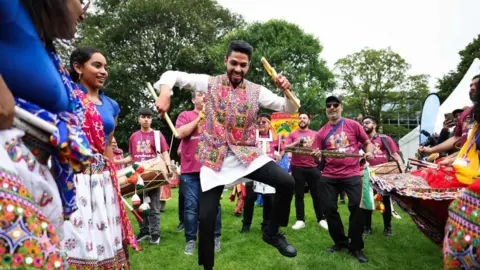
It started in one school and has grown since, also leading to the development of Belfast Mela, a "shared space" for everyone who took part in ArtsEkta's programmes.
From 500 people the first year, it has grown to a full 10-day long celebration of cultural diversity.
'Racism more prominent today'
Tandon said when she arrived in Northern Ireland, she was welcomed because racism was "never out in the open".
"People accepted you as a neighbour. I think it was a very welcoming place in the 70s," she said.
"It definitely was there, but it was not that prominent. It was not in everybody's face. And now it is in everybody's face. Worse today.
"I think people have lost that... respect. They think that we are invading their territories and we are this, we are that," she said, adding that they don't think about "the richness" of the diversity.
She said there were only 50 families in Belfast from the Indian community when she first arrived.
"But now look at it, there is your hospitality, your NHS, your technology, your whatever you want, your IT skills.
"They're running those businesses, and those industries are running because of migrants.
"I think it's good because it's good for our economy, it's good for everything."
