'Glass should be included in new recycling scheme'

 BBC
BBCGlass bottles should be included in the upcoming deposit return scheme (DRS), a watersports body has said.
From October 2027, a 20p deposit will be applied to single-use plastic bottles and metal cans, which will then be refunded when they are returned for recycling.
Paddle UK, the national governing body for paddle sports, said including glass would "keep things simple" for consumers and help reduce the amount of glass litter.
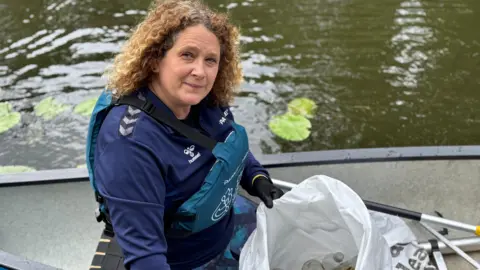
"We pull loads of glass bottles out of our waterways, we know it is having a huge impact on local wildlife," said Paddle UK's access and environment manager Chantelle Grundy.
"But there's also that sustainability issue because glass can be recycled over and over again so it will help that bigger climate agenda."
The government, however, said the inclusion of glass would add up-front costs and create challenges to the delivery of the scheme.
A spokesperson for the Department for Environment, Food & Rural Affairs (Defra) said: "Glass drinks containers will continue to be efficiently recycled under the Extended Producer Responsibility for Packaging scheme, leading to less waste in landfills while generating over £1bn annually."
Grundy added she is supportive of the DRS in general and thinks it will help reduce littering.
She was speaking at an event for the "Big Paddle Cleanup", an annual campaign to reduce water pollution during which volunteers clear rubbish from their local rivers and canals.
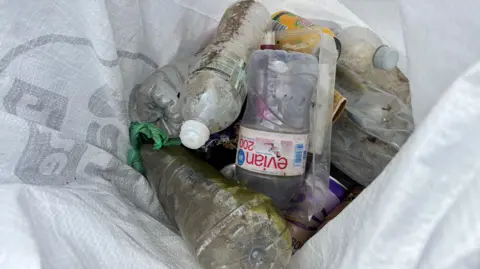
"As we look at what's in this sack, it is literally all those things that the deposit return scheme will include," she said. "The biggest contributor here this afternoon is single-use plastic bottles."
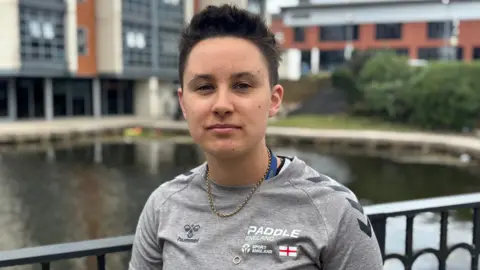
Marathon kayak athlete Freya Peters trains on waterways in Nottingham up to twice a day.
"Sometimes we see wildlife entangled in plastic waste. When I'm paddling I see plastic bottles, plastic bags, sometimes much larger items," she said.
"It can be really upsetting and often for me the first question is - why is that there?"
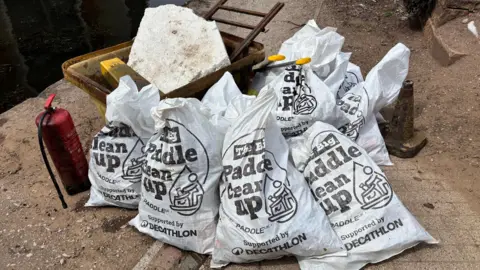
In three hours, Paddle UK staff and volunteers removed 20 sacks of rubbish from the water, along with "surprises" such as a grit bin, polystyrene slabs, a fire extinguisher and road signs.
Deposit return schemes already exist in countries such as Germany, Sweden and the Republic of Ireland.
The UK scheme was initially due to launch in 2023 but has faced repeated delays.
Glass will be included in the Welsh government's DRS, but not for the rest of the UK.
Exchange for Change, the official operator of the scheme for England, Scotland and Northern Ireland, says that every year in the UK about 6.5 billion single-use plastic drinks bottles or cans end up as waste, rather than being recycled.
Under the scheme, shops that sell drinks will have to host a return point for drinks containers, unless they qualify for an exemption.
Exemptions include retailers in urban areas with a retail selling space of less than 100 square meters.
The return point can be manual or automated using a reverse vending machine, and there will be no requirement to show a receipt or proof of purchase when reclaiming the deposit.
Other locations such as hospitality venues, schools, gyms, and community centres can apply to host a voluntary return point.
Rushcliffe MP James Naish, who took part in the Big Paddle Cleanup in Nottingham, said he was confident people would "embrace" the DRS.
"I think there's inevitably a level of scepticism about whether it will work, but we know from places like Ireland where it has been introduced that it's been extremely effective and they've seen returns far quicker than expected," he said.
He added he thinks glass should be included "at some point".
"I think the big challenge at the moment is around the cost of producing glass and actually adding anything to that could damage that industry," he said.
"We have parts of the country where glass production is a really significant part of the local economy."
Listen to BBC Radio Nottingham on Sounds and follow BBC Nottingham on Facebook, on X, or on Instagram. Send your story ideas to eastmidsnews@bbc.co.uk or via WhatsApp on 0808 100 2210.
