'Little miracle' twins after Addison's diagnosis

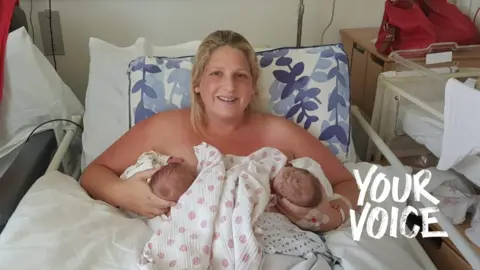 Victoria Oliver
Just four months after being told it would be almost impossible to have more children after being diagnosed with Addison's disease, Victoria Oliver was told she was expecting twins.
After the diagnosis in July 2018, she felt unwell again and sought help.
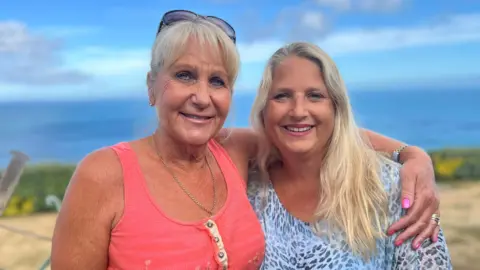
Her mother Sadie Wilkins told BBC Your Voice she got a call from Victoria: "She said, 'I've got twins', and I just said, 'Oh, Vicky. Come on, it's not a joke.'"
But she was not joking.
"Everyone told me it wasn't going to happen, and then not only did I get pregnant, I ended up with two beautiful girls," explained Victoria.
"They're my little miracles. It's a privilege - complete nightmare sometimes but a privilege."
The rare, chronic condition Addison's disease means the adrenal glands do not make enough cortisol and aldosterone. Even with treatment, it can cause severe fatigue, low blood pressure and darkening of the skin.
Victoria said she had a "shrivelled ovary" which doctors believed was linked to "septicaemia, caused my a lack of blood flow".
Combined with the Addison's disease diagnosis two years later, she said specialists warned her the chances of having more children were slim.
"I was planning for nothing," she explained.
"I got rid of prams, I got rid of cots, I got rid of everything.
"Then I had to get a double pram, two cots, two everything."
According to the National Library of Medicine, women with Addison's disease can have successful pregnancies but they may face more challenges conceiving and carrying a pregnancy.
This is because their bodies lack the hormones that normally help regulate reproduction, implantation, stress responses, blood pressure and fetal development.
Victoria had already had a miscarriage before her Addison's diagnosis.
She said: "I thought, I've got my beautiful Ruby, so I was okay with it.
"I think my husband was more upset about it because he always sort of said, 'I'd love to have two children'."
Body 'shutting down'
Victoria was diagnosed with septic arthritis in her hip in 2016 and required emergency surgery.
Sepsis, according to the NHS, "is a serious reaction to an infection that can be life-threatening".
It develops very quickly and needs urgent treatment in hospital.
"When I was awake, I just wanted to be asleep," she explained.
"I couldn't eat anything because anything I ate would just come up because the body was basically, effectively shutting down."
As the issues continued, Victoria found herself sleeping up to 20 hours a day.
She could not tolerate being outside in the sun and found her body becoming weaker and weaker.
Doctors thought she had meningitis or encephalitis and admitted her to hospital for six weeks.
During that time, she became jaundiced after antiviral medications affected her liver.
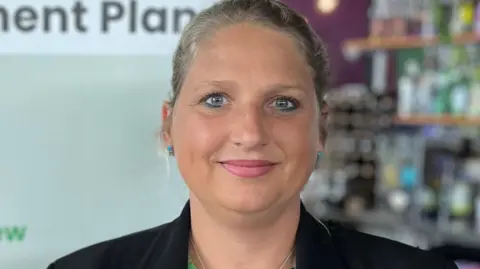
As her daughter’s condition deteriorated, one of Sadie’s friends stressed to her just how bad her daughter’s situation was.
"My friend Chris just turned around to me and said, 'My God, your daughter looks ill. She looks like she's dying'," Sadie said.
It was at that point she knew she had to take action.
She arranged an appointment with a rheumatologist in London.
To get to London from Guernsey, Victoria needed wheelchair assistance on the plane and to travel to her appointment.
While being seen by the doctor, she said she repeatedly collapsed.
The consultant was confident about what was causing her to feel so ill - Addison's disease.
Doctors later said they believed the infection in 2016 may have damaged her adrenal glands, leading to the disease.
Victoria said: "I had about three days left in me and I would have slipped into a coma, and nobody would have known what it was and I would have effectively died."
'I'm going to get my daughter back'
Victoria said the rheumatologist gave her a steroid injection and "almost immediately" the pains in her joints eased and she began to feel better.
Subsequent testing confirmed she had Addison's.
"As soon as they gave me that steroid injection, I said: 'Mum, my knees don't hurt anymore',"she said, adding: "'My wrists don't hurt.'"
Her mother also described seeing the change almost instantly.
"After 10, 15, maybe 20 minutes, after she'd had steroids in her, she started feeling better and you could see the change in her," Sadie explained.
"I thought, I'm going to get my daughter back because I really thought I was going to lose her."
Victoria said: "Addison's - no-one knew about it, no-one mentioned it; we didn't know anything about it."
Since then, mother and daughter have done their best to learn what they can about the condition.
Meanwhile, one of the twins, who are now six, said she wanted to become a doctor when she was older so she could find a cure for the condition which affects about 8,000 people in the UK.
Follow BBC Guernsey on X and Facebook and Instagram. Send your story ideas to channel.islands@bbc.co.uk.

