Too few migrants are coming to Scotland, say SNP
SNP minister Mairi McAllan says "too few" migrants are coming to Scotland, and that migration is "good and necessary" for the economy.
She was speaking on BBC Scotland's The Sunday Show as part of a Holyrood election debate on immigration with representatives from six political parties.
But Reform's Thomas Kerr said immigration had pushed the system to breaking point, with other parties were split on the issue.
Conservative Stephen Kerr said voters believed that governments did not have a grip on immigration, while the Lib Dems' Christine Jardine and Labour's Michael Marra said immigration was necessary and Patrick Harvie of the Scottish Greens said it was "valuable".
While powers over immigration are not devolved to the Scottish Parliament, it is an issue that voters say matters to them.
A national online opinion survey for BBC Scotland News earlier this year suggests that immigration was the fourth most important issue.
It followed the cost of living, health, social care and the NHS and the economy.
Pressure on housing
The SNP's Mairi McAllan said that too few, rather than too many, migrants were coming to Scotland, adding: "We are a welcoming nation".
She said migration was good for the economy - especially hospitality, health and social care, and business.
Much of The Sunday Show debate centred around how migrants should be housed.
McAllan, the SNP's housing secretary, acknowledged that there was housing pressure, but said this was separate from immigration.
She said economic conditions had "depressed construction" and caused difficulties in the cost of living which "made it harder for households to make ends meet".
McAllan said the SNP government had met its target to build 100,000 affordable homes and was now delivering plans for a further 110,000 before 2032.

 PA Media
Thomas Kerr, of Reform, said the housing system was at breaking point.
He said the SNP had removed the "local connection rule", which had allowed local authorities to refer a housing applicant to another council area on the basis of their connection to that area.
This was putting more pressure on the housing sector, Kerr claimed - especially in Glasgow - adding: "We are seeing people prioritised over others who are here locally".
But McAllan said the change in rules had nothing to do with immigration, because refugees are not deemed to have a connection to any other area - so councils have never been able to refer them elsewhere if they claim for homeless support.
She said the rule had been changed so that - for example - someone fleeing domestic abuse in Inverness could not be sent back there by another council.
Kerr went on to claim that in Glasgow, the latest figures showed 65% of homeless people were "illegal" migrants.
Between April and September 2025, 43% of applicants for homelessness support were from people with refugee status or leave to remain (excluding Ukrainian nationals).
The overall figure for Scotland is 15%.
 UK Parliament
Stephen Kerr of the Scottish Conservatives said voters were concerned that the government at Westminster did not have a grip on immigration, and he thought this was a well-founded concern.
He continued: "When people arrive here by illegal means and seek asylum, they may have a right to do that, but if you arrive in this country by illegal means, then you cannot be permitted to stay.
"We are a welcoming, warm-hearted people, but people feel that hospitality is being taken advantage of."
He said the previous Conservative government at Westminster did not do everything it could have and had paid a political price.
Kerr added: "Too often, parties on the left wish to designate the views of ordinary working people as being racist - they're not being racist, they are seeing what's happening in communities and are deeply concerned about it.

Compare policies on the key issues
We have compiled a simple summary of where the main parties stand on the issues most important to voters, based on the promises they have made during the election campaign.
Click on this link - Who should I vote for? Compare party policies - and select an issue to see their policies.
You can also use the postcode search below to find out who is standing in every seat at the election on 7 May.
Labour's Michael Marra said Reform was using very inflammatory language.
He added that people fleeing terrible situations had to be accommodated somewhere.
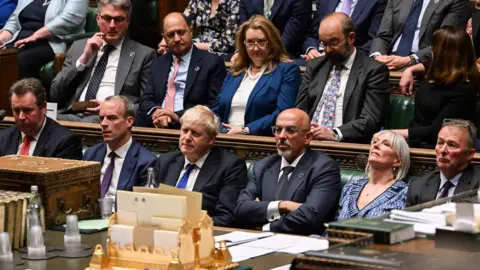
Marra added that the "Boris wave" saw a huge increase in immigration.
He said an additional two million people came to the UK while Johnson was prime minister, when his government brought in looser rules after Brexit.
Marra called for more homes to be built in Scotland.
He said housing completion rates were the lowest they had been in many decades.
Christine Jardine of the Scottish Liberal Democrats said immigration was necessary in Scotland, as "we have a massive skills gap, we have an employment gap".
She said the care sector was at threat of collapse due to staff shortages.
"The problem is that the [former] UK Conservative government lost control of immigration - we need to fix that.
"That is a different problem to people coming across the channel on small boats - Brexit caused that."
Jardine added that asylum seekers should be allowed to work so they could fill skills gaps and contribute to Scotland's economy.
If they were not granted asylum, they could still be deported.
The Scottish Greens' Patrick Harvie said seeking asylum should not be conflated with illegal immigration.
He said most people had a live and let live approach and recognised the value of immigration.
He said pressure on public services was "not the fault of immigrants or asylum seekers - they're the fault of decisions made by UK governments impacting on Scotland and pushing those cuts down the chain through the Scottish government and onto our councils as well.
He said investment was needed.
Professor John Curtice has suggested that polls indicate the SNP will remain "by far" the largest party, despite being much less popular than in the 2021 election.
He thinks Reform and Labour are in close contention for second place.
But the professor cautioned that there was still enough uncertainty in the polls to suggest the last 10 days of the campaign "could prove vital in determining the outcome".
