'This is how we're helping our Neets into jobs'

 Getty Images
Bradford is a youthful city with a high rate of social deprivation - and its young people need employment.
Across the UK, more than a million young people aged 16 to 24 (13.5%) are not in education, employment or training (Neet), according to data from the Office for National Statistics (ONS), and it's a key issue for decision makers in Bradford.
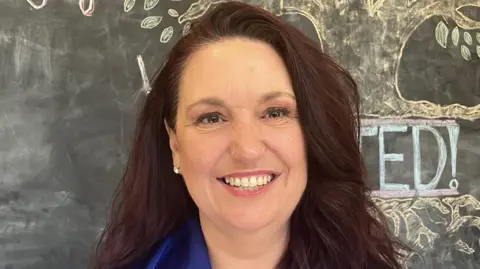
"We're looking at dealing with the problem before it happens," says Roxanne Coleman, who runs Coleman Training Development.
The company supports young adults aged 16 to 25 with educational challenges into independent, sustainable paid employment - often through supported internships.
"In Bradford, they're building up the Year 12 and 13 provision within schools. They are investing in programmes like mine and others," she says.
"Their catchphrase: what does a worthwhile life look like at 30?"
 Grace Wood/BBC
According to Department for Education statistics from 2025, in Bradford 4.4% of 16- to 18-year-olds were a Neet, or their situation was not known. The national average was 5.4%.
This figure ranges from 21.5% in Dudley in the West Midlands, to 1% in the London borough of Barnet. So why is Bradford bucking the trend?
There is "an awful lot happening", says Coleman, especially for young people with special educational needs.
"There are a heck of a lot of positives in Bradford. There is a lot of work on the PFA [Preparing for Adulthood] pathways, some substantial work."
Coleman says she suspects many people who fall into the Neet category also have educational needs and disabilities (SEND) - particularly neurodivergencies.
"If we're managing SEND from a really early age and we're really looking and understanding the young person and we're person-centered and we're supporting individual need, SEND or not, then those figures should just naturally reduce," she says.
Coleman says many of the young people she works with have education-based trauma - which could be causing people to avoid further study.
"Neets are not going to go back to school. They don't want to be at school. They can't access school. It's not right for them," she says.
She believes supported internships are the way forward, but understands why businesses are reluctant to take on younger employees.
"Businesses are being battered left, right and centre. I know myself, my costs have gone up phenomenally.
"Rent's rising, fuel's rising, national insurance is rising, minimum wage has risen. All of these things are rising," she says.
"And if other businesses are finding the same, they're not going to want to take on a young person who needs training, even if they come with a job coach."
'Increasingly recognised'
One of Bradford's biggest initiatives to encourage young people into work is the council's training and jobs service, SkillsHouse.
Councillor Andrew Judson, Bradford Council's deputy leader and portfolio holder for economy, regeneration and planning, says Bradford is "being recognised across the country".
"For the third year in a row, we've done better than the national figures, and we're seeing particularly good results for some of our most vulnerable young people," he says.
"This is down to strong partnership working, earlier support, better use of data and targeted help through SkillsHouse."
But he recognises the city still faces tough challenges around unemployment.
"Finding work can be tough both locally and nationally. We need to keep working closely with employers and partners to create more opportunities and help young people move into good jobs," he says.
 Unbranded Digital
Lee Hart runs a small digital marketing business in Bradford called Unbranded Digital, and is chair of Bradford Council's Skills House Creative Industries Board.
He started his own career after finding an apprenticeship through SkillsHouse.
"The work they do is amazing because I think in our city, things are much more joined up, where I feel like they may be more disjointed in other areas," he says.
"Schools actively have discussions with employers, councils are the kind of middleman in between those dialogues and discussions.
"So we're making sure the young people that come out of the education system are actually equipped with the right skills to follow a career pathway."
He says the organisation is "passionate" about giving people a"pathway rather than just any old job".
"That's really important. So they can actually have a career that progresses rather than feeling like they're stuck in a job which doesn't, because I think those people end up being much higher earners, they contribute much more to society."
But he also acknowledges that as a small business owner it has become more challenging to employ young people in recent years.
"We are a living wage employer as well at the agency. So for us to take on young people, it's quite expensive," he says.
"In our sector and industry, because of the stagnating wages, you could get somebody who's been in the industry for three, four, five years and paid in the low £30,000s to mid-£30,000s.
"So for us, it's quite an obvious choice to hire more seasoned people. And that's difficult because we have hired a lot of apprentices, but the incentives have been reduced."
During a recent recruitment process, Hart says he found a lot of young people lacked "persistence" and about 80% of the job applications they received had been written using ChatGPT.
"That is becoming a nightmare for employers, because the only thing you can judge them on then is by their experience.
"Everything looks the same and it's really difficult to differentiate candidates," he says.
"If you're going to use AI to write your CV, it's going to create a CV that most people have. Therefore, you don't stand out."
But those AI skills could be where the Neet generation are able to set themselves apart, he says.
"They can then create efficiencies in the business they join, they can drive more profitability. Lots of great things can come out of that.
"This generation needs to use AI, but they have to be very careful."
 Jeff Moore/PA
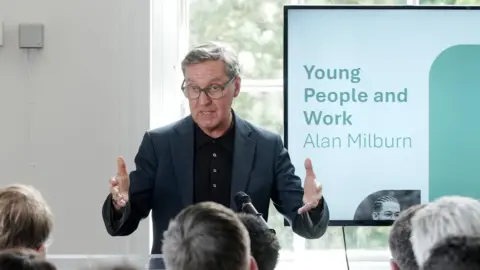
The authors of the Milburn Review - led by former health secretary Alan Milburn - travelled to Bradford as part of the study.
"In Birmingham and Bradford, more than 8% of 16- to 24-year-olds are on Universal Credit and looking for work, more than double the national average of 4.1%," the report claimed.
So while Bradford's Neet figures may be low, the problem is far from fixed.
"Still an issue in Bradford, now in particular, is parents losing benefits when their child goes into an apprenticeship versus being in full-time education," says Hart.
"It's a real issue that nobody's talking about. And I experienced that first hand in my household.
"I got an apprenticeship, I was earning £400 a month, which was the minimum back then, £2.65 an hour. But my mum lost all the benefits.
It's an "illogical" situation that traps young people, he says.
"It's something government really need to look at and encourage work," he says.
"At the minute there's a barrier and a reason not to do it when there shouldn't be any barriers. There should be encouragement in mind."
A source at the Department for Work and Pensions said: "We are determined to reverse the 40% decline in young people starting apprenticeships over the last decade.
"To give every young person the best start in their career, we are investing £2.5bn to tackle youth unemployment and creating 50,000 additional apprenticeships for young people."
Listen to highlights from West Yorkshire on BBC Sounds, catch up with the latest episode of Look North.
