Why did a Manchester woman want to be mummified?

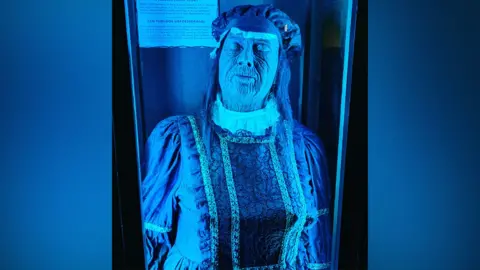 Marc Hartzman (WeirdHistorian.com)
It is one of Greater Manchester's quirkier tales.
The story of a woman from Hollinwood who was one of three mummies when Manchester's Natural History Society opened on Peter Street in 1835.
One was an ancient Egyptian mummy, one was a Peruvian mummy - but one was an old woman called Hannah Beswick who was mummified by her family doctor.
There are a lot of local myths surrounding the death of Beswick in 1758, but Dr Hannah Priest, author of Unburied, The True Story of Hannah Beswick, has separated the fact from fiction.
According to Priest there is the legend that her mummification was a resulted of Beswick's pathological fear of being buried alive, prompted when, just before the hastily arranged funeral of her brother, someone saw his eyelids flickering and realised he was not actually dead.
But Priest said there was no concrete evidence of this adding: "These stories have been told a lot and there's different versions of them and it's almost like a little bit of a pick mix.
"Sometimes the legend involves Hannah's buried fortune and of course sightings of her spirit guarding her treasure.
"Stories of headless ghosts, or actually my favourite version - a ghost that shoots blue beams of light out of her eyes."
Prior to her death, Beswick supposedly spoke to her physician, Dr Charles White (who, at the time, was founding the Manchester Royal Infirmary).
She told him about her fears and asked him to keep her above ground and check her for signs of life periodically after her death.
Research rumours
Quite what was agreed between the pair beyond that is unknown - and no instructions were written into Beswick's will - but when she died in February 1758, her body was not buried.
There were rumours White, known for his keen interest in anatomy, took the opportunity to see a grey area in her wishes and embalm her in order to add her to his personal collection, which already included the skeleton of Thomas Higgins, a notorious highwayman from Knutsford.
Beswick did leave a will however, but it was more to do with her assets than her burial plans.
As Priest explained: "She was a single woman in control of a large fortune who needed to ensure that the line of inheritance was clear.
"She left the majority of her fortune to her cousin's children.
"Hannah did not want to disinherit the female descendants hence the complex legalese to ensure that everybody got the share."
An inventory had to be drawn up of all of the items in both of the houses that she had, listing clothes, how many teacups, teaspoons and card tables she had.
One of the executors of her will was another unmarried woman who lived with her and to whom she left quite a lot of personal effects in her will.
Body bequeathed
White had kept Beswick's embalmed body, supposedly stored in a clock case at his home in Sale until his death, at which time he left the body to his friend, Dr Ollier, who decided it needed a proper place to be viewed upon his own death some years later.
Ollier's will passed the body to the Manchester Natural History Society, who displayed it in the entrance hall, alongside one Egyptian and one Peruvian mummy, at their museum on Peter Street in the city centre.
By the time the society donated their collections to Owen's College (now the University of Manchester) in 1867, interest in it was beginning to wane and it was decided that as Beswick was undoubtedly dead, that the obligation to her last request had long been filled and she should be buried.
The following year, with the permission of the Bishop of Manchester and an order from the government, Hannah Beswick finally faced her fear, being buried in Harpurhey Cemetery on Wednesday 22 July 1868.
Priest does not buy the fear of being buried alive theory as the reason for Beswick's post-death arrangements, adding "what I do know is that from the 1740s, there was a shift in funeral practise, with funerals becoming more commercialised.
"What this did was change some of the religious ideas about death and funerals too.
"For some people, the idea of being buried dead, as in as a mouldering corpse, had spiritual implications for them.
"I often wonder whether Hannah wasn't scared of being buried alive, but didn't want to be buried dead."
Listen to the best of BBC Radio Manchester on Sounds and follow BBC Manchester on Facebook, X, and Instagram. You can also send story ideas via Whatsapp to 0808 100 2230.
