Lib Dems lose overall control of Hull City Council

 Becki Bowden / BBC
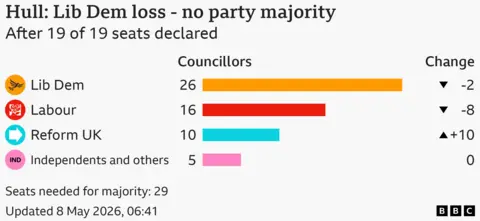
The Liberal Democrats have lost overall control of Hull City Council as Reform UK took almost half the seats being contested in the city.
The Lib Dems had controlled the authority since 2022 but lost two seats, cutting the number of their councillors to 26, and just short of a majority.
Labour lost eight of the seats they had held with group leader Daren Hale saying the vote was down to a "failure of national leadership".
Reform UK took ten seats when the results were announced on Thursday, making them the third largest party within the Guildhall.
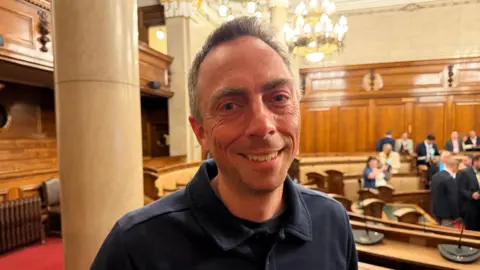
Lib Dem leader Mike Ross, who is also the leader of Hull City Council, said: "I'm incredibly pleased that we managed to win eight seats here in Hull.
"That is a tremendous result, given everything that's going on. It shows that the public of Hull have put their faith in us yet again."
He added: "I'm confident we can carry on running the council in this new political environment we face."
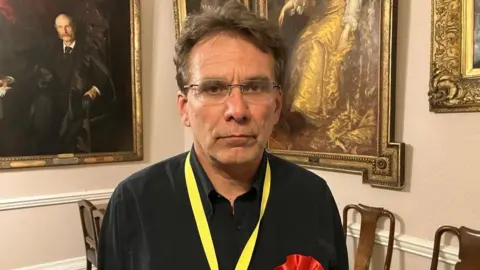
Hale described the result of the Hull vote as a "terrible night for the Labour Party" and called on Prime Minister Sir Keir Starmer to resign.
"What we were getting on every doorstep... was not about the Labour Party per se - certainly not about local councillors - it was about the leadership of the Labour Party," he said.
"I'm afraid councillors up and down the land, in Hull tonight, have paid the price for that.
"Keir Starmer needs to look at these results, reflect upon them and do the right thing and go."
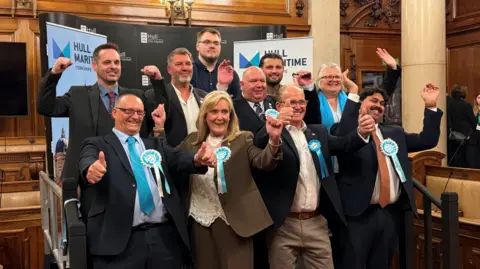
Reform UK entered the election holding no seats on Hull City Council. They ended the vote with 10 councillors to become the city's third largest party.
It followed the party winning the inaugural Hull and East Yorkshire mayoral race in May 2025.
The Green Party failed to win a single seat despite being hopeful of making progress when the polls opened.
Independents hold the remaining five seats.
The turnout figure for Hull was 30.25%, higher than the turnout in 2022, which was 23.5%.
The make-up of Hull City Council is:
- Liberal Democrats: 26 seats
- Labour: 16 seats
- Reform UK: 10 seats
- Independents: five seats
Analysis by Tim Iredale, Yorkshire and Lincolnshire political editor
In recent years, local government in Hull has been dominated by two parties – Labour and the Liberal Democrats.
Both took a hit from Reform UK.
The Lib Dems may feel a sense of déjà vu, one year after council leader Mike Ross was beaten into second place by Reform's Luke Campbell in the race to become the first elected mayor of Hull and East Yorkshire.
Labour will feel badly bruised in a city they once dominated.
Back in the 1990s, Labour held 59 of 60 seats in the Guildhall council chamber.
Some commentators will point to Hull as a place where many voters have fallen out of love with the established Westminster parties.
Nigel Farage will be hopeful that significant gains made locally could be transformed into seats at the next general election.
Reform's opponents will continue to paint them as a party of protest, not a party of power.
But after many years of a Labour-Lib Dem duopoly, three party politics has arrived in Hull and it may be that way for some time.
Listen to highlights fromHull and East Yorkshire on BBC Sounds, watch the latest episode of Look North.
Download the BBC News app from the App Storefor iPhone and iPad orGoogle Play for Android devices
