The fight to stop animals dying in fishing nets

 Cornish Seal Sanctuary
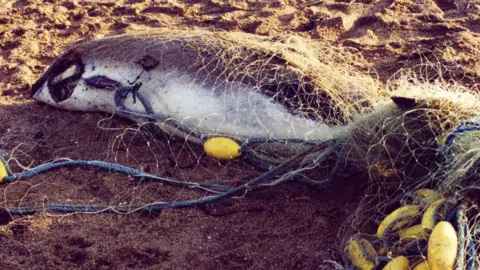
Environmental groups have renewed calls for the government to do more to prevent the deaths of thousands of dolphins, whales and seabirds accidentally caught in fishing nets in UK waters.
Known as bycatch a new report estimates that tens of thousands of protected seabirds, more than 1,000 porpoises and dolphins and dozens of whales are dying in this way each year.
A report spokesperson said the government had been slow to develop plans to reduce bycatch and rules prevent fishermen near UK shores from putting acoustic devices on their nets to deter dolphins.
A government spokesperson said it was "committed" to "restoring oceans to good health" and had been trialling deterrents since 2019.
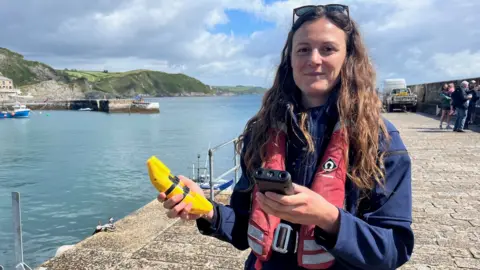
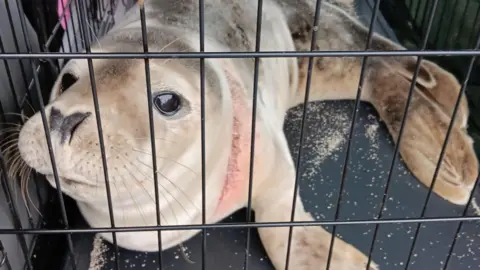
Grace Jones, from the Cornish Seal Sanctuary, said a seal found on Nanjizal Bay with fishing net around its net in April had been named Hot Cross Bun and while scarred for life, following treatment and rehabilitation, would soon be ready for release.
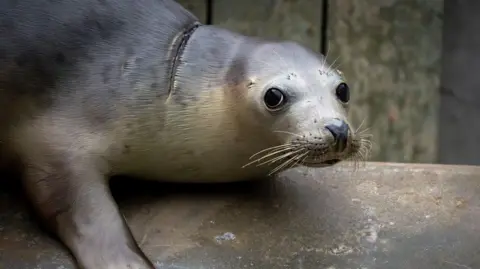
She said net entanglement was a "common occurrence" with up to 10% of the seals that come to them for rehabilitation having been injured this way.
Jones added: "We have a fantastic fisheries industry - especially here in Cornwall - we don't want to see that go.
"We want to work with them but we don't want to see this hideous entanglement being a long-term problem."
She said the government needed to boost monitoring to tackle the issue.
 Cornwall Wildlife Trust
Ruth Williams co-authored the report by environmental charities, which for the first time attempted to put a figure on the amount of protected species being killed each year.
These were its findings for bycatch in UK waters:
- More than 10,000 seabirds
- More than 1,000 porpoises and dolphins
- About 500 seals
- More than 120 tonnes of protected sharks, skates and ray
- More than 1,000 Atlantic salmon
Published by Wildlife and Countryside Link, the report calls on the government to "urgently introduce" bycatch action plans and require remote electronic monitoring on all fishing vessels operating in English waters.
Williams said the government could do more and the fishing industry was not to blame.
 Cornish Seal Sanctuary
She said: "The fishermen find this as distressing as any member of the public.
"The problem is government will and resource."
Williams said coloured nets could work to deter seabirds - as well as devices known as acoustic deterrent devices or pingers.
The Marine Management Organisation (MMO) requires vessels more than 12m (39ft) in length to use acoustic devices, and those outside that requirement must obtain a marine wildlife licence, which are not currently being issued.
Alessandra Bielli, from the Centre for Environment, Fisheries and Aquaculture Science, has been leading a trial since 2019 exploring whether pingers are an effective long-term deterrent when used closer to shore.
The devices produce sounds audible only to porpoises and dolphins, which can deter them from approaching fishing nets.
She said previous studies had focussed more on porpoises but the picture "remained unclear" for common dolphins.
Some scientists are concerned the pingers will only work in the short term - before dolphins get used to the noise and possibly even associate the noise with fishing.
Bielli said: "What we want is to make sure that before we advise if pingers are effective that we have enough information collected to do a comparison."
She said fishers were "keen" to have pingers on their nets - but they needed scientific evidence to determine whether they were an effective solution for the long-term.
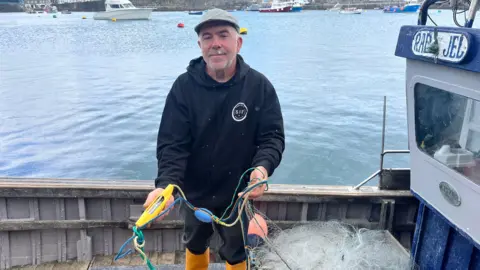
Will Shugg, who fishes from Mevagissey, has been taking part in the trial as well as voluntarily having cameras monitoring his catches.
He said: "No fisherman wants to catch a bycatch of any sort really. Not only does it break your heart it ruins your nets."
Shugg said fishers were "crying out" to use the pingers but that government policy was an obstacle.
He said: "That's the point of this trial - to make it legal for all fishermen to have them to use."
The report said alternative solutions such as heavier nets had proven effective in reducing seabird deaths, while weighted ropes in Scotland had lowered the number whales being caught in fishing gear.
A Defra spokesperson said: "This government is committed to restoring our oceans to good health and we are taking action to reduce the bycatch of marine species.
"Our flagship programme Clean Catch uses electronic monitoring to collect bycatch data and evaluate the effectiveness of mitigation measures, and our new Seabird Bycatch Action Plan will look to reduce seabird deaths in and around English waters."
