Michael Jackson and the 'invisible man' behind his success

 Glen Wilson/Lionsgate
Michael, the new biopic about the early life of Michael Jackson, has left many critics scratching their heads over its "saccharine" portrayal of the controversial entertainer.
But what few doubt is the continuing power of the music that made him the world's biggest star in the 1980s.
The story behind that success is partly down to a relatively forgotten songwriter from the British seaside resort of Cleethorpes.
Rod Temperton, who died nearly a decade ago, was known as music's "invisible man" because of his low profile.
He penned crucial tracks on Jackson's breakthrough solo work, Off the Wall, and the gargantuan follow-up Thriller, which became the biggest-selling album of all time.
"He was the sound of a generation," says Julia Thompson, who is making a documentary about Temperton's life. "You know, that disco sound, those funky beats."
So how did a Lincolnshire lad who worked as a fish-filleter in a Grimsby frozen food factory go on to conquer the pop world?
Temperton was born in Cleethorpes in 1949. Despite growing up in austerity Britain, he started on the path to stardom at an early age.
He was inspired by his music teacher at De Aston School in Market Rasen, says Thompson, and went on to become a familiar face on the local scene.
Alan Carey, an old band mate, remembers Temperton in his early days and later joined him on a tour of Germany, where they often played in front of American servicemen.
"I first saw Rod in the pub in Ferriby, the Duke of Cumberland. I was very impressed with him as a keyboard player," he says.
"The Americans absolutely loved Rod, but he used to play the keyboards backwards.
"So he'd walk to the front of his keyboard, tilt it towards him, and then do a massive solo, like upside down. They absolutely loved that."
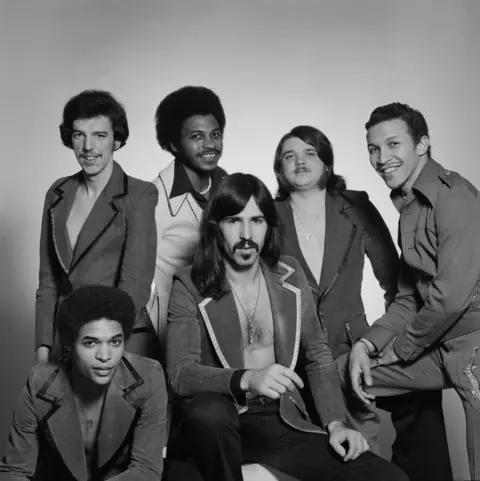
In 1974, Temperton joined an up-and-coming funk band called Heatwave. Fame, however, was still some distance away, as bandmate Roy Carter recalls.
"Heatwave were doing mostly the American bases and social clubs, so I met Rod Temperton in Germany.
"We were both keyboard players and we were both from England and we had a very similar background.
"We were roommates for a while. We washed our socks together in the sink and hung them up to dry."
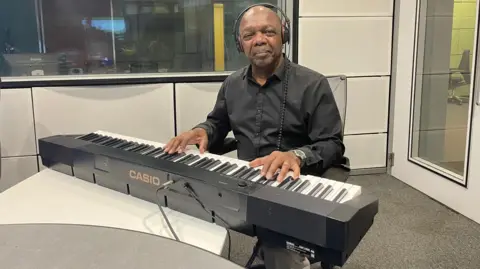
Barry Blue, who became Heatwave's producer, remembers seeing the band for the first time.
"As we got near the venue there was a mile-long queue," he says. "Rod was the keyboard player and the band was sensational."
Heatwave got a deal with a small record company and Temperton's talent as keyboard player was soon matched by his flair as a songwriter.
"We'd all sit round the piano and he would do the best he could to sing them to us," recalls Carter.
"He could sing harmonies, because that's what he liked to do, but he's not a lead singer.
"So, he'd be in the background, he'd be playing these songs, and we'd go, what chord is that?
"I'd have to convert what he was playing on the piano into guitar chords."
 Michael Putland/Getty Images
Blue adds: "He said, 'well, I got this little tune, this is just a ballad, you know, it's not going to go anywhere'. And he played me Always and Forever, which I thought was amazing."
Always and Forever became a hit, along with The Groove Line.
But Heatwave's biggest success came in 1977 with the single Boogie Nights, which reached number two in the UK and US.
"Boogie Nights was the legacy," explains Carter. "Us, the Bee Gees, Saturday Night Fever, that whole disco thing. Boogie Nights rode that disco wave."
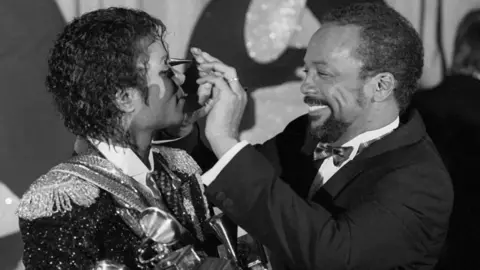
Temperton now came to the attention of the legendary producer Quincy Jones.
So impressed was Jones that he asked him, as Temperton once put it, "to work on everything he was doing".
 Getty Images
"I was there when he first got the call from Quincy Jones," recalls Blue. "There was a call that came into the studio and I picked it up. 'Can I speak to Rod Temperton please?'
"I said to Rod, 'There's a call for you here'. And he goes, 'Who? Quincy?'
"He put the phone down, because he thought someone was winding him up."
Jones asked Temperton to come to Los Angeles to work on a project with him. It turned out to be for a Jackson solo album, Off the Wall.
He wrote three songs, including the title track and the smash-hit Rock with You.
Carter still has the demo for Rock with You on cassette.
"'No,' he says, 'no, that's not a Heatwave song'," Carter recalls. "He gave them to Michael."
 PA Media
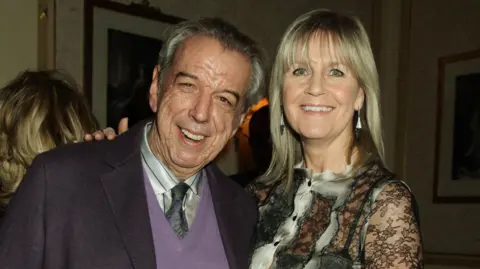
The new partnership with Jones produced hits for George Benson, Aretha Franklin and Donna Summer, to name but a few.
Carter also got to meet Jackson.
"He got out of the car. I was just on my way out and Michael came up and they said, 'Oh, this is Roy from Heatwave'," he remembers.
"He came out and spoke to me, had a chat about music and what Rod was doing for him and how encouraged he was."
But the biggest success for Temperton was still to come. In 1980, he began working on Jackson's next album, Thriller. Released in 1982, he would again write the title track and two other numbers.
The period leading up to Thriller is covered in the new biopic Michael, which ends in the early 1980s, and though the film has drawn criticism for its "sanitised" approach to Jackson's life, the music scenes have won praise.
Temperton died in 2016, but he is still fondly remembered.
"Rod was such a lovely, lovely man," Carey recalls. "He was quirky. He used to get up in the morning in the hotel, we had a sink in the hotel, and he literally used to run the tap, put his finger on it, put his finger on one cheek, and then the other cheek and say, that'll do me."
Blue adds: "He was a unique talent There was no doubt about it. He should be more recognised.
"One of the greatest songwriters that's ever come out of the UK, if not the world."
Listen to highlights fromLincolnshire on BBC Sounds, watch thelatest episode of Look North.
Download the BBC News app from the App Storefor iPhone and iPad orGoogle Play for Android devices
