Secrets of Lincoln Castle, from royal love story to grisly deaths

 Ullstein Bild via Getty Images
The tragic story of a medieval "power couple" lies within the walls of one of the England's finest castles.
Visitors who wander through the main entrance to Lincoln Castle might spot a "very unassuming stone" next to the Georgian gaol, which is all that is left of 13th Century Eleanor cross.
It is the first of 12 grand monuments King Edward I put up in honour of his wife Eleanor of Castile, following her death in 1290.
Harry Wiggs, a PhD student with the University of Lincoln and Historic Royal Palaces, says the couple were married for political reasons, "but it seems their relationship flourished and had quite a strong bond".
"They spent most of their time in each other's company, which wasn't always the case for kings and queens of the period," he tells the Secret Lincolnshire podcast.
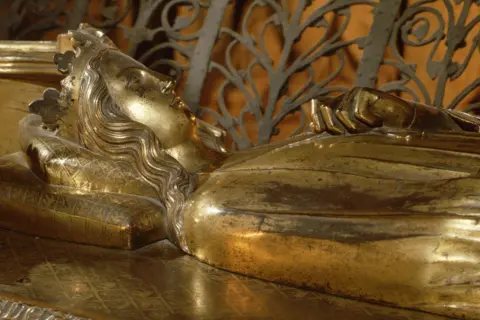
When Queen Eleanor died in Harby, a small village near Lincoln, Edward "grieved for his wife quite heavily".
He travelled with her body from Lincoln Cathedral to Westminster Abbey, where she was buried.
The journey took 12 nights and Edward ordered 12 "elaborate crosses" to be built in her honour at each of the places where they rested.
The Lincoln cross was initially placed near South Common before being rediscovered during the Victorian period and moved to the castle.
The surviving stone "could be the portion of her skirt from one of the actual effigies of Eleanor herself on her cross".
 Corbis via Getty Images
"I can't think of many other examples of a king expressing his love and grief in such a dramatic fashion," Wiggs adds.
"It truly is a real sort of romantic love story in my mind."
Eleanor and Edward's love story is one of several fascinating tales connected with Lincoln Castle.
Almost a century before the story Eleanor and Edward, Nicola de la Haye became the first woman to be appointed sheriff of Lincoln Castle.
Sharon Bennett Connolly, a local historian, credits Nicola with helping to thwart a French invasion during the First Barons' War.
 Heritage Images via Getty Images
King John, who was fighting a war against Prince Louis of France and rebel English barons, appointed Nicola sheriff hours before his death in 1216.
The rebels surrounded the castle, but Nicola remained loyal to the young King Henry III and held out for more than six months.
It meant that William Marshal, often described as "the greatest knight in all the world", could gather forces to fight a battle.
"Rather than just push the rebels out of Lincoln, he could actually defeat them," Connolly says.
"Nicola and Marshall saved England and if it wasn't for the battle at Lincoln, we'd all be speaking French.
"The idea that she actually commanded the defence of the castle and it wasn't given to an assistant, she was the one commanding it, that is unusual."

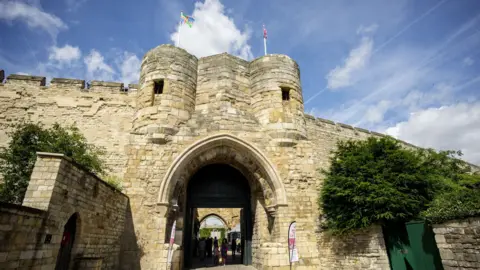
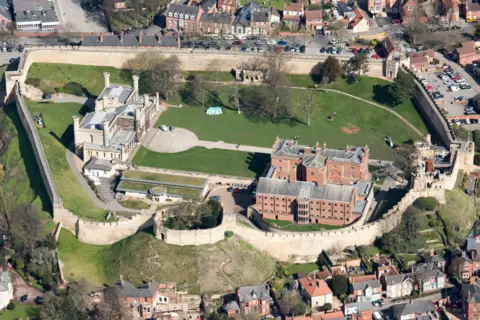
Lincoln Castle was built in 1068 by William the Conqueror as a major military fortress, but its purpose has changed over time.
Today, it remains in use as the home of the city's crown court.
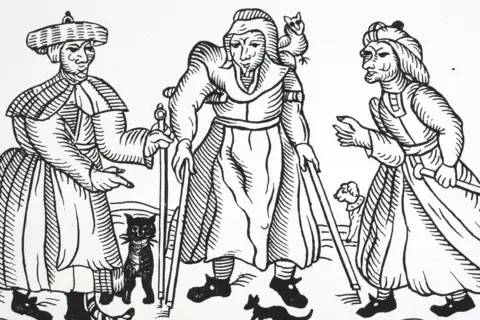
Over the centuries, all sorts of criminals were tried at the castle, including three women now known as the Witches of Belvoir
Connolly says some women were accused of witchcraft when people "wanted to blame them for things".
In 1618, Joan Flower and her two daughters, Margaret and Philippa, were arrested for allegedly poisoning the Earl of Rutland and his family, killing his two boys.
They had previously worked for the family, but were fired for stealing and were suspected of trying to get their revenge.
 Hulton Archive/Getty Images
Joan died on her way to Lincoln Castle, but her daughters were put on trial.
While they confessed to the poisoning, Connolly says this does not mean they were guilty because it is likely that methods such as sleep deprivation were used to extract a confession.
Historians also believe the uneducated women would have had little chance at trial, where they would have had to defend themselves.
The two girls were convicted and sentenced to hang. But in 2013, new evidence emerged suggesting that they might have been framed by the Duke of Buckingham, a friend of King James I.
According to the theory, the duke killed the boys in an attempt to inherit the earl's wealth by marrying his daughter.
 Universal Images Group/Getty Images
Traditionally, prisoners sentenced to hang could expect a slow and painful death through strangulation.
But during the 19th Century, executioners developed the "long-drop" method of hanging, which was intended to break the neck and cause a quick death.
It was more efficient and meant it would take "seconds to die, rather than minutes or hours", according to Connolly.
William Frederick Horry was first to die by this method at Lincoln Castle in 1872.
Horry was an alcoholic and when his wife left him and took the children, he bought a revolver and shot her.
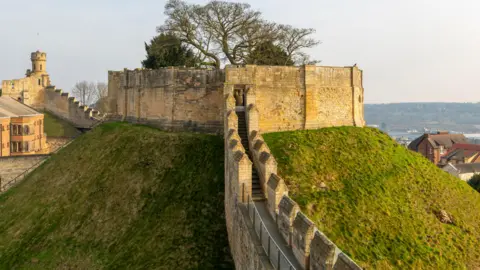
He was hanged by William Marwood, who developed the long-drop method, on 1 April and is buried in a simple grave in the Lucy Tower.
Marwood's method was refined over the following decades and used until the last executions were carried out in the UK in 1964.
Today, the imposing stone walls still watch over the city, but where once crowds gathered to witness executions, today they are more likely to enjoy concerts such as the Live at Lincoln Castle series, which this year is bringing artists such as Rick Astley and Deacon Blue to the city.
"When the castle was originally built, it was built to control the local population," Wiggs says. "Now it is really part of the city's fabric.
"I don't think there's many other places you can go to today and stand within a structure which is almost a thousand years old and take in contemporary art in its best form."
Listen to highlights fromLincolnshire on BBC Sounds, watch thelatest episode of Look North.
Download the BBC News app from the App Storefor iPhone and iPad orGoogle Play for Android devices
