Is there a quiet coalition challenging Reform in Bradford?

 Aisha Iqbal/BBC
Despite taking political control of Bradford Council after dramatic local election gains, Reform UK found itself locked out of the authority's key scrutiny and oversight roles.
On the same day that Stephen Place was elected council leader, a series of votes saw Reform councillors fail to secure a single major committee chair or deputy chair role.
It hinted at what some insiders describe as a quiet cross-party effort to maintain checks and balances on the new administration as Bradford enters an uncertain new political era.
Reform UK may now lead Bradford Council, but the rest of the chamber appears determined to retain influence where possible.
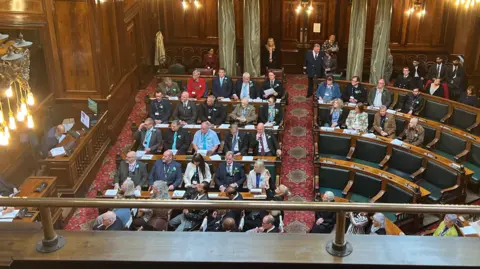
In vote after vote during the council's annual general meeting (AGM) on Tuesday, Reform candidates were blocked from securing a committee chair or deputy chair position, despite the party becoming the authority's largest political group following the local elections.
Instead, those influential roles were divided between Labour, the Conservatives, the Your Bradford Independent Group and the Greens, which together hold 54 of the council's 90 seats following the elections on 7 May that transformed the political make-up of the authority.
One source inside the council said: "There's no real benefit for the political parties in trying to block Reform taking the leadership.
"The committees were the one place where the rest of the chamber could still exert influence."
 Grace Wood/BBC
The outcome means Reform councillors will not chair any of the council's main disciplinary, scrutiny, licensing or oversight committees.
They will, however, still control the council's decision-making executive committee and cabinet positions, the details of which are yet to be confirmed.
Reform councillors will also continue to sit on the committees themselves, because membership is allocated proportionally to reflect the political make-up of the council chamber.
However, without the chair or deputy chair positions, Reform councillors will not hold the casting votes or leadership influence attached to those roles.
The committees oversee many of the decisions that directly affect people's day-to-day lives across the Bradford district, from licensing bars and taxis to scrutinising children's services, health provision, planning and council spending.
Some also deal with standards, misconduct and disciplinary matters involving councillors and senior council officers, meaning they play a key role in accountability and oversight inside City Hall.
At Tuesday's AGM, where Place was named leader of Bradford Council after two rounds of voting, Reform put forward candidates for most of the available committee leadership positions, 10 chair roles and 10 deputy chair roles, but failed to secure a single one.
In each contested vote, Reform candidates faced a single rival nominee from another political group.
No other parties competed against one another for the positions, with vote after vote instead seeing councillors back the non-Reform option.
The pattern meant various new combinations of Labour, Conservatives, Greens and the Bradford Independents will be working together across the committee system.
Labour secured five chair positions and three deputy chair roles, Conservatives took three chairs and three deputy roles, the Greens secured two chairs and two deputy positions, while the Your Bradford Independent Group secured two deputy chair roles.
The voting pattern is likely to fuel speculation about the extent of behind-the-scenes coordination between the council's non-Reform groups as they seek to retain influence over key areas of scrutiny, licensing and council oversight where more detailed boardroom level decision-making takes place.
'Like marking your own homework'
One Bradford Council source admitted there had been some "informal" initial conversations between groups discussing "what's the alternative from Reform", as well as behind-the-scenes conversations about cooperation on committees.
They rejected suggestions of any formal organised campaign to block Reform from positions, but stressed Reform councillors themselves had not engaged in discussions with other groups ahead of the meeting.
"The committees are there to hold the executive to account," the source said.
"If the ruling party controls the committees, then it's kind of like you're marking your own homework."
They added: "The very nature of this kind of council means it gives a lot of control to the leader, even though in this case the leader doesn't have a mandate. The only way to really counteract that is to take the committees."
The source admitted the "divvying up" of some committee roles had been strategically considered because it was felt Reform "could be quite dangerous" on certain committees.
However, they stressed: "The constitution is what it is. The membership of the committee is set proportionally, as it should be."
The developments came during Bradford Council's first annual meeting since local elections which saw Labour lose overall control of the authority and Reform emerge as the largest political group in the chamber.
However, Reform still lacks an outright majority on the council and any formal coalition arrangement with any other political group has so far been ruled out.
Listen to highlights from West Yorkshire on BBC Sounds, catch up with the latest episode of Look North.
