'Chronic back pain put my life on hold - now I have hope'

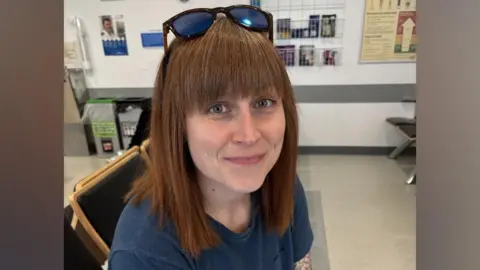 Sam Naylor
For years, Sam Naylor's life has revolved around managing chronic back pain.
The 36-year-old, who enjoys climbing, hiking and running, said she had been forced to give up many of the activities she loved after developing severe lower back pain in 2020.
Now she has become one of the first patients at Newcastle Hospitals to receive a new implant designed to treat a specific form of chronic mechanical lower back pain.
The procedure, carried out at the Royal Victoria Infirmary, involves implanting a small device in the lower back to stimulate muscles that help stabilise the spine.
The operation followed years of investigations and treatments which Naylor said had failed to resolve the problem.
"It started with a slight pain on the left side of my lower back that was only noticeable when leaning forward," she said.
"Then one morning I woke up after a run the night before, and the pain was so bad I couldn't get out of bed."
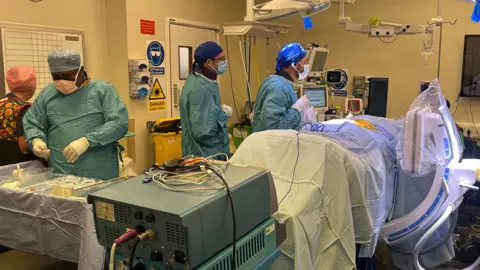
The BBC was in theatre as specialists implanted the ReActiv8 device under general anaesthetic.
The device, which Naylor will turn on for 30 minutes twice a day, is designed to stimulate the muscles, helping restore neuromuscular control - the communication pathway between the brain and muscle.
Naylor, from Newcastle, said medication and rest helped settle the initial flare-up, but the pain never completely disappeared.
Over the following years, she underwent MRI and CT scans, physiotherapy, pain medication and a procedure intended to reduce pain by targeting nerve endings.
"The pain never fully went away," she said. "It just kept getting worse."

Naylor said periods of severe pain could leave her struggling with everyday tasks and unable to work.
"When I have bad flare-ups, I could end up being off work for a week or so," she said.
"I can have pain going down my leg and across my lower back, finding general movement and everyday tasks difficult.
"You do everything in your power to make the day-to-day more manageable, and then something simple can set it off.
"Being in a seated position for too long, like driving, can cause debilitating pain lasting for days."
She works for an outdoor equipment company and said she had increasingly been based at a computer rather than taking part in outdoor events and product testing because of concerns about triggering further flare-ups.
The uncertainty surrounding the cause of her pain also affected her wellbeing, she said.
"I've tried to be patient, but when you don't know what's causing the pain, it makes it much harder to treat.
"I just feel like my life has been put on hold whilst I wait to get better."
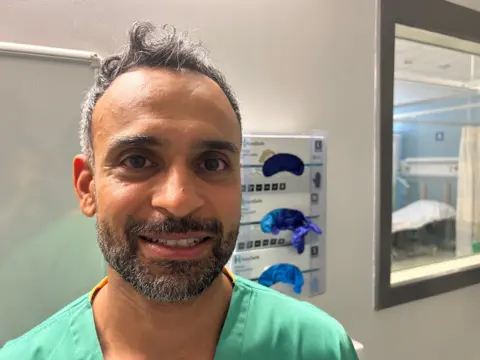
Naylor said receiving a diagnosis from Dr Sachin Rastogi, a consultant anaesthetist specialising in chronic pain at Newcastle Hospitals, marked a turning point.
"It was a huge relief to finally have somebody who immediately recognised my symptoms and potentially has an answer to my chronic back pain," she said.
Rastogi said the technology could benefit patients whose back pain was linked to weakness and dysfunction in deep stabilising muscles of the spine.
"This technology can be life-transforming, and it has so far had a huge impact in improving the quality of life for our patients who have undergone this procedure," he said.
"It's potentially a cure for this particular type of low back pain where there is muscle weakness."
He said the treatment was intended for a specific group of patients whose symptoms have not improved despite conventional approaches, including physiotherapy, medication and injections.
"We put two electrodes into each side of the muscles deep in the lower back, just off the spine, and we connect those to an implanted battery, like a pacemaker," he said.
"Twice a day, the patient switches it on for 30 minutes and it basically reactivates and stimulates the muscle to contract, building strength up again, and leading to improvements in function and pain."
Rastogi said the muscles targeted by the device were difficult to strengthen through exercise alone.
"You can't exercise this muscle through physiotherapy, as it's very deep in the spine," he said.
"If it gets weak or loses function, the pathway from brain to muscle is lost, so this battery stimulates the muscles instead."
The implant is the latest example of neuromodulation technology being used by Newcastle Hospitals.
Similar approaches are also used in treatments for conditions including Parkinson's disease and epilepsy.

The procedure comes several months before Naylor is due to marry her partner, Chris Futers, after 17 years together.
She said the possibility of reducing her pain had given her renewed optimism about the future.
"The worst part of my whole experience, other than the intense pain, was being told that there was nothing that could be done and that I had to just learn how to live with it," she said.
"Now I know there is a chance this new procedure might improve the level of pain or even remove it altogether means there's a big possibility I can get my life back."
