Pigeons or pirates? Mystery behind beach's secluded cave in the cliffs

 Nicole Barley
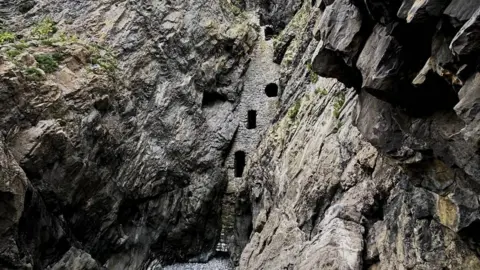
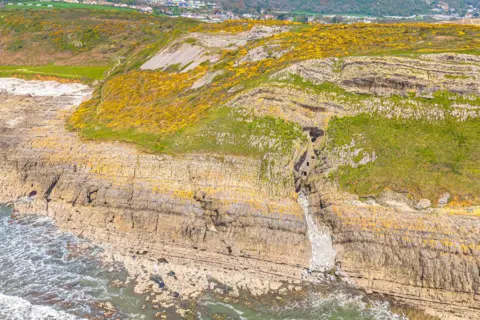
Hidden in the cliffs on a scenic part of Wales' coastline, Culver Hole has long mystified historians and inspired stories of pirates and smuggling.
Helen Nicholas was just six when her dad took her on an adventure "over the cliff" to explore the cave.
As soon as they clambered around the corner, the 60ft stone wall with mismatched windows came into view and she "was absolutely hooked" with what she saw as "a castle in the rock".
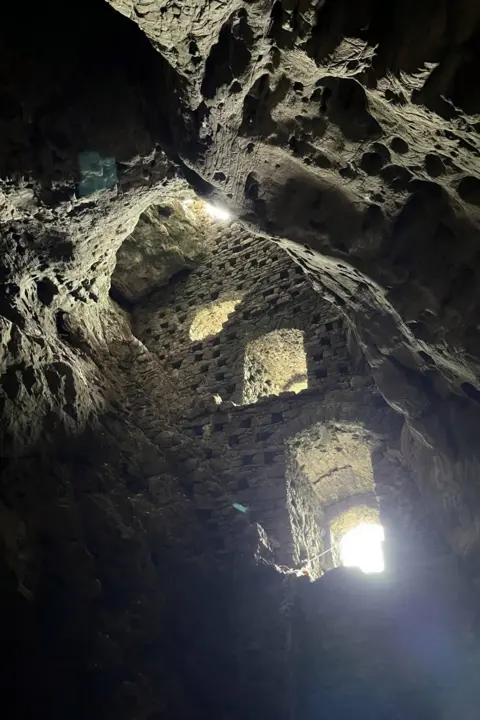
Commonly thought to be a dovecot due to its internal ledges, Ruth Ridge, a volunteer with Gower Society and National Trust volunteer, questioned "why build a pigeon house in such an inaccessible spot?"
"We don't know who built it or why."
"You feel exposed before you even step inside, the sea surges below, the air is damp and echoing and, despite the stonework, it never stops feeling like a cave," said Helen, 50, who is the director of Gower Unearthed.
She said it was easy to imagine a man standing on a windy cliff, hurrying his men to smuggle away goods.
"The stories tell us there are tunnels, but there's very little evidence of that," she added.
When she and her dad climbed the rope to get into the building that first time, she said she remembers the "slippery dark green algae on the rocks and then the birds suddenly fluttering out".
Now when she visits, she said it is obvious it is a place for pigeons, even its name - culver - is old English for pigeon.
"It doesn't necessarily mean or rule out the fact that it was said to have been used by John Lucas, a notorious smuggler," she said.
"He has been described as a pirate, ungovernable, but very handsome, apparently."
She said the concept of smuggling was likely as it was common in the area, and John Lucas fortified the family house Salthouse, "giving the feel to the story he was protecting himself because he was involved in smuggling".
The cave feels like a place steeped in "Gothic romance".
 SMDroneography
"Why Culver Hole was built, that is still an enigma, it's still a mystery," she said.
"Yes it's used for birds, but there's still unanswered questions."
"It's a very strange place, anyone who sees it can't believe what they're looking at," added Ruth Ridge.
She said the structure is thought to date back to the 13th or 14th Century and there have been tales of a castle having existed on the headland, though no evidence has ever been found.
After moving to the area in 1970, Ruth, her husband Malcolm and their three children moved to the Gower.
When they joined the Gower Society, they were told about Culver Hole and went to explore.
After a winding coastal path and a scramble across the rocks, they turned the corner and saw the "enigma".
"Somebody went to an awful lot of trouble to build it, because, let's face it, it is not an easy place to get to.
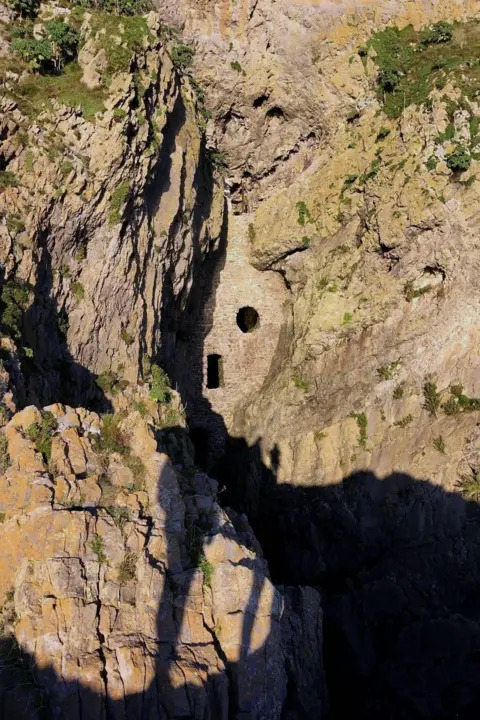
"It's got a large, almost like a doorway, near the base. It's got other oblong openings and it's got circular openings.
"The local legend for centuries has always been 'it's a smugglers lair'. It's very nice for local folklore, but I don't think there's any truth in it."
 Nicole Barley
Ruth said lots of Gower's castles have their own dovecotes as it made fresh eggs available in winter and spring.
"I think he probably did have a little bit of smuggling on the side. I mean, it was rampant in those days.
"Brandy and lace were being brought in on Gower's coast. We know that there are tales of a large number of smugglers, and people who went wrecking.
"A lot of the houses in Rhossilli were built from a boat that was wrecked on the sands there that was carrying a lot of pitch pine."
 Malcolm Ridge
She asked, why build a pigeon place in such an inaccessible spot and make it hidden from anywhere else on the land?
"Most castles would have had dovecots adjacent to their buildings so that it was easy for the cooks to get access to it, unless, of course, they were actually going for rock doves rather than ordinary pigeons.
"It does seem a very strange place, and I don't think there's anywhere else in the UK that's got anything that resembles anything like Culver Hole."
 Nicole Barley
"It still is a mystery. We don't know who built it or why," she said.
Building it would have been a "serious endeavour, when you realise they didn't have scaffolding poles".
She said it is also mysterious that the brick wall has managed to survive in its condition in such an exposed location.
"You'll see some attention to detail has been put into its making," she said.
"Even the bits above the rectangles, the bricks have been caught, have been cut to frame the top of the windows.
"It makes it makes me think it was there for more than just pigeons."
