'A heel prick test might have saved our seven-year-old son's life'

 Family handout
Teddy Johnson hit all of his milestones and was walking from 11-months-old.
"He was perfect in every way," his mum Jemma says.
But when he was 18-months old Teddy was diagnosed with with Metachromatic Leukodystrophy (MLD), a rare metabolic disorder that leads to a progressive loss of physical and mental skills - something he was born with.
Teddy died when he was seven-years-old but his parents say newborn testing could have saved their son's life.
His late diagnosis, Jemma says, meant it was too late for treatment as he was already showing symptoms. She and her husband are meeting politicians in Westminster on Tuesday to call for testing.
MLD affects approximately one in 40,000 births and can be treated if detected early enough in babies. The Department for Health and Social Care said it "must be guided by science".
Jemma said her son did not display any early signs of the disease when he was a baby.
"He was your very normal, cheeky little monkey," she said.
However at about 17-months-old, he started to walk with a limp which was unusual.
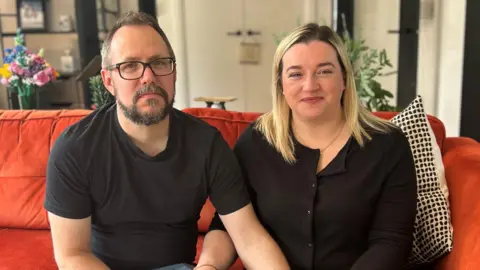
Jemma and her husband Marvin, from Portadown, did not think much of it until it did not improve, and after four weeks it had become quite extreme.
What are the symptoms?
Following a referral to a neurologist, Jemma said "their world fell apart" when their son was diagnosed with this rare disease and they were told he was unlikely to live past the age of four.
"Every single thing he had learned or developed at 18-months-old started to reverse," she added.
The couple were told there was treatment in Italy but it was only available for those children not already showing symptoms.
Little over a year later, Teddy had lost most of his functions. He was unable to move, or talk, was in pain, and his body became very rigid. He was also fed via a peg in his stomach.
"The hardest part for me was him losing his talking," said Jemma. "To not hear him call mum or dad or his older sister's name was incredibly difficult.
"We gave up our careers as we were told his decline would be very fast, and this was the best thing we could have done as we were able to dedicate our full attention to him.
"We protected him through covid and to us he was royalty in our house. Life has revolved around him completely for the last six years."
Teddy died on 16 April.
"Teddy has left a massive void in our lives," said his mum.
What has the government said?
Earlier this year, the UK National Screening Committee (NSC) recommended against adding the disease to the list of 10 rare conditions that newborns are screened for through the 'heel prick' test.
It said this was because it was not currently known if screening tests were accurate and if a suitable test cut-off level had been set.
It also said it was not known if early treatment as a result of screening improved long-term health outcomes.
 Family handout
The couple will be in London on Tuesday to raise their case with a number of politicians including the UK Parliamentary Under-Secretary of State for Public Health and Prevention, Sharon Hodgson.
Marvin said they want to educate health leaders that Teddy's death could have been avoided and he could have lived a normal life if his rare condition had been picked up on the heel prick test.
"We are campaigning for other parents to give them the opportunity to save their children," he said.
"It's very important that we make change. Children are dying because of it."
The couple's daughter Jean was also found to be carrying the gene for MLD and could pass this on to any future children.

Following news of Teddy's death, the DUP Upper Bann MP, Carla Lockhart, called on the prime minister to look again at early tests.
In response, Sir Keir Starmer pledged to re-examine the inclusion of MLD in newborn screening.
"We are so far behind other countries with this. Parents are being robbed of their children," said Lockhart.
"Some researchers have said it would amount to around 17 pence per child to be added to the heel prick test.
"It is such a minimal cost and what blows my mind is that we have a treatment in the UK if children are diagnosed before symptoms appear."
Prof Simon Jones, a leading expert in inherited metabolic diseases, said gene therapy had been approved in the UK in 2022.
"It's almost curative as a treatment but the problem is that it is complex and protracted and needs to be started before the child becomes ill, which is the opposite of how we usually do medicine."
He added that since the approval of the new drug, there have been 40 additional children diagnosed with MLD in the UK but they have only been able to treat eight.
"The other children, despite us having this amazing and innovative therapy, we have had to send them home essentially to die like Teddy. This is unacceptable to us," he said.
A spokesperson for the Department for Health and Social Care said: "We understand how devastating metachromatic leukodystrophy (MLD) can be, and our hearts go out to Teddy's family."
It added that the independent UK National Screening Committee is considering MLD for a new evaluation to "build more evidence on routine newborn screening".
