Family of British toddler criticises police as Australian inquiry into cold case murders begins

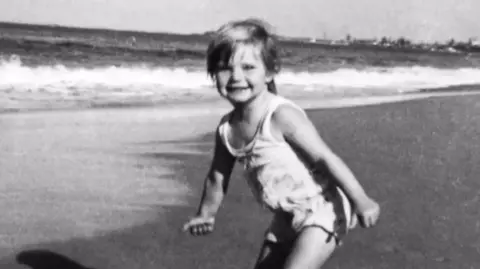 Family handout
The brother of a British toddler who disappeared from an Australian beach has told an inquiry the family has lived with the consequences of police failure for more than 50 years.
"If [the police] had done their job in 1971, we would have known the truth years ago," Ricki Nash told a New South Wales (NSW) parliamentary inquiry looking into cases of unsolved murders and long-term missing people.
Cheryl Grimmer, 3, disappeared from Fairy Meadow beach in Wollongong, south of Sydney, in January 1970. Despite extensive searches, there were no leads.
A suspect was charged with her abduction and murder in 2017, but his trial collapsed after his teenage confession was ruled inadmissible.
The man, known as "Mercury", denies any wrongdoing and prosecutors dropped the case.
Cheryl's disappearance happened almost two years after her emigration from Bristol to Australia with her parents and three brothers.
"Cheryl was not a case file, she was an amazing funny little girl," her elder brother Ricki Nash, told the inquiry on its first day of public hearings.
The twin brother of Kay Docherty who went missing near Wollongong in 1979 at the age of 15, also spoke at the hearing.
"Both my parents went to an early grave without answers or knowing what happened to their only daughter," said Kevin Docherty. "They virtually died of a broken heart eight years apart."
Kevin Docherty was one of several families detailing the failures of police in handling the disappearances of their loved ones.
"As mum always said, when she went to that police station that night, there was one good cop, there was one bad cop," he said, telling the inquiry that the police wrote her off as a runaway and as a result, little was done to try and find her.
The case of Kay Docherty is one of several being examined in the inquiry that may have links to the notorious Australian serial killer, Ivan Milat.
Between 1989 and 1992, Milat kidnapped and murdered at least seven victims aged 19 to 22 - three Germans, two Britons and two Australians. The backpackers were picked up when hitchhiking on a long stretch of road between Sydney and Melbourne. Each was taken into NSW's Belanglo State Forest.
The family of Keren Rowland also gave a submission to the inquiry outlining their belief that she may have been Milat's first victim. Rowland was just 20 and five months pregnant when she disappeared in February 1971 in Canberra.
Speaking to the inquiry, Rowland's cousin Dr Andrea Hughes said there had been more than five decades of "ignorance, poor leadership, parochialism and arrogance" in relation to the investigation.
Forensic criminologist Dr Xanthe Weston also gave evidence from her research into the serial killer.
Milat was "egocentric," Weston told the inquiry, adding that when Milat's sister died and he "lost control of his personal life, he compensated by killing."
There will be further hearings over the next few months.
NSW police have been contacted for comment.
