Cairngorms wildfire 'will have inevitable economic impact'

 Steve Kenyon Roberts/Deeside Gliding Club
A business organisation has warned that a wildfire that has burned in the Cairngorms for two weeks will have an "inevitable economic impact".
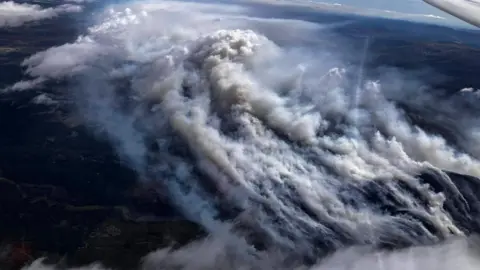
The fire has destroyed about 10 sq miles (25 sq km) of moorland and forestry near Aviemore since 15 July, and firefighters say there could be a risk of flare-ups in coming weeks.
Scottish Land and Estates (SLE) said the fire had come at the height of the tourist season and the incident had forced the closure of walking routes and some attractions.
SLE's Ross Ewing said it was too early to put a figure on the impact, but accommodation providers, cafes and activity businesses faced "prolonged disruption".
Following the outbreak of the fire, homes in Nethy Bridge and a campsite and properties in Glenmore had to be evacuated temporarily.
Cairngorms Mountain Resort and RSPB Scotland's Loch Garten reserve have been among the attractions forced to close.
Police Scotland has said walking routes shut for safety reasons included around Glenmore, Loch Morlich and Badaguish, and routes providing access to Cairngorm Mountain, the Northern Corries and Meall A' Bhuachaille.
Meanwhile, data gathered by the Copernicus Atmosphere Monitoring Service (CAMS) show carbon emissions in the Highlands increased due to the wildfire.
Ross Ewing, who is director of moorland and strategic projects at SLE, said landowners, gamekeepers, estate staff and specialist contractors were playing "a vital role" in the firefighting effort.
He added: "The scale of the wildfire will inevitably have an economic impact on businesses in and around the Cairngorms, particularly while roads, paths and visitor attractions remain closed at the height of the tourism season.
"It is too early to put a figure on that impact, but accommodation providers, cafes, activity businesses, estates and their suppliers will all be affected by prolonged disruption.
"Landowners, who take a long-term view - often decades ahead - of how land is managed, will now need to assess both the economic and environmental impact of what has taken place."
 RSPB Scotland
Highland Council said it was working with the Scottish government, Highlands and Islands Enterprise and other organisations to assess the economic impact.
Businesses in the affected area of the Cairngorms National Park have been sent a survey by Cairngorms Business Partnership asking what short and longer-term support they might need.
The Scottish Greens have called for an emergency fund to be set up to support communities responding to wildfires and provide for businesses suffering cancellations and closures.
MSP Ariane Burgess said: "Wildfires of this scale are not going away.
"Our changing climate is making extreme conditions more frequent, and government support must become planned, permanent and ready to deploy, not improvised after the flames have already spread."
Responding to the comments, Justice Secretary Neil Gray said, whose government role covers the fire service, said: "The Scottish government is engaging with businesses in the local area to gather information on impacts as we move into the recovery phase to assess what immediate medium and long-term support is needed."
 FLS
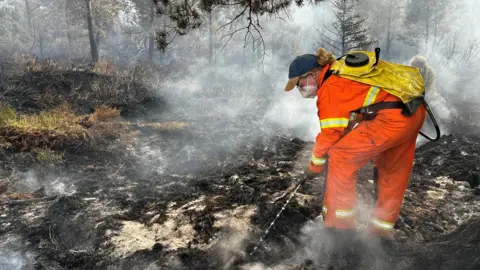
FLSThe Scottish Fire and Rescue Service said about 70 firefighters remained at the scene of the wildfire.
Forestry and Land Scotland (FLS) said helicopter waterbombing continued where hotspots had been detected.
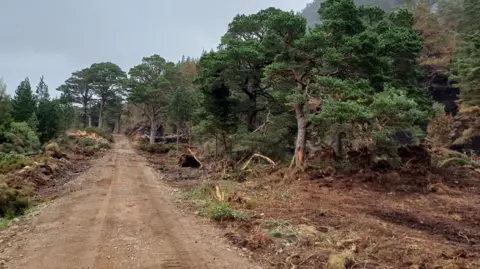
FLS said it had also started work on removing hundreds of trees felled or bulldozed to create a four-mile long firebreak.
North region manager Alex Macleod said: "Immediate action was required and it was necessary to fell the trees without the planned care and due attention and diligence that is our usual practice.
"Many trees were just bulldozed to get them out of the way as quickly as possible."
