Worms sent to space for extreme conditions research

 Reuters
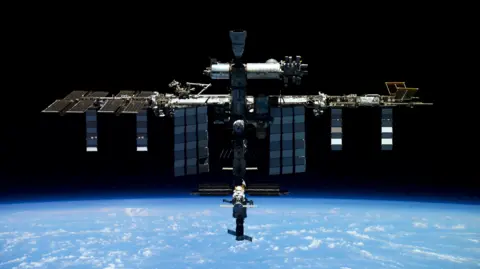
Scientists have sent microscopic worms to the International Space Station (ISS) in a bid to understand how biological organisms respond to extreme conditions faced by astronauts.
The Space Agency - the government body which funded the project - said the worms were launched from the Florida's Kennedy Space Centre on Saturday.
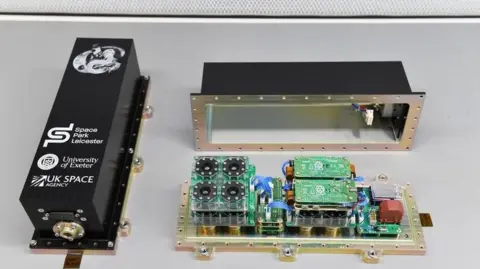
According to the agency, the scheme to create the miniature space laboratory, named the Petri Pod, was led by the University of Exeter and built by the University of Leicester at Space Park Leicester.
It is hoped the project could help provide insights into how biological systems change in space and therefore how astronauts can stay healthy.
 Space Park Leicester
The agency said the experiment would be mounted on the outside of the ISS by a robotic arm, so researchers could conduct tests on microscopic worms, called C. elegans nematode worms, controlling the equipment remotely from Earth.
The worms - which are 1mm in length - are commonly used in scientific research, the agency said.
The Petri Pod contains 12 experimental chambers, four of which can be actively imaged using fluorescent and white light imaging capabilities.
Each chamber provides a miniaturised life support environment, by maintaining temperature, pressure and a trapped volume of air for organisms to breathe when exposed to the vacuum of space.
'One step closer'
The experiment will initially spend time inside the ISS before being deployed outside - exposing it to the vacuum and radiation of space along with microgravity for up to 15 weeks.
During the mission, researchers will monitor the worms' health using fluorescent glowing signals and white light optics, captured via photographic stills and time-lapse video.
The system will collect data on temperature, pressure and accumulated radiation dose, the agency said.
Dr Tim Etheridge, from the University of Exeter, said: "By studying how these worms survive and adapt in space, we can begin to identify the biological mechanisms that will ultimately help protect astronauts during long-duration missions — and bring us one step closer to humans living on the Moon."
Prof Mark Sims, project manager for the Fluorescent Deep Space Petri-Pods project at Leicester, added it was the university's first "major" microgravity life sciences project.
"It has been both an interesting and challenging instrument to design and build. The project builds upon previous work with Tim Etheridge and the University of Exeter," he said.
"Having now delivered the experiment to Voyager Space Technologies, who provide the interface to NASA and its flight on the International Space Station, the project team at Leicester look forward to seeing the first images from orbit.
"We hope this will contribute to our understanding of the microgravity environment, and we're excited about the potential to further develop the instrument concept in the future."
Listen to BBC Radio Leicester on Sounds and follow BBC Leicester on Facebook, on X, or on Instagram. Send your story ideas to eastmidsnews@bbc.co.uk or via WhatsApp on 0808 100 2210.
