Climate change or dodgy drains - what caused town floods?

 Jacob Ottaway/BBC
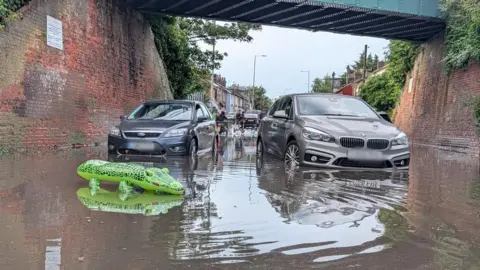
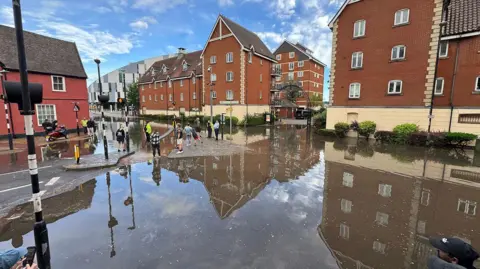
Ipswich came slipping and sliding to a halt on Tuesday evening, as flash flooding -exacerbated by intense rainfall - caused traffic chaos throughout the town.
Bus services were diverted, motorists became stuck and stranded in water on Wherstead Road, and areas around the University of Suffolk were left deluged.
While Suffolk's county town was seemingly hit the hardest, the downpours also left parts of Lowestoft, including its local cinema, and Woodbridge under water.
But was this particular weather event catalysed by climate change and a sign of things to come? Or just simply a case of dodgy drains?
 Supplied
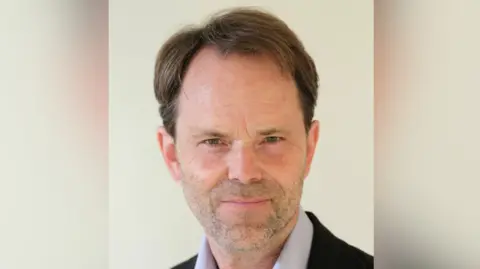
Dr Rupert Read is an environmental philosopher and a former professor at the University of East Anglia. He is now the co-director of the Climate Majority Project.
He told the BBC that his "heart goes out to everyone" who was affected by the flooding but said it was something everybody would soon have to get used to.
"There are going to be more and more of these kinds of events because we've set in tow climate breakdown," he said.
"We are going to see a lot more flooding, a lot more weather extremes and it is absolutely clear these things are happening because of human-caused climate change."
 Zoie O'Brien/BBC
Climate change is the long-term shift in the Earth's average temperatures, which can cause extreme weather conditions, such as heavy rainfall and, therefore, flooding.
This is caused by the release of carbon dioxide and other greenhouse gases into the air which humans have contributed to since the 1800s, according to the Met Office.
It predicts that by 2070 winters will be between 1 and 4.5°C warmer and up to 30% wetter, while summers will be between 1 and 6°C warmer and up to 60% drier.
Read told the BBC we needed to learn to "protect ourselves again this better" and get ready "for worse and worse floods for a long time to come".
"We need to adapt and prepare and that means a big mindset shift and a big shift on the ground and a big shift of resources," he said.
"I think everybody can see in their heart of hearts that our climate is deteriorating.
"We have to get a lot more serious, nationally and globally."
'Putting people at risk'
The flooding in Ipswich came as the Reform UK-led Suffolk County Council declared it would scrap the previous administration's climate change emergency declaration.
The declaration was an acknowledgement of climate change and a commitment to making changes to reduce emissions and achieve net zero by 2030.
Read said the decision to scrap it was "very worrying and dangerous" and was "putting the people of Suffolk and all the people of this country at greater risk".
 John Fairhall/BBC
But county council leader Michael Hadwen said he believed the move would actually benefits residents.
"Declaring a climate emergency was political posturing in 2019," he said.
"By removing it, we can focus on reviewing all net zero schemes, to evaluate which are offering clear benefits, practical outcomes, or real savings.
"For those that don't, we can look to resource the services that will have a direct impact on Suffolk's residents."
Speaking specifically about the flooding in Ipswich, he said: "Freak weather events happen."
"In terms of where flash flooding has happened, we are working with highways colleagues to see what can be done to improve roads and drainage," he added.
That sentiment was echoed by Anglian Water, which told the BBC it was "continuing to monitor reports of flooding" in Ipswich but said its sewer network was operational.
"At this stage, there are no issues reported on our sewer network, and our teams remain in the area keeping a close watch," a spokesperson said.
"Current indications suggest this is related to surface water drainage, and we'll continue to monitor the situation and liaise with relevant partners."
Do you have a story suggestion for Suffolk? Contact us below.
Follow Suffolk news on BBC Sounds, Facebook, Instagram and X.
