How one of the UK's most vibrant spots was almost lost

 George Carden / BBC
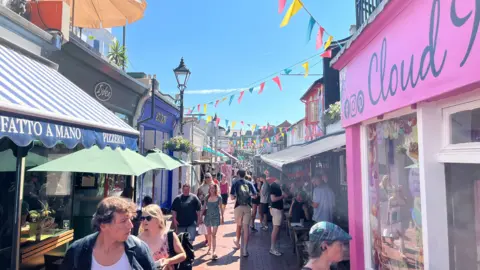
Tucked in the heart of Brighton is the North Laine.
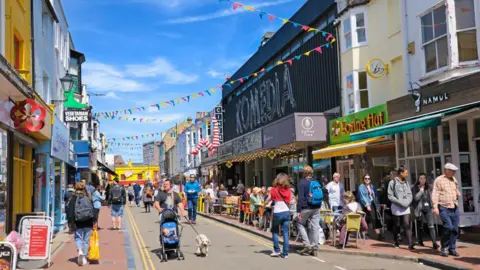
It is a vibrant, colourful part of the city, packed with hundreds of independent shops, cafes, pubs and restaurants.
But it did not always used to be this way.
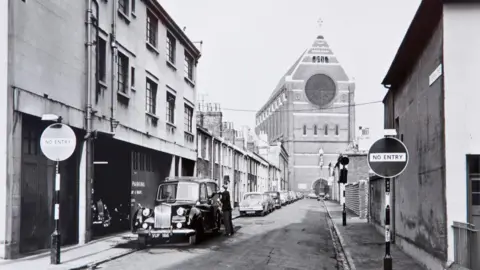
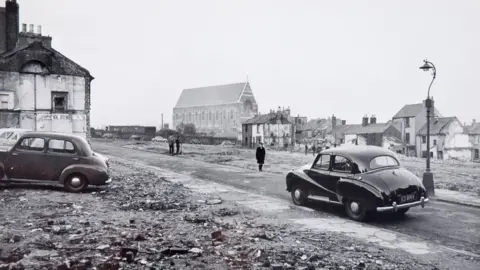
"The area was very rundown after the Second World War," said Sue Delafons, chair of the North Laine Community Association (NLCA).
"The houses were in a bad way - some had trees growing out of them. A lot of the industry there had closed down or moved away."
With the North Laine in a state of dilapidation, plans were mooted in the mid 1960s that could have altered the area beyond recognition.
The council had already demolished most properties around Blackman Street at the start of the 1960s after the Brighton medical officer declared them "unfit".
This area was then partially rebuilt with the construction of Theobold House in 1966 - then the tallest council block - which still towers over the North Laine today.
"Councils throughout the country were trying to deal with the shortage and poor quality of the housing stock that had been caused by bombing in the war and neglect of Victorian terraces," says the NLCA.
"Concrete buildings symbolised progress and were cheap to build - moreover, because they could be put up quickly... the tax base could be kept," it adds.
 Regency Society
Then came a shock for the area.
In 1967, the council commissioned consultants, Hugh Wilson and Lewis Womersley, to prepare a redevelopment plan for the city centre.
They proposed building an elevated motorway over the North Laine, connecting Preston Circus, north of the station, to a 1,600 space car park in central Brighton.
"It would have totally obliterated the area," Delafons told the BBC.
"That charm, magic of the North Laine would have been lost.
"It would have been skyscrapers and concrete boxes instead of the vibrant, colourful streets we know and love."
The NCLA estimates that hundreds of buildings in the area would have been cleared.
Delafons explained that at the time the mood in planning terms was "very much swinging towards the car".
"High-rise blocks, car parks, flyovers - that was the fashion."
 Regency Society
However, Delafons said there were still people in the area who felt strong about the North Laine.
The community began to organise and fight the plan, while the national trend went away from these "rather expensive brutalist ideas", she told the BBC.
"It's a great example of how social action can have a lasting impact".
Delafons also pointed to the "terrific" Ken Fines, who pushed to get the North Laine conservation status, which helped pave the way for this protection and eventual renewal.
"He saw its potential," she added.
The plans were eventually shelved in 1973, though Delafons said threats to the area have not "completely evaporated".
"There is still a big community there, and a good spirit that keeps it human," she said.
"But its distinctive character could be really harmed by a big development and then there is the quiet erosion due to Airbnbs."
"We shouldn't take it for granted".
 Getty Images
Brighton & Hove City councillor David McGregor said the North Laine is one of the city's greatest assets.
"I think we're all very grateful those plans in the 60s and 70s didn't go ahead," he said.
"Thankfully common sense prevailed."
He added that the local authority understood the importance of protecting its character.
"As a conservation area, a higher bar is set for new developments to ensure they're in-keeping with the area."
Airbnb has been approached for comment.
Follow BBC Sussex on Facebook, X, and Instagram and listen to BBC Radio Sussex on Sounds. Send your story ideas to southeasttoday@bbc.co.uk or WhatsApp us on 08081 002250.
