Want to get better at making decisions? Ask an ant

 Getty Images
From cocky cockroaches to self-aware flies, there's a lot we can learn from creepy crawlies about how to make better decisions. Here are five lessons from the insect world that could help you improve your choices.
We humans tend to fancy ourselves at the top of the evolutionary pyramid for our ability to think oh-so-hard. But all that deliberation sometimes doesn't get us very far. We're not infallible, and we routinely call the wrong shots.
Insects, on the other hand, despite their tiny, poppy-seed-sized brains, have a perhaps surprising amount of wisdom when it comes to decision-making. Many insect problem-solving skills have, in fact, inspired algorithms for efficient deliberation in real-world human industries.
Here are five things we can learn from bugs about making wise choices.
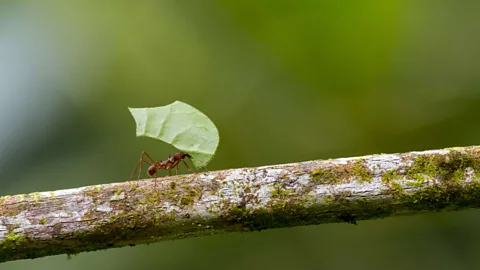
1. Optimising ants
Making your mind up on the best way to get something done is no easy task – especially in a world with so much stimuli. It's called choice overload.
Ants, too, are faced with such a conundrum when they are making a group decision about their next foraging spot. But they've evolved a neat trick, common across a variety of different species.
At first, several ants leave the comfort of their nest, questing to find the closest and best place for a hearty meal. The adventurous ants go out into the wild at random, keeping all their options open and exploring different paths. Along the way and back, they leave a faint pheromone trail on the ground for other ants to follow later on. These pheromones evaporate over time, and ants are more likely to follow the strongest trail.
The ants that find the most efficient foraging spot get back faster with the food, and trace over their pheromone trail before it evaporates completely. They also pass the relay more quickly to any following ants going out to forage. This means that over time, more ants tend to go back and forth along that path, leaving more cumulative pheromone, making the trail smell stronger.
The objectively shorter pathways are therefore reinforced over time, while the others fade away. In the end, the colony collectively finds the shortest and most efficient path without any one ant specifically knowing it was theirs.
"The main lesson… is that efficient collective decision-making can emerge without centralised control," says Marco Dorigo, co-director of the artificial intelligence lab of the Université Libre de Bruxelles, in Belgium. "[Ants are] simple individuals with limited capabilities and only local information, yet they are able to collectively solve complex coordination problems."
This system – dubbed the ant colony optimisation method – has actually been turned into an algorithm for improving human scheduling, telecommunications, transport and logistics across the world. Experts have used ant optimisation algorithms for railway planning, for instance, and Dorigo developed AntNET, a system to efficiently move information around within communication networks.
 Getty Images
2. Democratic honeybees
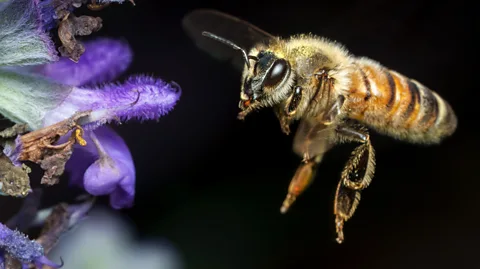
Honeybees use a method very similar to ants' optimised foraging when it comes to finding their new nesting spot.
Several scout bees fly out and look for options at random, like ants. But instead of leaving trails of pheromones, they come back to the nest and directly communicate their preferences. They do a waggle dance for their nest mates, rhythmically shaking their bodies to convey whether they think the new site has what it takes: how safe it is, how close, how large, how well-positioned. The better the nest site, the longer and more vigorous the dancing.
The waggle dance also describes the exact location – how far to go and in what direction the nest mates need to fly – and another round of bees is then sent out to corroborate these findings. When they return they give their verdict in dance, too, either supporting their predecessors or offering new options.
Over time, a preferred location naturally emerges: a couple of dozen bees return from their expedition with positive dances for the same place. They reach a quorum, and they move accordingly from there, like in a human democracy.
3. Neutral locusts
Getting people to change their minds is hard, especially when a group is split between two options. The debate can quickly descend into a stark black-or-white binary, leaving everyone feeling even more entrenched in their ways.
Fortunately, a recent study on locusts points to a way out of this common bind.
Marching locusts are locusts so juvenile they still don't know how to fly, so they march instead. In his experiment, Christian (Kit) Yates*, professor of mathematical biology at the University of Bath, UK, put groups of them in a ring-shaped arena to observe how they collectively decide which direction to go. He realised they routinely flip-flop direction, after a moment of stalling.
It turns out that it is this fleeting moment of suspension – when more and more locusts stop marching and become neutral – that helps the swarm break out of one consensus and switch to the other.
In the experiment, Yates also tested 19 humans with a similar task: he ran a game where participants could choose between X and Y, or abstain. Like the locusts, they found that when people had the option to abstain, it helped the group reach a consensus – just X or just Y – more "quickly and cleanly" than when they didn't, says Yates.
That's because, Yates explains, in a large and highly engaged group, lots of small, independent influences average out, so the overarching direction is hard to budge. But if many individuals become neutral, even just for a moment, the group of decision-makers shrinks.
"With fewer active votes in play, the same small nudge – a brief local cluster moving the other way, a noisy bit of information, a couple of people switching allegiance – produces a larger proportional effect on the group's direction," says Yates.
Ultimately, locusts teach us that neutrality can create the necessary pause for everybody to reassess and reach a consensus, says Yates. The takeaway? If you want to overturn the status quo, don't worry about the indecisive – encourage more people to be so.
 Getty Images
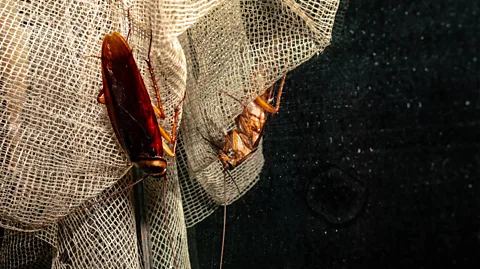
4. Cockroaches with personality
It's especially hard to reach group conclusions when there are a lot of strong personalities in the debate. Many people with "main character energy" can steer the debate their way, trumping the collective.
But a study with cockroaches suggests that strong individual personalities among a group can actually speed up decision-making.
Some cockroaches are bold, while others are timid. So Isaac Planas-Sitjà, assistant professor at the Tokyo Metropolitan University in Japan, ran computer simulations of how cockroaches aggregate – one that mimics, for instance, how they hide in a specific dark corner behind a fridge. He tweaked the system to include no personality differences, some personality differences and, finally, a lot of personality differences.
It turns out that the models where every cockroach behaved exactly the same couldn't even get close to what cockroach decision-making is like in the real world. Groups with a lot of personality variation, on the other hand, made collective decisions faster – because they had more social interactions.
"I was very surprised. I expected to see some trend, but not such a clear and repeatable pattern," says Planas-Sitjà.
It means that cockroach groups with only bold or explorer individuals will find it more difficult to aggregate and choose a suitable shelter because they move too much, he says. And while groups with too many shy individuals may settle fast, they risk choosing a poor shelter.
"It is the fine-tuning between the degree of cooperation and behavioural diversity that ultimately drives collective intelligence," says Planas-Sitjà. "If personality matters in these small animals, we can imagine the impact it can have on animals living in societies with additional layers of social complexity."
5. Reflective flies
Sometimes we mute our gut feelings to make decisions we think are logical, even if they feel wrong on a visceral level. Other times, we follow our deep convictions about something without learning from our mistakes.
Fruit flies, it turns out, could teach us a lot about being more self-aware in our deliberations.
Research shows fruit flies are extremely perceptive in how they integrate external and internal information to shape their every move. When choosing between two odours, for example, the more similar the scents, the longer the flies hesitate, as if they're tallying the pros and cons.
When faced with a nice-tasting but unnutritious reward, or a bitter-tasting but nutritious sugary substance, flies can compute the net value of that choice and white-knuckle through the unpleasant-tasting food in return for nutrition.
More like this:
They're also more likely to go for a small reward that's a safe bet, rather than a hefty reward if it comes with a threat – that is, unless they're very hungry, or stressed. When trained with positive odour and reward, or negative odour and reward, healthy flies are often happy to approach an ambiguous odour and see what comes from it, while stressed flies are more prone to not risking it.
Like flies, sometimes our internal states cloud our judgment. But they also remind us that these gut feelings and learned experiences – made up of a kaleidoscope of tiny fragments of perceptions we're constantly having about ourselves and others – can sometimes help us exercise good judgement.
--
*Christian (Kit) Yates, professor of mathematical biology at the University of Bath, UK, is also a freelance mathematics feature writer for BBC.com.
--
If you liked this story, sign up for The Essential List newsletter – a handpicked selection of features, videos and can't-miss news, delivered to your inbox twice a week.
