Cats, condoms and licence plates: The sharks that will eat anything

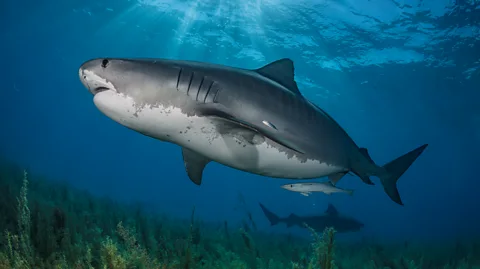 Hannes Klostermann/ Ocean Image Bank
From antelopes to TVs, tiger sharks are far from picky eaters and will even brave hurricanes for a feast. Luckily, their extreme diet has upsides for others too.
The size of a small bus yet streamlined like a torpedo, and with an immensely powerful bite force, tiger sharks are one of the world's largest predatory sharks.
They are the "tanks" of the sea, says Neil Hammerschlag, lead researcher at the Marine Biodiversity Observation Network. Plus, they boast the widest diet of all shark species, earning them the nickname the "garbage cans of the ocean".
They will chow down on molluscs, stingrays, sea snakes, seals, squids and whales. They gobble up seabirds and land animals. Mole-rats, antelopes, dogs, goats and cats have turned up in their stomachs. One poor shark regurgitated one of Australia's spikiest inhabitants, an echidna. Perhaps its spines were too tickly.
Human rubbish is also on the menu: crisp packets, condoms, cigarettes,licence plates, tyres,TVs – even, reportedly, a full suit of armour.
As are humans. Together with great whites and bull sharks, tiger sharks are known as one of the world's "Big Three" most dangerous shark species – although you are much more likely to be carried away by a rip tide or struck by lightning.
They will even swim into the eye of a hurricane if it means they'll get a good meal. But their stomachs of steel have an upside for others too.
By scavenging, tiger sharks clear away dead and dying creatures in the food chain. In doing so, they help maintain the health of the seas.
The hurricane clean-up crew
When a storm is approaching, many "sharks detect the change in barometric pressure and move to deeper, less affected waters", says Phil Doherty, a lecturer in marine conservation science at Exeter University.
Tiger sharks, though, seem to turn up in anticipation of a feast – and stick around to "scavenge on animals that have died".
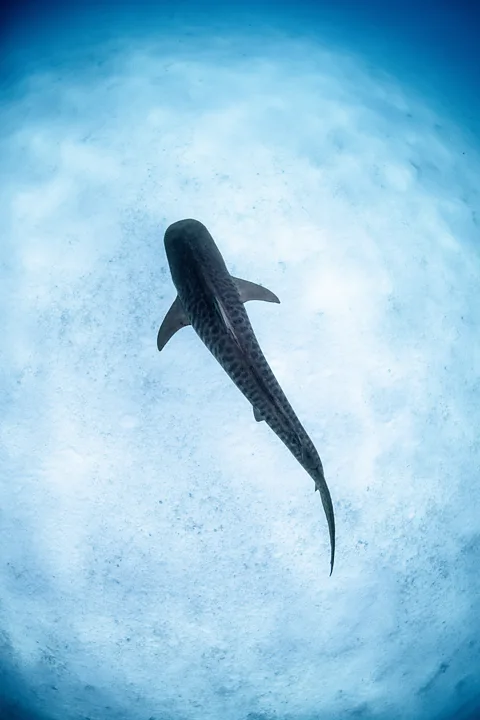 Dani Escayola/ Ocean Image Bank
This was something Hammerschlag was able to track in detail when, on 6 October 2016, Hurricane Matthew swept through The Bahamas.
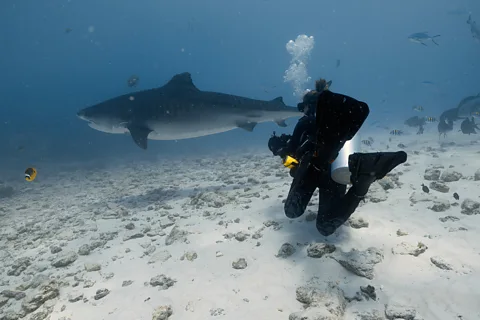
Tiger Beach – a large sandbank off the coast of Grand Bahama – is a popular dive spot, famous for its tiger sharks. Sandy flats are dotted with patches of seagrass and coral, and the clear, warm water is full of tiger sharks that are "longer than the water is deep", Hammerschlag says.
When the hurricane struck, the tiger sharks remained in shallow inshore waters – even as the site received a direct hit from the category-5 hurricane. And, by the time the storm had passed, the number of tiger sharks in the area had doubled.
Tiger sharks are ectothermic, or cold-blooded, says Hammerschlag, meaning they can't create their own heat. Their movements, therefore, tend to follow a layer of water, called an isotherm, at 26C (78.8F) – the same temperature at which a tropical cyclone can begin to form.
When pregnant, some tiger sharks even take refuge in the balmy waters of Tiger Beach – relying on the environment around them to "warm the bun in the oven", says Hammershlag.
Hammerschlag and his team had previously attached acoustic tags to the Tiger Beach tiger sharks to study the impact of tourism on the animals. The tags keep transmitting for 10 years so, in 2016, Hammerschlag saw an opportunity to study the sharks' reaction to Hurricane Matthew.
"My prevailing thought was that they would all flee," says Hammerschlag. "In shallow water, you get boulders flying, the seabed all stirred up. You see sharks, manatees…thrown onto the beach. But deeper water is not disturbed. Deep water provides a refuge from the storm."
 William Tan
Previous studies back up this assumption, showing that many sharks tend to leave coastal areas when a storm is imminent, and some species leave more than a week before one arrives.
Yet when Hammerschlag and his team tracked the tiger sharks before, during and after the hurricane, "I was shocked", he says. "Not only did they not flee, but on the very same day more tiger sharks arrived.
"The storm killed a lot of things: turtles, fish, lobsters, crabs, birds. We think the tiger sharks saw the coming storm as a scavenging opportunity to feed on the dead and dying."
Hammerschlag believes the tiger sharks were able to remain in the area during the storm because, he says, "they are built like tanks".
A fearsome maintenance squad
Tiger sharks have also learnt to take advantage of seasonal events, when they know there will be an abundance of food.
Take green turtle breeding season at Raine Island, Australia, for instance, or the summer fledging of albatross chicks at French Frigate Shoals atoll, Hawaii. The sharks time their arrival to coincide with a glut of easy prey – sometimes turning up at the same spot on the same day in consecutive years.
More like this:
They will often travel long distances to reach that prey, routinely travelling more than 4,600 miles (7,500km) on their annual round-trip journey from tropical coral reefs to the open waters of the mid-North Atlantic, and back again. One tiger shark even travelled an astonishing 27,340 miles (44,000km) as it completed a three-year circuit around the Atlantic.
When they reach a favourite feeding ground, tiger sharks save their energy wherever possible. At Raine Island, they prefer to scavenge on dead and dying turtles rather than actively hunt healthy individuals.
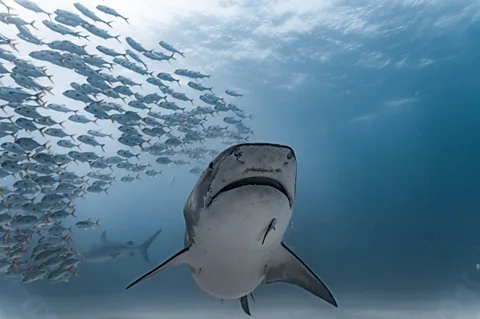 Carlos Diaz/ Ocean Image Bank
This might sound like the stuff of nightmares for weakened turtles but, in doing this, the sharks prevent disease from spreading. Plus, by keeping turtle numbers in check, they protect seagrass from overgrazing – a crucial habitat for many marine species.
Natasha Marosi, a researcher at the University of Exeter, UK, and founder of the Fiji Shark Lab, regularly spends time getting to know the tiger sharks that frequent the seas around Fiji. Despite their fearsome reputation, she says, these sharks have personality.
Of her many encounters with these hardy sharks, Marosi says they leave her with a variety of feelings – from unsettled to awe struck.
"The individuals I have encountered have been uniquely different and exhibited different behaviours." A young female named Tsunami, she says, "is all sass and fire", while another named Apolonia channels "vulnerability and a warrior spirit simultaneously".
Similar stories come from the Bahamas, too, with divers observing that some of the Tiger Beach tiger sharks appear bold, while some seem shy. "I love spending time in the water surrounded by these extremely large apex predators," says Hammerschlag, whose previous research shows these sharks have complex social lives, and even favourite friends.
So, perhaps there is a softer side to these tanks of the ocean. While their diet is virtually limitless, tiger sharks are no mindless eating machines. And what's more, says Marosi, they play a vital role as apex predators in marine ecosystems.
"From their top-down control vantage point, they can influence the distribution, behaviour and abundance of other species within the food web." Tiger sharks' extreme diet, she says, keeps life in the ocean in balance.
--
For essential climate news and hopeful developments to your inbox, sign up to the Future Earth newsletter, while The Essential List delivers a handpicked selection of features and insights twice a week.
