Why the French are painting their windows with chalk to beat the heat

 Getty Images
A simple, low-tech remedy may help cool homes. Here's the science behind the trend.
As record-breaking heat sweeps over France, some shops are running out of a simple, cheap and unexpected product – crushed chalk.
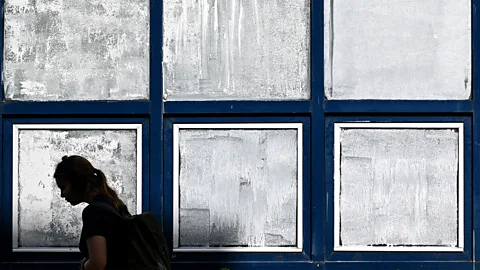
Known as Blanc de Meudon, or Meudon whiting, it is normally used to make paints or as a cleaning product. But faced with punishing temperatures, there are reports that ingenious people have been using the chalky material as a home remedy against the heat, covering windows in schools and private homes.
Mixed with water, then painted on glass, the result is a milky, whitish coating that lets in some light but reflects the heat. And a growing body of research suggests that there may be some solid science behind the DIY cooling hack.
With heatwaves growing ever more frequent and intense due to rising global temperatures – and posing a particular danger to populations in cities – could a simple lick of white paint help people cope better when it hots up?
Radiative cooling
White paint – on walls and roofs, usually – is widely known to have a cooling effect. Generally speaking, white surfaces reflect sunlight and heat, while dark surfaces absorb it. This principle can be used to cool buildings and cities. Commercially available white paint on a surface can reduce temperatures on the other side by at least 1.7C (3F) compared to the ambient temperature at noon.
Paints specially developed to maximise cooling, such as ultra-white paint, have been shown to reduce the indoor temperature by several degrees by not only reflecting sunlight but also shedding heat through a process know as "radiative cooling".
One study on a form of ultra-white paint by researchers at Purdue University in Indiana, US, found it could reflect up to 98.1% of sunlight, while typical white paint reflects about 85% of sunlight. Another study showed that combining it with a layer of ultra-black paint underneath could lower daytime temperatures by up to 7.6C (14F).
One of the reasons why chalk might be effective, however, lies in the properties of its main component, calcium carbonate (CaCO3), which is not only highly reflective but also resistant to solar radiation.
"Chalk is mostly CaCO3," says Xiangyu Li, a researcher at the Cooling Technologies Research Centre at Purdue University. "It absorbs very little sunlight, including the visible range, which makes it white. Additionally, it does not absorb UV and very little near infrared light, making it a great option for reflect all of the sunlight."
This property has led some researchers to use nanoparticles of calcium carbonate in new kinds of "super cool" paint.
"These kinds of particles are widely used in radiative cooling paint, also in our super cool paint," says Jiashuo Wang, a student at the University of New South Wales in Sydney, Australia, who is part of a team also working on cooling paint.
Chalk has also been used as a coating for fabric that keeps the wearer cool. Particles of calcium carbonate – the main ingredient in chalk – are good at reflecting ultraviolet and near-infrared light (the portion of sunlight that transmits heat).
In addition, chalk is considered to be relatively benign in terms of its health and environmental impact – though there may be some risks to respiratory health from indoor chalk use, and inhaling particles.
 Getty Images
White windows and 'le cool roofing'
According to French media reports, demand for Blanc de Meudon is leading to stock shortages around the country as people struggle against temperatures of more than 40C (104F).
Blanc de Meudon is traditionally used to whiten shop windows during renovations or by gardeners in their greenhouses. But after the chalk-paint trick circulated on social media, demand for the product soared, French newspapers report.
"We'd known about the idea for a while, we talked about it during the last heatwave but forgot to buy any," Ouest France quotes a shopper called Philippe. "Now it's too late! It's sold out everywhere!"
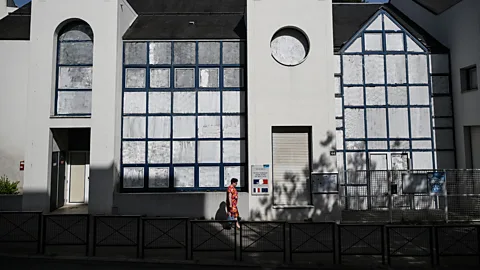
Some French schools have also used the chalk paint on their windows, though an official warned that it's "not a miracle solution" and that properly insulated roofs are needed instead.
People have also whitened the windows of their apartments.
"If the windows are painted white, it will significantly reduce the indoor temperature, with stonger effects compared to walls," says Li.
The chalk, as well as white paint more generally, is cheap. And unlike air conditioning, which worsens the overall heat effect and emissions problem by consuming energy and releasing heat outside, paint only uses energy when it's produced.
More like this:
White-painted cool roofs – also known as "le cool roofing" in France – are also getting moreattention there as a sustainable, low-tech way of combating extreme heat. The idea taps into a long tradition in many southern parts of Europe, such as Greece, of painting houses white to ward off the heat.
One study suggests that cool roofs – roofs painted white or with reflective coating – could have cooled London "by about 0.8C (1.4F) on average during a heatwave, preventing the heat-related deaths of an estimated 249 people". (Read abouthow women in India are using white paint to cool their homes.)
For those interested in another home remedy, there is an alternative: yoghurt. An experiment by researchers in the UK found that the indoor temperature of a house with yoghurt-painted windows was on average 0.6C (1.08F) cooler. They found that a thin film of the dairy product could lead to rooms being up to 3.5C (6.3F) cooler when it was "hot and sunny". While a smelly solution at first, the odour apparently disappears quickly as the yoghurt paint dries.
--
For essential climate news and hopeful developments to your inbox, sign up to the Future Earth newsletter, while The Essential List delivers a handpicked selection of features and insights twice a week.
