Researchers say they may have just found Amelia Earhart’s long-lost plane – experts aren’t convinced

 Getty Images
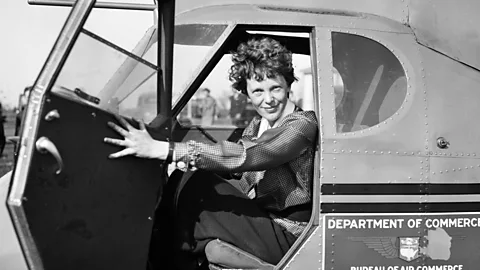
Claims that a recent undersea discovery may be Amelia Earhart’s long-lost aeroplane raise questions. Experts weigh in on the mystery that continues to captivate us.
Researchers believe they may have found aviator Amelia Earhart's long-lost plane. Sonar imaging, which maps the ocean floor using sound waves, just led researchers to what they claim is a small aircraft. The discovery was made at around 4,877m (16,000ft) from the surface of the Pacific Ocean.
The team has claimed via social media that they have reason to believe this could be the Lockheed 10-E Electra that went missing 87 years ago, when Earhart and her co-pilot Fred Noonan attempted to fly around the world.
Footage of the undersea expedition was shared by Deep Sea Vision, an ocean exploration company, in a post on Instagram on 27 January. "Deep Sea Vision scanned more than 5,200 square miles of ocean floor with a 16-person crew and the Kongsberg Discovery HUGIN 6000, the most advanced unmanned underwater drone, before finding what could be the legendary American aviator's Lockheed 10-E Electra," the organisation wrote in a video caption of the crew's exploration.
The mystery of what happened to Amelia Earhart’s plane has baffled researchers for decades, while managing to still capture public interest. A 2017 History Channel documentary explored one captivating theory: that Earhart and Noonan survived the crash, landed in the Marshall Islands and were taken captive by the Japanese. The documentary also implies that the US government knew what happened to the aviators all along.
One opinion is that Earhart's plane crashed when it ran out of fuel near Howland Island. Dorothy Cochrane, the Aeronautics Department curator at the Smithsonian National Air and Space Museum in Washington DC, holds this view. She told the BBC that, "Given the strength of her radio call to the USCG Itasca, waiting at Howland Island, Amelia Earhart and Fred Noonan were not far from the island." Earhart stated, "We must be on you…" before her demise, said Cochrane. "It seems that tragically they could not find the tiny island before they had to ditch the Electra into the Pacific Ocean," she added.
While Cochrane feels fairly certain about what happened to Earhart, she’s not sold that the latest discovery is her plane, given the only evidence so far is a sonar image. "Photographing the object would greatly assist in identifying it further," Cochrane said. "I am encouraged that DSV is searching near Howland Island and believe they would like to make another expedition to conduct more research."
Richard Jantz, professor emeritus of anthropology and director emeritus at the University of Tennessee, Knoxville's Forensic Anthropology Center, believes he knows what happened to Earhart. In 2018, he re-examined seven bone measurements conducted in 1940 by physician DW Hoodless, who had believed the bones belonged to a man. Using Fordisc, a far more modern computer programme, Jantz found that crucial errors had been made. He also noted in the study, "There was suspicion at the time that the bones could be the remains of Amelia Earhart."
His findings revealed that the bones were more similar to Earhart’s than 99 percent of individuals in a large reference sample. If the bones did, in fact, belong to Earhart, that would mean she died on the island of Nikumaroro, where they were discovered, which is about 640km south of Howland. Jantz tells the BBC that his views haven't changed with the new discovery. "In order for the Nikumaroro hypothesis to be disproven that aeroplane would have to be positively identified as Earhart’s Electra," he says. "That has not yet happened, and until it does there is no point in speculating about an Earhart connection."
 Alamy
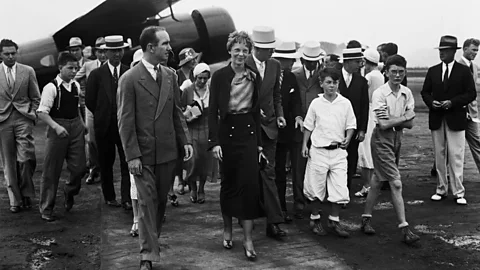
AlamyRichard Gillespie, founder of The International Group for Historic Aircraft Recovery, also supports the Nikumaroro theory. Gillespie has led 12 expeditions searching for Earhart's plane and has written several books on the subject. He calls himself the "leading authority" on what happened to the aviator and told the BBC, "We know what happened. We have abundant evidence" that she died on Nikumaroro.
He also asserts that the latest discovery simply cannot be Earhart’s plane. "It is definitely not the Lockheed Electra and it's not just me that thinks so," he said. "Any sonar expert will tell you that one grainy image doesn't tell you anything." He added that if the image is of a plane, it doesn’t resemble Earhart's – the wings aren't "swept back". He said it more closely resembles a US Navy fighter jet.
Still, plenty of people are happy to go along with the mystery. Earhart's story has captivated the world for the better part of a century, and should the plane turn out to be hers, Cochrane is just one person who would be thrilled. "I'll be delighted when the Electra is found and the mystery is finally solved," she said.
--
If you liked this story, sign up for The Essential List newsletter – a handpicked selection of features, videos and can't-miss news delivered to your inbox every Friday.
