Umber: The colour of debauchery

 Wikimedia
The umber pigment was first made from Italian soil. Kelly Grovier looks at how a shade of brown came to depict sinfulness and shadow.
Umber is a conundrum, a rusty riddle of a colour. A cross between the deep redness of blood and the blasé blandness of mud, umber is a havering hue with a haunting humidity all its own. Umber’s ability to ebb and flow between shades of our interior self and those of the exterior world we inhabit make it the perfect pigment for painters as diverse as Bosch and Modigliani, Titian and Velázquez, to create scenes of enduring urgency – scenes we feel as much as see. Swipe umber from the paintbox of art history and the dramatic chiaroscuro of Caravaggio’s canvases and the meditativeness of Rothko’s 1962 work Untitled (Umber, Blue, Umber, Brown) would dissolve into drabness.
More like this:
So complex a mixture is umber’s identity of the inner and outer worlds, its very name (originally in Italian ‘terra d’ombra’, or ‘earth of shadows’) is pulled in two directions. Some maintain the word is merely an echo of an actual location, Umbria, the mountainous region of central Italy where, sometime in the 15th Century, the pigment was first professionally concocted from soil rich in manganese and iron oxide.
Others contend that the colour’s name is less a geographical allusion and more a mystical designation inspired by the spiritual depths that the pigment enables artists to plumb, one that owes its origin instead to the Latin ‘umbra’, meaning ‘shadow’. If we mix the two hypotheses together, we discover perhaps something closer to the truth: a paradoxical shadow-land of a hue, one that binds into a single substance the material grittiness of this world and the immaterial gloom of one that lies just beyond our perception.
 Alamy
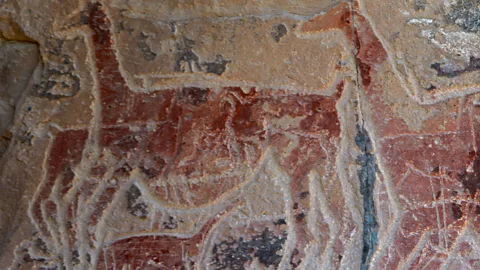
AlamyThe use of umber by artists dates back to our earliest image-making ancestors who smeared soil on cave walls as a suitable approximation for the auburn fur of beasts. Flash forward a few millennia, from the neolithic age to the cusp of the Renaissance, and umber begins to come into its own as a subtle aesthetic force – adding a ruddy depth to more garish pigments when combined on the artist’s palette.
Down to earth
Reacting against the naiveté of simplistic perspective and the crispness of colours often found in Medieval altars and icons, artists began to experiment with more realistic figurative proportions as well as with greater complexities of pigment, adding earth-tones such as umber and sienna (which hailed from an adjoining province), in both their raw and burnt forms, to their inventories. Without a rich assortment of browns to keep things rooted and real, Humanism might never have got off the ground.
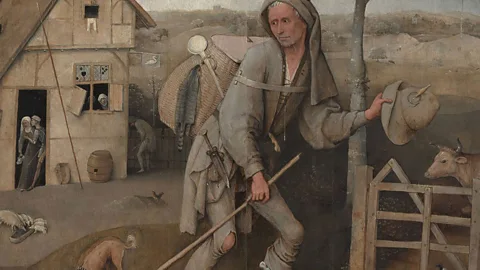
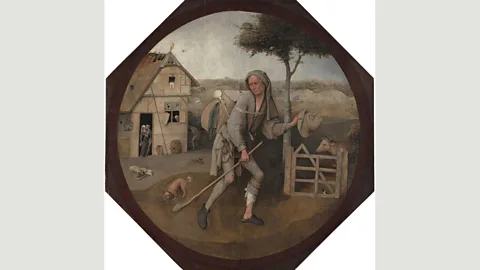
Years before Hieronymus Bosch began work on the carnal carnival of colours for which he would be most remembered, his famous triptych The Garden of Earthly Delights (1503-1515), the Early Netherlandish master would find himself seduced by the shabby solemnity of umber. Bosch’s teasing tondo (or round painting) The Wayfarer, undertaken around 1500, captures a limping pedlar, overburdened by the wares and weariness of this world.
 Wikimedia
Although the laden figure appears to be heading for a gate that leads to pastoral purity, he looks back in the direction of a squalid house of sin behind him. This structure, from which he may have recently emerged, relies for its sense of shadiness on an admixture of shadowy umber and sickly, syphilitic ochre. Caught between the temptations of the flesh and spirit, Bosch’s subject is forever halted in his progress towards salvation by the lures of a debauched world – a paralysis intensified by the pallid gloom of umber that shadows him.
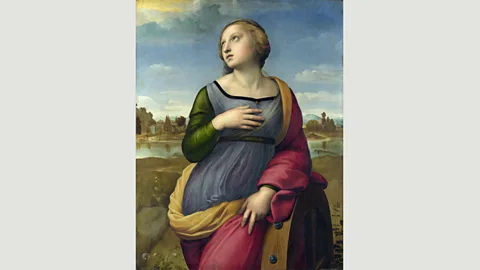
Soon after Bosch created his allegory, umber can be found unsettling the ambience of another Renaissance masterpiece, this time at the orchestration of the Italian prodigy Raphael, then in his early 20s. Raphael’s oil-on-wood portrait of Catherine of Alexandria, completed around 1507, depicts the 4th-Century Christian martyr leaning against a wooden ‘execution wheel’ – a bone-crushing torture device to which Catherine had been sentenced after refusing the advances of the Roman Emperor Maxentius. According to legend, the implement, also known as a ‘breaking wheel’, broke the instant Catherine touched it.
 Wikimedia
Catherine’s ecstatic gaze upwards is intended to fix our focus on the promise of heaven hinted at in the gleaming clouds above her, but our eyes cannot help drifting back to earth and to that brutal wheel against which she strikes a strangely casual pose. Raphael has carefully fashioned the horrendous hoop’s wood grain from a sophisticated cocktail of yellow, azurite and vermillion. But it is the secret ingredient of umber – newly introduced into the artist’s palette – that keeps both the wheel (forever about to shatter into splinters at Catherine’s touch) and the painting itself, grounded and real. The umber wheel is what helps the painting navigate its course through the shadowy realms of suffering and faith.
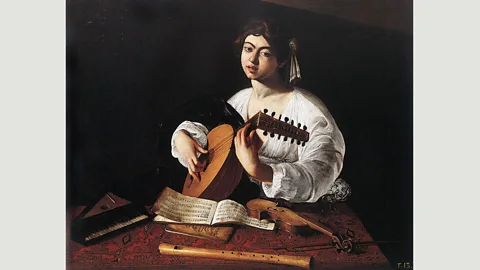
By the end of the 16th Century, umber was no longer content to play merely a supporting role in paintings, and began to emerge from the shadows to define shadows utterly and in its own right. Caravaggio’s high-contrast canvases, for example, where the drama of dimly-lit interiors is articulated by the gutter of an unseen candle that flickers somewhere outside the frame, would not be possible without the artist’s wholesale reliance on the profound power of umber.
 Wikimedia
The young musician in The Lute Player (1596), for instance, which the artist believed was “the best piece that he ever painted”, plucks himself into melodious existence against an umbral abyss echoing behind him. Here, the heaviness of umber’s encroachment, intensified by carbon black, threatens to engulf the lutist, yet is held in eternal abeyance by music’s mystical light.
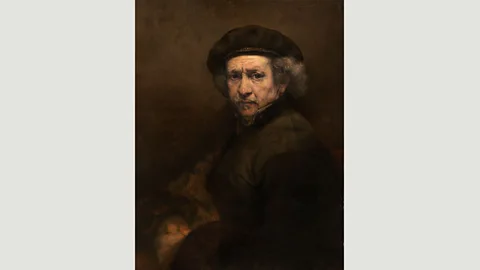
In the centuries since Caravaggio steeped his subjects in umber, no artist would experiment with its moving metaphysics more profoundly than Rembrandt. Umber is the inexhaustible bog from which the 17th-Century Dutch master dredged the faces and stares of those who sat for his soulful portraits.
 Wikimedia
Rembrandt’s incessant self-portraiture, moreover, is itself a ceaseless churning of earthiness and shadow, made possible by the potency of umber as a colour that can conjure simultaneously the fleetingness of flesh and durability of spirit.
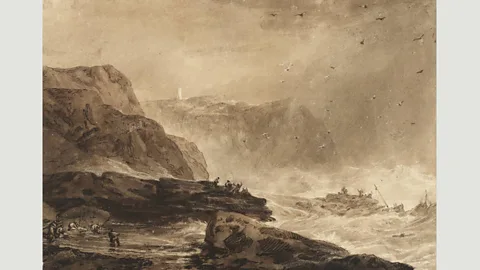
For the lyrical landscape artists of the ensuing 18th and 19th Centuries, and particularly for the Romantic visionaries J M W Turner and John Constable, umber would come to dominate the foregrounds of scenes that feel as if they depict as much an aspect of mind as an actual spot of time and place. Though historians might wear themselves out parsing the relative achievement of these rivals, they share a reverence for the rituals of umber.
 Wikimedia
The affecting pencil-and-watercolour sketch Coast of Yorkshire (c. 1806-7), over which a wash of unadulterated umber alchemises the dramatic scene into nostalgia, is testimony to Turner’s total faith in the colour. “When we speak of the perfections of art,” Constable asserted in a lecture in 1836, “we must recollect what the materials are with which a painter contends with nature. For the light of the sun he has but patent yellow and white lead – for the darkest shades, umber or soot”. The primary colours of being in the world are recalibrated by Constable and Turner – and umber is among their number.
Umber fell from favour towards the end of the 19th Century with the arrival of an Impressionist movement allergic to the allure of sombre browns. Kept embering in the soaring branches that scrape Vincent van Gogh’s anguished skyscape The Starry Night, the colour then enjoyed a resurgence in the 20th Century thanks, in part, to the earthiness of African art and tribal masks with which avant garde artists became obsessed.
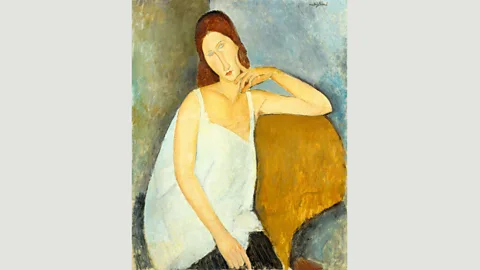
Perhaps no painting in Modern art more poignantly reasserts umber’s ability to draw us into its mysteries than Amadeo Modigliani’s haunting portrait of his lover and muse Jeanne Hébuterne, created a few months before the artist died of tubercular meningitis in January 1920. Two days later, the grief-stricken Hébuterne leapt to her own death from a fifth-story window. At first glance, Hébuterne’s own eerie eye-less glare – a disconcerting trademark of the Italian artist’s expressively inexpressive portraits – gives us the uncanny impression of staring at an empty mask, the wearer having already departed.
 Wikimedia
Bracketing the barren countenance, and determining the temperature of the space, are carefully calibrated modulations of umber traceable in Hébuterne’s umber-rich hair and in the curdling golds of the armchair, tinged by the same pigment, upon which her life-in-deathness and death-in-lifeness is precariously poised. It is umber that summons us to the strange space she inhabits – one that is neither warm nor cold, real nor imagined, remembered nor prophesied.
And if you liked this story, sign up for the weekly bbc.com features newsletter, called “If You Only Read 6 Things This Week”. A handpicked selection of stories from BBC Future, Culture, Capital and Travel, delivered to your inbox every Friday.
