The bra: An uplifting tale

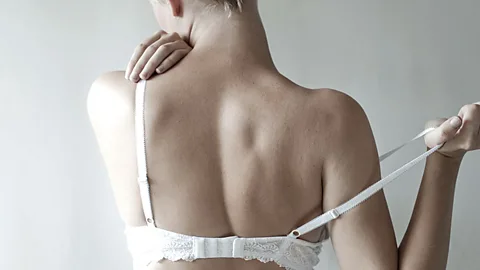
From Ancient Greece to the modern day, the brassiere has undergone many incarnations in form, function and social context. Katya Foreman sizes it up.
It’s amusing to think that in her youth, lingerie queen Chantal Thomass was anti-bra. It’s an undergarment that over the decades has fallen in and out of favour in line with changing social contexts, fashions and views on the female body. “With the advent of feminism in the 1960s we removed our bras. It was the hippie period and we’d wear T-shirts with nothing underneath, and go topless on the beach. Nobody goes topless on the beach anymore!” says the iconic red-lipped, black-bobbed French designer who in the ‘70s pioneered the concept of lingerie as a fashion accessory. “I put it on the catwalk during fashion week and that’s how it took off.”
At the time, the only place one could find sexy lingerie like garters and balcony bras was in Pigalle, Paris’s red light district, “in tacky fabrics”. Lingerie was considered functional, says Thomass, whose archive features designs from more feminine periods, such as delicate, flat styles from the 1920s and ‘30s in “exquisite colour mixes, fabrics and embroideries”. “Back then you could do beautiful handmade designs, today it’s too expensive,” laments the designer who regards the tradition of “breast support” and dressing or showcasing the breasts as “part of our patrimony”. “In Europe the tradition stretches back to the Middle Ages, though to varying degrees – supporting the breasts, for sure, has always been part of our culture,” Thomass tells BBC Culture. “It only really hits me when I travel to Asia where they have no bra culture, and see how fascinated they are by the undergarment. In the 19th Century in Asia women still [wrapped fabric around] their breasts; they have never worn bras, it’s completely new over there.”
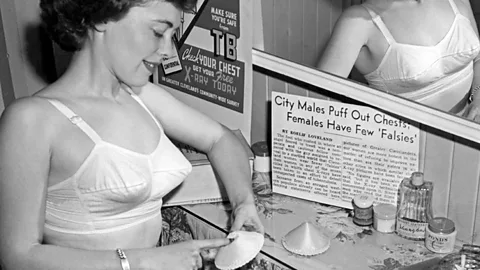
The bra – short for the French word brassiere, literally 'bodice, child's vest' – is complex in fabrication. Early designs – often bulky, elaborate contraptions, or “boulder holders”, to borrow a phrase from Bette Midler’s satirical song Otto Titsling – were worlds away from today’s sophisticated, high-tech, high-stretch bras. An excerpt from the book Uplift: The Bra in America describes the scene back in the 1930s, the decade in which the large-scale production of bras began. “Mature customers and women of all ages with large pendulous breasts were offered long-line brassieres, built-up backs, firm bands under the cup, wedge-shaped inserts of cloth between the cups, wide straps, power Lastex and light boning.” According to the tome, it was SH Camp and Company that pioneered the chart relating the “size and pendulousness” of breasts to letters of the alphabet, A to D (a scale that today stretches to infinity). Prior to that, “companies had relied on stretchable cups to accommodate different depths of breast”.
“It’s a highly technical garment, made of lots of tiny pieces of fabric, with so many sizes to consider for the different cups, etc. It’s a garment you wash every day, so the seams and structure need to be extremely robust. It’s very different from a piece of clothing; it’s in direct contact with the skin, it needs to be super solid,” Thomass explains, who recalls the impact Lycra had on the industry when it became big in the 1980s. “It brought new comfort and design possibilities. I had always loved Vargas’s paintings of pin-ups in underwear as the pieces looked like second skin and we were only able to do that when Lycra came along.”
It’s impossible to pinpoint when the bra was first invented, with early depictions of bra-like garments going back all the way to ancient Greece. The modern-day bra has often been presented as a successor to the corset, though the theory is sometimes challenged. During a dig at an Austrian castle in 2008, archaeologists unearthed four tattered bras remarkably similar to the undergarment’s modern form. A chicken-or-the-egg-style debate ensued.
“Evolution sometimes takes a break,” argued Beatrix Nutz, an archaeologist and researcher at the University of Innsbruck in Austria, in smithsonianmag.com. “The Greek mathematician and geographer Eratosthenes (276 BC–195 BC) knew our planet was a globe and even calculated its circumference, but throughout the Middle Ages people believed it to be a flat disc. Bras are certainly not even remotely as important as the actual shape of the earth, but they were obviously invented, went out of fashion, were forgotten, and supposed to be invented (again) in the late 19th Century.” Nutz also cited two earlier written sources referencing what could be perceived as early versions of the bra. “The French surgeon Henri de Mondeville (1260-1320) reported what women whose breasts were too large did. They ‘insert two bags in their dresses, adjusted to the breasts, fitting tight, and put them into them every morning and fasten them when possible with a matching band,’” she said, adding: “An unknown German poet of the 15th Century wrote in his satirical poem, ‘Many make two breastbags, with them she roams the streets, so that all the young men that look at her, can see her beautiful breasts.”
Storm in a D-cup
According to Colleen Hill, associate curator, accessories, at The Museum at the Fashion Institute of Technology, and organiser of the recent exhibition Exposed: A History of Lingerie, Cadolle, one of France’s oldest lingerie houses, was “certainly incredibly influential in introducing the bra as we know it today”. Indeed on its website the brand lays claim to the bra’s invention, attributing it to house founder Herminie Cadolle, “a feminist and revolutionary”. “At the end of the 19th Century, during the Belle Epoque, she chose to liberate women by liberating their bodies of the corset… She came up with this ever so small, tiny thing that today goes by the name of the bra.”
The bra in question, launched in 1889, was essentially a two-piece corset “which would have allowed for a little more freedom,” explains Hill. “As we move into the early 20th Century the bra very much corresponds to the idea of women leading more functional lives; if you’re abandoning your corset for perhaps a more flexible girdle and a separate bra, that’s something that’s not only giving you a more modern silhouette, it’s also certainly allowing you a lot more flexibility and movement and corresponds to a more modern lifestyle.”
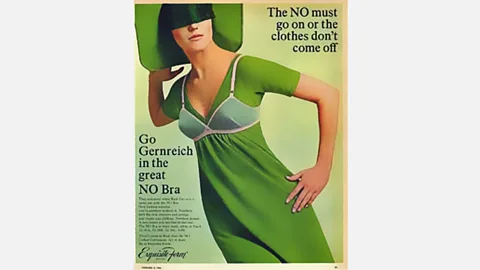
Among the most revolutionary bras, Hill points to fashion designer Rudi Gernreich’s “no-bra” bra, launched in 1964. Billed as the first sheer bra, the minimalist, unstructured design was a radical departure from the heavy, torpedo-shaped brassieres of the 1950s. While researching her show however, Hill unearthed evidence of an earlier example. “I was going through a trade magazine from the late 1940s that was focused on corsets, bras and lingerie and I found a kind of early version of a bra made from see-through fabric,” she recalls. “And the reason it stood out from the text and all of the illustrations in this fairly dense magazine was that the original owner of the magazine had circled the illustration and drawn a line up to the top of the page and written ‘Disgusting!’.”

“I had researched previously Rudi Gernreich’s ‘no-bra’ bra, and how it was a success and sales for that bra were good, it made quite a big impact and you can see that very well into the 1970s, even today, so obviously people were ready for that style in the 1960s but not so much in the 1940s… It really was about making a statement about the acceptance of women’s bodies.”
Game of cones
Thirty years later, Madonna famously re-appropriated the bra – once rejected by feminists as a symbol of repression – to express her own statement on female sexuality and empowerment. On her Blonde Ambition World Tour, the singer sported corsets with exaggerated in-built conical bras by Jean Paul Gaultier who throughout his career has played on the concept of underwear as outerwear. “It’s provocative but it’s also really sexy and playful,” says Hill. “I loved reading about Gaultier’s interest in corsets and girdles and how that relates back to his childhood when women weren’t really wearing foundation garments like that and when he saw these pieces in his grandmother’s closet, he thought they looked so antiquated and strange. The idea of changing that into an item of fashion is really quite fun.”
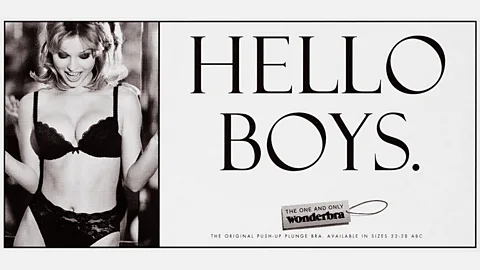
Similarly, Wonderbra’s controversial 1994 Hello Boys advertising campaign, photographed by Ellen von Unwerth and starring Eva Herzigova, her cleavage thrust into view with aid from the bra’s padding and underwire construction, played on the idea of women embracing their sexuality. The Czech-born model insisted the campaign was “empowering”, according to a report in the Evening Standard.
Whether anti- or pro-bra, the popular association between feminism and the act of burning bras is a myth, according to Hill. “It relates back to the Miss America protest in 1968. The women who were protesting the Miss America Pageant had what they called a freedom trash can in which they threw a number of things; it wasn’t exclusively bras and girdles – though those made their way in – it was also high heeled shoes and cosmetics and women’s magazines. However there was no actual burning. I think there was one person in all of history who claimed, yes, they burned them but most people say it was more of a symbolic burning; it was throwing all these things into the trash can but, because of fire codes, nothing was actually burned.” Like Thomass, who started out celebrating the freedom of going braless and ended up embracing the undergarment as the symbol of absolute femininity, perceptions continue to shift about this ever-evolving design with multiple personalities and expressions.
