'Emotion, pain and torture': The grisly American Werewolf in London scene that took horror to new extremes

 Getty Images
John Landis's horror-comedy classic was released 45 years ago, but its key sequence still astonishes – and its make-up maestro, Rick Baker, won the first Oscar in a new category.
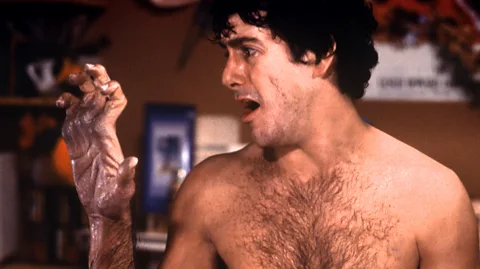
In the history of horror cinema, there are few scenes quite as jaw-dropping as the centrepiece of John Landis's An American Werewolf in London. The 1981 classic tells the story of a hapless young US tourist, David (David Naughton), who is bitten by some sort of animal while trekking across England's North York Moors. Recovering in London, he is seen transforming into the titular wolfman – and the sequence took monster movies to graphic new extremes.
Alone in his girlfriend's apartment as the full Moon blooms, David suddenly screams that he is "burning up", falls to his knees in agony, and rips his clothes off. His hands elongate, his body gets hairier, his teeth and nails sharpen, and his face twists and warps. The soundtrack is vital: David's screaming, his bones crunching, Sam Cooke singing Blue Moon. But the scene depends on the practical effects masterminded by Rick Baker, which still chill the blood and boggle the mind, 45 years after Landis's horror comedy was released in August 1981.
"It made this huge earthquake in horror films," Hector Sotomayor, professor of film studies at Ringling College of Art & Design in Sarasota, Florida tells the BBC. "There was a renaissance of make-up effects in the 1980s and that really begins with An American Werewolf in London. It established make-up as a legitimate movie art form."
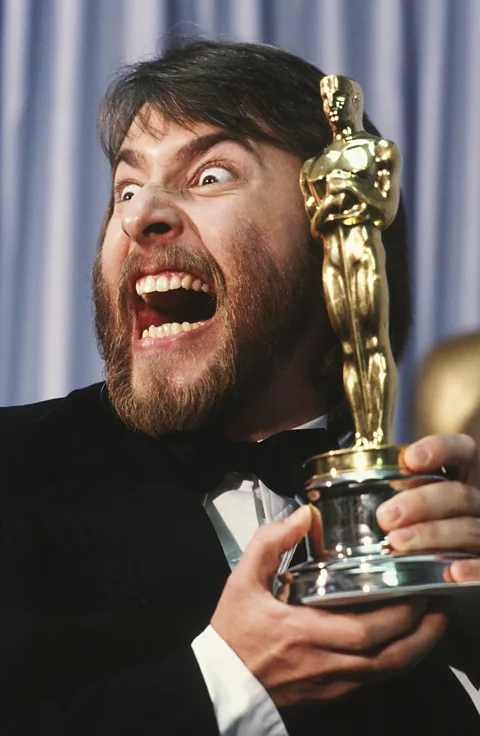
It's such a groundbreaking scene that Baker won the first ever Academy Award in a new category, best make-up and hairstyling, in 1982. Some historians even argue that the film was partly responsible for the award's creation. The Exorcist, Star Wars, and The Elephant Man had increased calls for the Academy to recognize the skills and imagination that went into hair and make-up design, says Paul Davis, author of Beware the Moon: The Story of An American Werewolf in London. "By the time An American Werewolf came along, the Academy thought, we cannot ignore this anymore."
Baker and Landis began plotting how to make an innovative transformation sequence when they were working on Landis's first film as a writer-director, 1973's Schlock, a low-budget horror comedy about a 20-million-year-old ape-man going on a rampage in southern California.
Quickly recognizing a fellow horror and monster-movie obsessive, Landis gave Baker the script for An American Werewolf in London and told him, "I want to do a transformation in bright fluorescent lighting where you see the body change. It has to be emotional and painful," says Davis.
 Getty Images
In earlier werewolf films, whenever characters like Larry Talbot (Lon Chaney Jr) in 1941's The Wolf Man became beasts, noticeable techniques like stop-trick photography – where the camera stopped, hair was added, and filming commenced again – were used. Directors also relied on slow dissolves, dim lighting, showing a silhouette of the shape-shifting – and the good old falling-down-behind-a-sofa-and-sticking-on-a-wig technique.
Landis was adamant that a more seamless and visceral transformation sequence could be created. After the huge box-office successes of The Kentucky Fried Movie (1977), National Lampoon's Animal House (1978), and The Blues Brothers (1980), Polygram Pictures finally gave him the chance to put this theory to the test. "They let him do what he wanted to do and how he wanted to do it," says Jon Spira, a film-maker who contributed a video essay on the film to Arrow Video's 2022 4K release. "By filming largely in the UK, he was away from Hollywood and people looking over his shoulder. That all feeds into the latitude and freedom that he and Rick Baker were given."
What makes the sequence so harrowing
In the eight years between Schlock and An American Werewolf in London, Baker had worked out exactly how to achieve Landis's vision. Together they created a scene where viewers not only see David transform, but feel it, too. "They really convey the emotion, pain, and torture," says Davis. "You see David's humanity being taken away from him piece by piece. For a lot of the sequence, he's still mostly human and aware of what is happening. That's what makes it so harrowing."
In the six months prior to filming, Baker used a stretchy substance named polyurethane elastomer to create fake hands, heads, legs, and a body. It was chosen because it combined the elasticity of rubber with the strength and durability of plastic. Baker also made several moulds of Naughton's face contorting in different stages of pain to be used as the scene progressed.
Inside the fake hands, four syringes with their plungers out were attached to four syringes with their plungers in. "All you did was push the plungers" to stretch and distort David’s fingers, says Davis.
 Getty Images
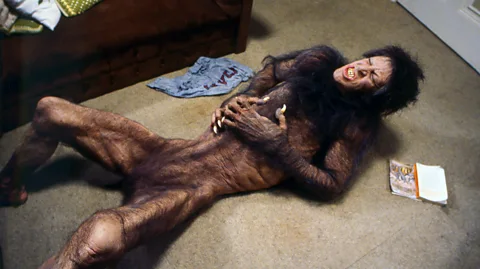
A similar process was used to stretch pneumatic bladders placed on David's back. This made it look as if vertebrae were popping up from his spine. Air made the cheeks, forehead, and nose on David's fake face morph into a werewolf's features, including a snout, while Baker and his assistants used levers to open the monster's snarling mouth.
More like this:
For the part where the lupine David is lying on the floor, Naughton was actually underneath it, with only his heavily made-up head and arms poking through. Speaking to the Morbidly Beautiful horror appreciation website in 2016, Naughton said, "I was in the make-up chair for sometimes 10 hours a day before I'd even get out on the set." The werewolf's body was then assembled around him, with Baker and his team controlling the movements of the legs and body from beneath.
"Baker combined make-up, prosthetics, animatronics, fake heads and hands," says Spira. "He's in this middle ground between make-up and special effects. That's what makes the scene so revolutionary."
It also explains why Baker won his history-making Oscar. He would go on to win the same award six more times, for the likes of The Nutty Professor, Men in Black and How the Grinch Stole Christmas. And in 1983, Michael Jackson hired Landis to direct and Baker to create the make-up for his Thriller music video. A direct homage to An American Werewolf in London, Thriller went on to become one of the most acclaimed and watched music videos of all time – and a recreation of the video is central to this year's Michael Jackson biopic, Michael.
Meanwhile, An American Werewolf in London set the blueprint for the horror-comedy genre. In the following decade, Gremlins, Evil Dead 2 and Beetlejuice blended practical horror effects with comedic sequences, while Edgar Wright said its tone and use of make-up and practical effects changed his life and set him on course to being a director.
The transformation sequence is key to the film's continuing influence and cult success. But it's more than that, says Spira. It's "the definition of movie magic and the reason why people fall in love with cinema".
--
If you liked this story, sign up for The Essential List newsletter – a handpicked selection of features, videos and can't-miss news, delivered to your inbox twice a week.
