'A hypnotic effect that fills you with joy': The incredible story of 96 Tears, the US's unlikeliest one-hit wonder

 Getty Images
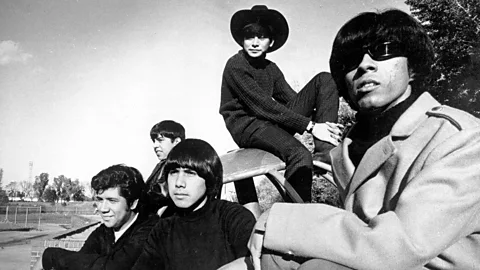
In 1966, a Mexican-American teen band made one of the great smash-hit singles and helped invent garage rock, a genre that has inspired artists for decades.
The strangest song to hit number one on the Billboard Hot 100 in 1966 wasn't 96 Tears by ? and the Mysterians. It was probably Staff Sergeant Barry Sadler's pro-war dirge The Ballad of the Green Berets or perhaps the New Vaudeville Band's bassoon-driven music hall pastiche Winchester Cathedral.
But 96 Tears was certainly the unlikeliest number one: an ultra-lo-fi wig-out of a debut from a group of Tejano teens from small town mid-Michigan, recorded in a home studio for a tiny Tex Mex music label. "We were kids," guitarist Bobby Balderrama told the Two Guys Talking About Records podcast. "I'd be walking down the hall and people would say, 'There's that guy with the hit record,' and I kept thinking, 'Are they talking about somebody else?'"
In contrast to Adler's and the New Vaudeville Band's efforts, 96 Tears wasn't a novelty song. It was a deadly serious two-minute tale of adolescent heartbreak and bitterness, delivered by a too-cool-for-school singer over a groovy haunted-house organ riff. There were no gimmicks or tie-ins that aided its ascent.
Instead, it was a steady-rising, radio-driven, honest-to-goodness pop smash. Released 60 years ago this summer, 96 Tears spent nine weeks in the US top 10 and one week at number one. It ended 1966 as Billboard's second best-charting single of the year, behind only the Mamas and the Papas' California Dreamin', and beating all-time classics from The Four Tops, The Supremes, The Rolling Stones and The Beatles.
It was also, by most people's definition, a total one-hit wonder: a follow-up single and debut album reached 22 and 66 respectively, but the band's second LP and subsequent singles went nowhere. By 1969, before its youngest members had finished school, ? and the Mysterians had split up.
Yet 96 Tears had a second life, as a founding text of garage rock and a set-list staple for countless other back-to-basics basement bands. Punk magazine founder Legs McNeil called it "a safe candidate for first punk rock song ever". In 2003, a panel assembled by Mojo magazine ranked 96 Tears eighth in its list of the greatest jukebox singles of all time.
The birth of garage rock
"Garage rock only came to be defined as a genre well after the original bands, like ? and the Mysterians, had mostly disappeared," ethnomusicologist José Vicente Neglia tells the BBC. In the early 70s, weary of rock's excesses, critics began retrospectively championing simpler sounds from forgotten regional guitar acts. Inspired by the British Invasion, hundreds of these bands had sprung up across the US in the mid-60s, playing rough-and-ready takes on contemporary pop and R&B. Some cut singles and achieved local renown via AM radio stations. And a few of these singles, like Louie Louie by the Kingsmen, crossed over and became national hits.
The apex of this wave of garage one-hit wonders was 1966, with top 10s for the Count Five's Psychotic Reaction, Syndicate of Sound's Little Girl and the Shadows of Knight's take on Gloria, and a handful of garage-adjacent number ones. But even bare-bones chart-toppers like Tommy James and the Shondells' Hanky Panky sounded slickly professional compared to 96 Tears.
 Alamy
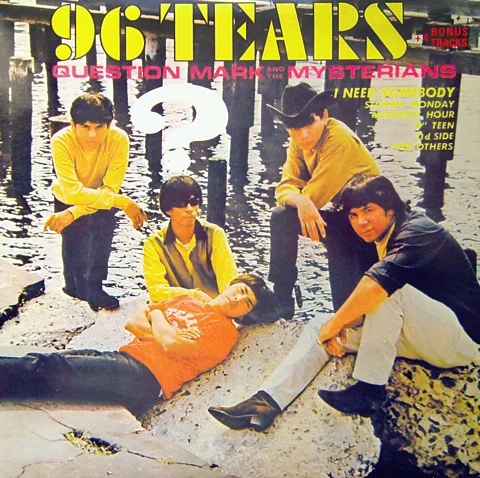
AlamyNeglia argues that garage revivalists have "projected a certain idealism onto the original bands", but ? and the Mysterians came as close as anyone to that ideal: young and unpolished, the DIY product of a hyper-local music community, yet full of wide-eyed pop ambition.
"96 Tears belongs to a class of songs that we could call 'unhinged frat-rock', a category that includes the Troggs' Wild Thing, The Kingsmen's Louie Louie, and Sam the Sham and the Pharaohs' Wooly Bully," garage historian Seth Bovey tells the BBC. "The lyrics of these songs are so sublimely inane they take on the quality of Dada poetry, and their feel-good tunes are amazingly rudimentary."
The band's Bay City origins
Bay City, Michigan's most famous former resident, Madonna, once described it as a "little smelly town". The scent that permeated the singer's childhood summers came partly from factories processing beet sugar. They drew Mexican migrant farm workers up from Texas, many of whom stayed after finding better jobs making car parts for the giant General Motors plant in Detroit. This was the case for Bobby Balderrama's family. With his father and brother working for GM, the Balderramas could afford their own farm between Bay City and Auburn. The farm, in particular its garage, became an important part of the ? and the Mysterians story.
Named after a 1957 Japanese sci-fi film and initially a three-piece with Bobby's nephew, Larry Borjas, on bass and Robert Martinez, from nearby Saginaw, on drums, The Mysterians rehearsed in the Balderrama family garage, playing surf rock instrumentals by The Ventures and The Surfaris.
Not long after their first gig, the trio invited Robert's older brother Rudy to join as frontman. Rudy Martinez, soon to be known only as Question Mark, brought with him dance moves, songwriting ambitions and weirdo rock-star charisma, and quickly became the band's focal point. The group added Beatles and Stones covers to their repertoire and played teen dances in lieu of being old enough to perform in bars.
 Getty Images
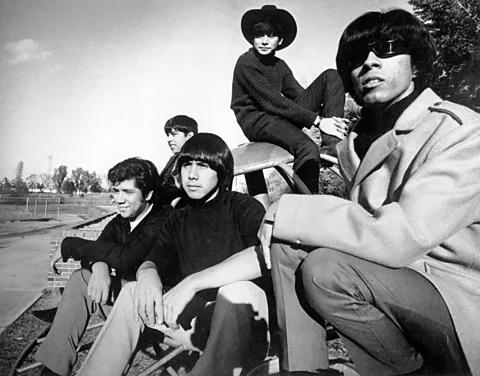
Frankie Rodriguez, a local piano prodigy, was next to join. The group gigged throughout 1965 until Borjas and Robert Martinez enlisted in the army. It was around this point that the remaining three members, 15-year-old Balderrama, 14-year-old Rodriguez and 20-year-old Question Mark, sat down to write their future number one single.
Rodriguez improvised an organ riff, Balderrama worked out guitar parts, and Question Mark sang lyrics he'd previously written: "Too many teardrops / For one heart to be cryin' / Too many teardrops / For one heart to carry on".
"The tune is little more than a two-chord progression propelled by choppy one-chord organ lines that alternate with a pair of carnivalesque organ riffs", says Bovey. "The resulting concoction has a hypnotic effect that fills listeners with joy and makes them want to dance."
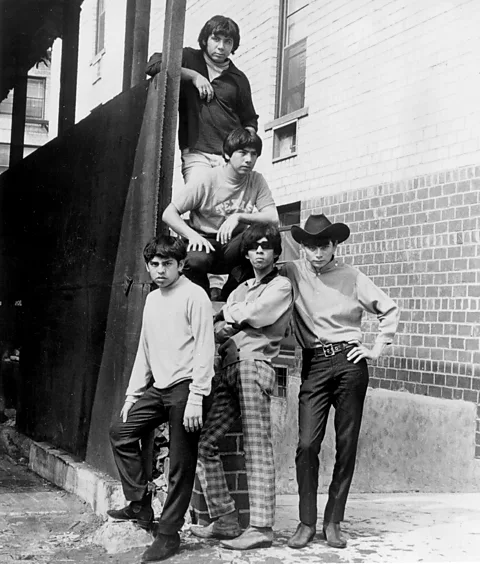
With a mostly complete line-up and at least one killer tune in their arsenal, ? and the Mysterians auditioned for local band manager Lillie Gonzalez.
 Getty Images
Lillie and her husband Joe owned a Mexican grocery store in Saginaw and had run a record label specialising in Tejano folk music back in Texas. In April 1966 she booked the Mysterians into a studio located in the rec room of a small house in Bay City. ("We had to move the pool table," Balderrama recalled.) Lillie and Joe made 96 Tears the second single on their new Pa-Go-Go label. Distribution was as DIY as the recording process. Pa-Go-Go pressed 500 copies and Lillie, with little experience outside Tejano music, set the band themselves the task of getting the record into the hands of local DJs.
Soon 96 Tears was receiving regular airplay on both Bay City and Saginaw radio, and filtering its way through to other Michigan stations. Within weeks, the single was number one in Detroit and had caught the attention of the Philadelphia-based Cameo-Parkway label, which began promoting it nationally. By September it had crept into the Billboard Hot 100, and by the end of October it was the number one song in the country.
Things fall apart
But just a few months later, things began to fall apart. The lead single from the band's second LP, a cover of The Four Seasons' Can't Get Enough of You Baby, had a familiar organ riff tacked on at the label's request, transforming the track into a pretty shameless soundalike of their number one. It peaked in the lower reaches of the Hot 100. Five more singles followed, on five different labels, but none were hits. Band members drifted away.
Question Mark bought the rights to the group's name and began performing with new line-ups. A nadir came in 1969 when a reconstituted ? and the Mysterians played on bills alongside entirely fake versions of The Zombies and The Animals.
More like this:
The band's second act began almost as soon as its original run had faded from the collective cultural memory. In 1972, guitarist Lenny Kaye put together Nuggets, a compilation of old garage rock singles by the Count Five, The Standells and others (96 Tears was included on Kaye's tracklist for a never-released second volume). The LP was hugely influential, particularly on the emerging punk scene, and inspired numerous other collections of garage curios, like the Pebbles and Back from the Grave series. By the early 80s a full-on garage rock revival had begun, led by bands like The Fuzztones and The Cramps (whose Human Fly, on their debut EP, cried "96 tears in 96 eyes").
Like its 60s forebears, latter-day garage thrives in close-knit regional scenes. One of these emerged in Michigan in the late 90s, producing groups like The Dirtbombs, The Detroit Cobras and a primitive guitar-and-drums duo called The White Stripes. Earlier this year, Jack White served as musical director when Stephen Colbert guest hosted the Michigan public access TV show Only in Monroe. His first musical cue was an unmistakable organ riff by the state's original garage rock heroes.
The 14-year-old responsible for that riff reflected on its impact many years later. "I didn't think 96 Tears was gonna go anywhere," a then-71-year-old Frankie Rodriguez told Goldmine magazine in 2023. "But it did real good."
--
If you liked this story, sign up for The Essential List newsletter – a handpicked selection of features, videos and can't-miss news, delivered to your inbox twice a week.
