'A dark and violent scene': The 1927 painting that foretold Germany's downfall

 Courtesy private collection/ Gina Folly
A new exhibition focuses on the paintings of German painter Max Beckmann. Among them is Variety Show, an unsettling artwork depicting a chaotic cabaret scene – what does it mean, and did it foreshadow the rise of Nazism?
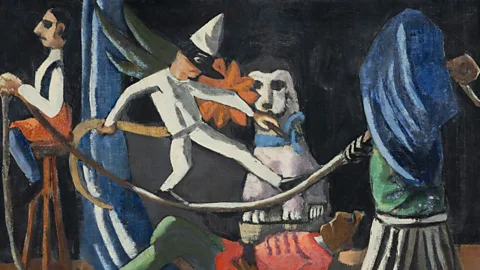
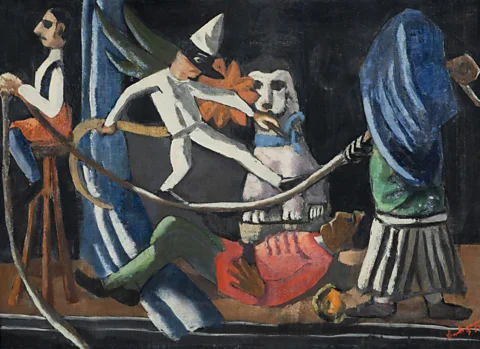
In the 1927 painting Variety Show by German painter Max Beckmann, a cabaret performance is turned on its head. A man in a red military overcoat lies on the floor. Another walks a slack tightrope over his supine body and nearby a figure stands with their face covered in a blue cloth, while a seemingly uninterested man on a stool faces away from the spectacle. A large dog-like creature watches in the background.
"It seems to be a stage, figures performing, but there's this idea of nobody really taking responsibility for what's going on here," art historian Lucy Wasensteiner tells the BBC. At first glance, it's a depiction of the nightlife prevalent in 1920s Germany. Entertainment during the Weimar period (1918–1933) exploded, with cabaret in particular becoming increasingly boundary-pushing, political and satirical.
But if you look longer, the mood in the artwork is less celebratory and more peculiar. What does this strange painting tell us about this precarious moment in history – and did it foreshadow the rise of Nazism?
The dramatic piece is on show in an exhibition of Beckmann's work at Hauser & Wirth in Basel, Switzerland. The artist lived through two world wars, the collapse of the Weimar Republic, and the rise of fascism. He fled Germany in 1937, and moved to Amsterdam, then in 1947 to the United States. He died in New York three years later.
 Courtesy private collection/ Gina Folly
"He's one of the few artists coming from Germany who's not so easily classified," Carlo Knoell, director of the gallery's Basel branch, tells the BBC. "He's not like the New Objectivity [a realist movement in Germany at the time]. He's not an Expressionist. He is really going his own path."
Variety Show is a "society painting", says Knoell, "in the sense that it's looking at the state of human beings. Every figure in itself is a symbol on its own, including the awkward-looking – I don't know even if it is – dog and the orange flower shape [behind the tightrope walker]." It is a "dark and violent" scene, he says, and the man lying on the floor looks as if "he has been attacked or is out of shape or at least 'out of power'".
Considering this scene was painted during the Weimar period – the years after the end of World War One and before the beginning of Nazi Germany – it arguably foreshadows the bleakness soon to come. "You've got two aspects there. On the one hand, there was a lot of freedom in the Weimar Republic that hadn't existed before, but people knew that it was a fragile situation," says Wasensteiner, a professor at the University of Bonn.
'Problems were brewing'
The man walking on the tightrope is a depiction of the precariousness of the situation, she says. "The government was known to be unstable, there were high-profile assassinations, the Nazi party was slowly on the rise, there were other parties that were causing trouble, so people knew that problems were brewing."
Yet, the Weimar Republic is also described as culturally vibrant, with new forms of architecture, a booming entertainment industry and rapid modernisation. "Now, with hindsight, we can look at these paintings and say he was insinuating that [the vibrancy of the era] was all somehow fake, all just an act, and that it was inevitably going to come to an end," says Wasensteiner.
 Courtesy private collection/ Gina Folly
Knowing the historical tragedies that followed, it's easier to define the work in this way almost a century later, she adds. "I agree with the idea of the Weimar Republic as a kind of stage. It's interesting to interpret the painting that way because there's a large group of works from the 1920s that are showing these kinds of scenes," she says.
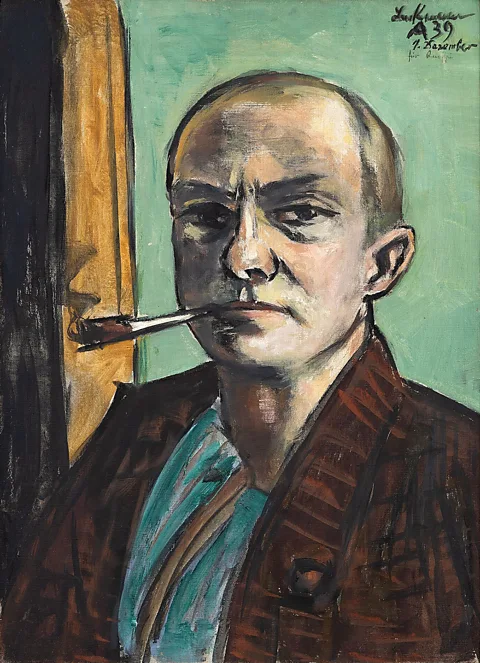
Beckmann served as a medical orderly during World War One and suffered a mental breakdown during this time, in 1915. Consequently, his depictions of life thereafter became noticeably cynical, and he abandoned his earlier more romantic style. "He was basically saying either, 'This is how [the world] is,' or 'This is how I see it, and I don't see it very positively,'" says Wasensteiner. This attitude was a factor when more than 500 of his works, along with those of several other artists, were forcibly removed from public institutions by the Nazis.
'Degenerate art'
In 1937, the Nazis opened Degenerate Art (Entartete Kunst), a propaganda exhibition featuring artworks that the regime had confiscated and that it deemed immoral. Its aim was to humiliate the artists and degrade the work. The Nazis had a loose and uneven criteria for what was considered "degenerate", and while there were several inconsistencies, they typically favoured realistic, heroic imagery and disapproved of modernist styles, abstraction and experimentation. Beckmann's work fell into the last category.
More like this:
"A lot of his paintings are quite complicated to look at. They're quite unappealing in some ways, and there's a lot of black, there's a lot of darkness," says Wasensteiner. Ten paintings and 12 graphic works by Beckmann were included in the Degenerate Art exhibition. He reportedly left for Amsterdam immediately after it.
Yet Variety Show managed to evade the exhibition, having left the country soon after it was painted. It remained with private collectors, and was displayed across Germany and other parts of Europe. The fact that the painting managed to avoid the regime creates an extra layer of mystery and highlights how even in the toughest of times, ideas can still travel.
--
If you liked this story, sign up for The Essential List newsletter – a handpicked selection of features, videos and can't-miss news, delivered to your inbox twice a week.
