Was this billionaire recluse truly mad?

 Alamy
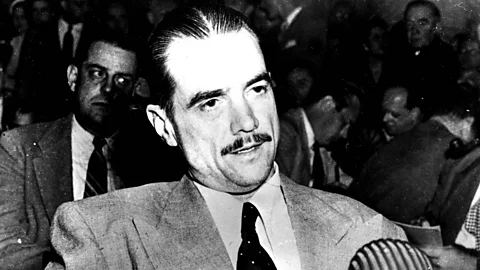
AlamyHoward Hughes is the archetypal super-rich hermit, said never to have trimmed his nails and to have kept urine in jars. But who was he really? Nicholas Barber takes a look.
It takes a brave director to tackle a life story that Martin Scorsese has already put on screen, but that’s what Warren Beatty has done in Rules Don’t Apply. As well as writing, directing and producing the film – which he has been planning for 40 years – Beatty stars as Howard Hughes, the eccentric Texan aeronautics pioneer and Hollywood mogul who was portrayed by Leonardo DiCaprio in Scorsese’s The Aviator.
But Beatty needn’t worry too much about comparisons. Rules Don’t Apply is set in 1958, a decade after the Scorsese biopic finishes, so it could be seen as a de facto sequel. The inventor, film producer and eccentric recluse billionaire who, according to legend, was crippled with obsessive-compulsive disorder in his final years and barely seen by anyone, Hughes has popped up in many films and TV shows from Melvin and Howard to The Rocketeer.
He is both a fantasy figure of the dashing young tycoon playboy and a cautionary tale about the corrosive power of wealth. David Thomson, the cinema historian, argues in The New Biographical Dictionary of Film that movie fans – especially male movie fans – are fascinated by Hughes because he lived out our guiltiest adolescent fantasies. “He is the fan who walked in off the street, who made movies and bossed a studio, and who was crazy and hopeful enough to think of having Jean Harlow, Jane Russell, Katharine Hepburn, Ida Lupino... and so on, into the night. Hughes did what every shy, lonely moviegoer dreams of doing.”
 Wikipedia
To read about Hughes’ parents is to picture Daniel Plainview from There Will Be Blood marrying Scarlett O’Hara from Gone With the Wind. Howard Hughes Sr was a roving drill master in the oil industry, who regularly made and lost small fortunes. Allene Gano was a Dallas debutante, and the aristocratic granddaughter of a Confederate general. Allene nearly died when she gave birth to Howard Jr in 1905, but the trauma was the motivation Howard Sr needed to make his millions – and keep them. In 1909, he patented a revolutionary drill bit which could tear through granite. Oil companies queued up to lease it, and the Hughes Tool Co gave Howard Jr a childhood of extraordinary luxury and quite some strangeness: Citizen Kane springs to mind.
Hughes’ mother, who was obsessed by disease, would have him sleep in her bedroom most nights. His father, in an attempt to balance her mollycoddling, packed him off to a string of boarding schools, bypassing their academic requirements by writing colossal cheques. The shy, partially deaf Howard found it hard to fit into these schools, but he was drawn to two pursuits that offered thrills and glamour without requiring him to make conversation: aviation and cinema.
 Fox
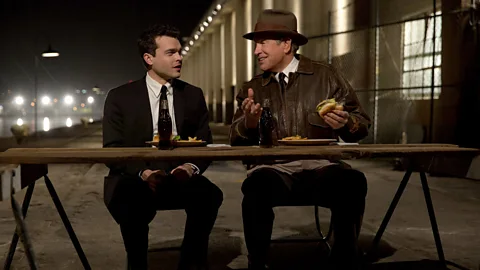
FoxWhen his parents died within two years of each other, they left behind a rootless, half-educated, darkly handsome 18-year-old with a lust for movies and aeroplanes, some deeply ingrained hang-ups about health and hygiene, and a firm belief that his inordinate wealth could push through every obstacle as surely as his father’s drill bits.
Fantasy to reality
Abandoning Houston for Hollywood, where his uncle Rupert was a screenwriter, Hughes spent his inheritance as fast as he could. As Peter Harry Brown and Pat H Broeske put it in their biography, Howard Hughes: The Unknown Story, “Hughes never bought one pair of imported shoes when he could buy 20, never purchased one car when he could have half a dozen,” they wrote. “He bought up fancy watches by the tray and was fitted for 20 hand-cut Brooks Brothers suits in a single afternoon.
 Warner Bros
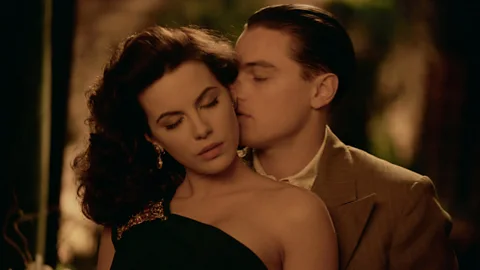
Most of the young Hughes’ money went toward films. He got around his relatives’ objections by buying them out of Hughes Tool Co, and then sunk $3.8m – a record-breaking sum at the time – into his World War One aerial-combat epic, Hell’s Angels. Three directors were hired and fired before he took on the job himself. But when the long-delayed film was finally finished in 1930, it was a commercial and critical hit which turned the original “platinum blonde”, Jean Harlow, into a star. Hughes was no longer a Texan upstart. He was a Hollywood player. The most beautiful women in Los Angeles flocked around him.
After Hell’s Angels, he set about ticking off other genres. In 1932, he produced Scarface, a gangster drama inspired by Al Capone. Then came The Outlaw, a stagey western in which Doc Holliday and Billy the Kid argue interminably over a horse. It would be long forgotten if Hughes hadn’t discovered its curvaceous leading lady, Jane Russell. After he took over directing duties from Howard Hawks, he made his priorities clear: “We’re not getting enough production out of Jane’s breasts.” Determined to furnish Russell with a push-up bra which wouldn’t be visible through her blouse, he declared, “This is really just a very simple engineering problem.” Russell agreed, but refused to wear the “absolutely ridiculous-looking” contraption he designed.
Lonely at the top
Unlike Hell’s Angels, The Outlaw was derided by critics, but Hughes had done such an effective job of marketing Russell’s figure and the film’s salaciousness that it, too, became a hit. He then bought RKO Pictures, making him the first person to be the sole owner of a Hollywood studio. But most of the films with his name on them were little more than vehicles for Russell and various girlfriends. He sold the studio in 1955 so that he could focus on aviation. After all, how could any film compete with the whirlwind excitement of his own life?
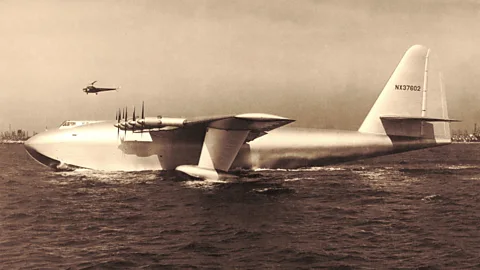
Some of Hughes’ aerial adventures are dramatised in The Aviator: his purchase of an airline, TWA; the transcontinental air-speed record and the round-the-world flight that made him a national hero; his building of the world’s largest seaplane, The Hercules, which detractors dubbed “the Spruce Goose”. After the period encompassed by Scorsese’s film, Hughes’ Aircraft Company went on to become a major military contractor, selling helicopters and missiles to the US government.
 Warner Bros
At this point, Hughes’ life resembled a science-fiction movie. In 1966, his company designed and built Surveyor 1, the first American craft to land on the moon. And in 1970, when the CIA planned to recover a Soviet submarine that had sunk in the Pacific, the agency persuaded Hughes to provide a cover story. A fervent patriot, he told the press that the CIA’s salvage vessel was really just a mining boat of his called The Hughes Glomar Explorer. It was a covert mission straight from a cold-war spy thriller, up to and including its code name: Project Azorian.
 Fox
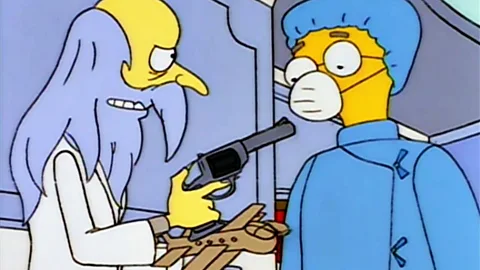
FoxIn the meantime, Hughes’ genius for business and technology had made him the richest man in America, and his land grab in Las Vegas rivalled anything in Scorsese’s Casino and Barry Levinson’s Bugsy (another vehicle for Warren Beatty). Between 1966 and 1968, Hughes bought more hotels and casinos than any investor in the city’s history, and rounded off his spending spree by acquiring the city’s television station, KLAS. The story goes that he insisted on it screening his favourite films through the night, and if he nodded off during one of them he would call KLAS and have them show it again from the beginning.
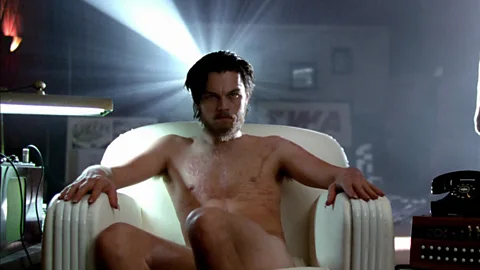
Hughes had gone from being a lonely boy who sat in the dark watching films to a glamorous playboy who swanned around Hollywood making films to a daredevil pilot whose life was the stuff of films in itself. But, throughout his life, though, Hughes had suffered from obsessive-compulsive disorder, among other mental-health conditions. He would incinerate his entire wardrobe if he thought there were too many germs in his house, and wash his hands until they bled. Many biographers believe that his OCD contributed to his success: without it, he may not have had the feverish perfectionism which he applied to everything from Jane Russell’s underwear to the rivets on the wing of the world’s fastest aeroplane. But in his last years, as his deafness and emotional instability worsened, and his medication increased, he dropped out of public life. He shut himself away in a succession of hotel suites, distracting himself by sitting in front of the same films, over and over again. When he died in 1976 he had come full circle, finding escape in the flicker of the silver screen in a darkened room – alone once again.
And if you liked this story, sign up for the weekly bbc.com features newsletter, called “If You Only Read 6 Things This Week”. A handpicked selection of stories from BBC Future, Earth, Culture, Capital, Travel and Autos, delivered to your inbox every Friday.
